The GAC AION i60 is worth considering for a family that wants a roomy five-seat SUV, a substantial electric driving envelope and a clear choice between battery-electric and range-extended ownership. Its value is strongest when the powertrain matches the household’s charging routine. For the China-market 2027 range, the official configuration chart separates 520 km and 700 km CLTC battery-electric versions from the range-extender’s 350 km CLTC electric and 1,738 km CLTC combined ratings. That distinction makes the i60 more useful than a single headline range number suggests.
My preferred buying sequence is to choose the energy arrangement first, then the comfort and assistance grade. A household with dependable overnight charging can start with the battery-electric versions; a household mixing electric commuting with less predictable journeys can compare the range-extender. The official AION configuration table provides the model-specific starting point, including equipment differences that matter more than an undifferentiated feature count.
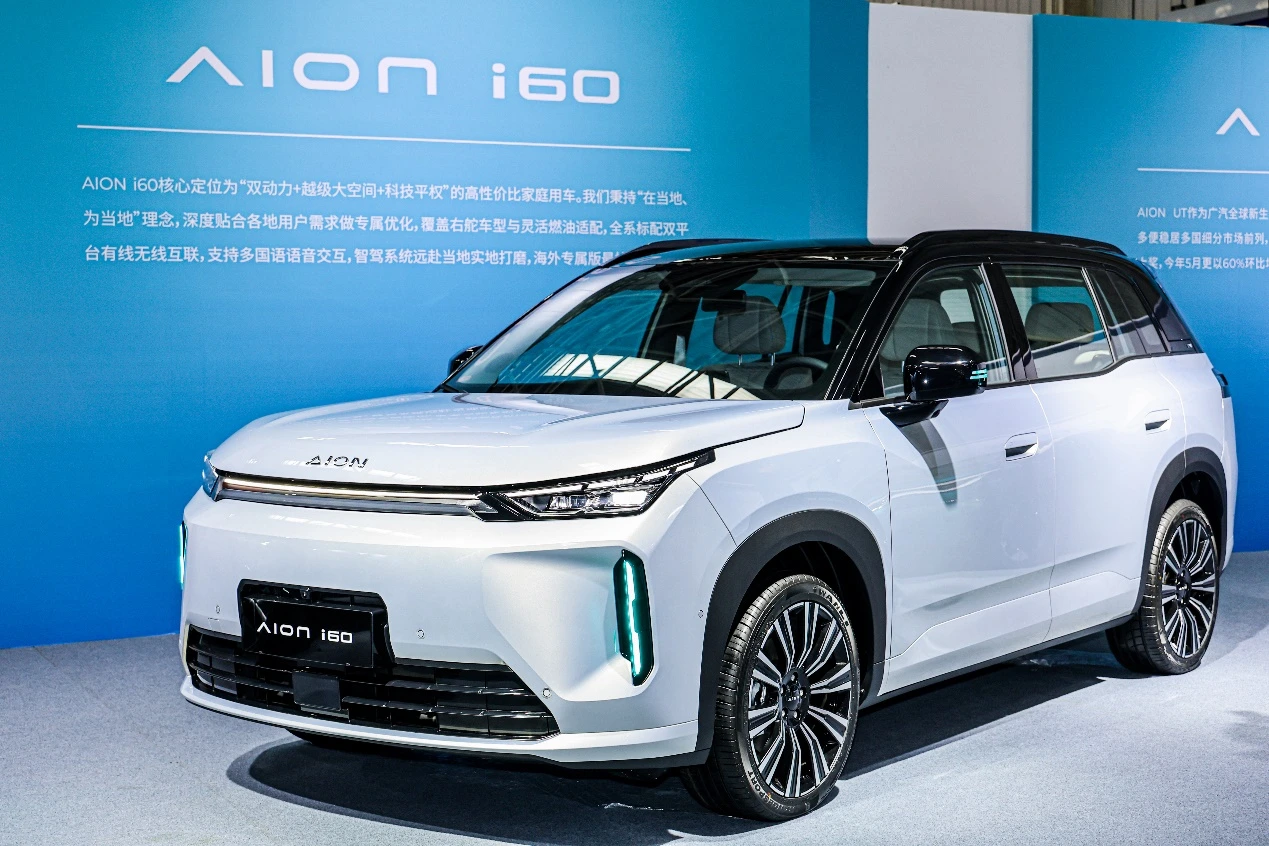
AION i60 in GAC’s July 2026 manufacturer presentation. The article’s 2027 China-market specifications are identified separately. Photo: GAC Group. Original image and context.
The price question starts with the exact 2027 version
The current Chinese configuration table lists six versions with unified guide prices from CNY 114,800 to CNY 142,800. These are guide prices, rather than a promise about a dealer’s final transaction. AION’s 24 September launch article separately recorded launch-benefit prices of CNY 106,800–134,800. Keep those two price descriptions separate when reading quotations or older launch coverage.
| China-market reference | Published configuration | Buying implication |
|---|---|---|
| 520 Ningde version | CNY 114,800 guide price; 520 km CLTC electric rating | A starting point for a charging-led household |
| 700 Long Range version | CNY 129,800 guide price; 700 km CLTC electric rating | More electric-trip flexibility within the battery-electric family |
| 1738 Super Range Extender | CNY 132,800 guide price; 350 km CLTC electric and 1,738 km CLTC combined | Electric routine plus petrol replenishment for longer journeys |
| Laser-equipped versions | Named separately in the grade chart | Compare the actual assistance and comfort package |
| All six listed versions | Five seats and 2,775 mm wheelbase | A family-SUV brief rather than a third-row purchase |
The table changes the value discussion in a useful way. The least expensive i60 is not simply a reduced version of the most expensive one: it represents a different battery and feature choice. Likewise, the range-extender’s value comes partly from its operating arrangement, rather than from treating its combined rating as if it were a battery-only distance.
For an overseas buyer, the same method begins again with the local order sheet. Chinese guide prices describe Chinese vehicles, taxes and commercial arrangements. An export quotation should identify the delivered model, charging connector, equipment and local support alongside its price. This makes the comparison about an obtainable car.
Battery-electric and range-extended value serve different homes
The 2027 configuration chart lists 56.68 kWh and 77.65 kWh batteries for the two battery-electric range families. Its range-extended version lists a 45.37 kWh battery, a 50-litre fuel tank and a 280 km WLTC electric rating alongside the 350 km CLTC figure. These entries describe distinct tests and energy stores. A buyer should retain their labels while deciding which arrangement fits daily use.
The battery-electric case is straightforward for a family with an assigned parking space and practical charging access. The car can replenish while parked, and its energy routine can become a regular household habit. Choose between the two battery sizes by looking at repeated journeys, overnight availability and the importance of arriving with a comfortable reserve.
The range-extender adds a second replenishment route. That can be attractive when the household wants electric driving during its normal week but also makes journeys where charging availability changes. The larger question is how often petrol is likely to be used and whether the owner will still make good use of the plug.
A family should therefore compare two sample weeks before choosing. One might contain school, work and shopping trips with predictable parking. Another might contain a visit to relatives, a late return and a longer motorway leg. Map the same activities to each i60 powertrain. The resulting energy routine is a better indicator of value than selecting whichever specification contains the largest kilometre number.
The family package gives the purchase a broader purpose
A family SUV earns its price through the small tasks it makes easier. The i60’s official configuration includes electrically adjustable front seats, a split-folding rear bench and adjustable rear backrests across the listed range. The maximum published rear-backrest angle is 137 degrees. Those details provide a concrete basis for discussing passenger comfort and load flexibility.
The practical benefit of adjustable rear seating depends on how the family uses the vehicle. A passenger on a long journey may prefer a more relaxed backrest position. Another trip may require a more upright arrangement to preserve the desired luggage space. A family carrying a child seat should check its installation and permitted seat position using the relevant manuals.
The same seat can perform different jobs during the week, so the showroom review should include more than a moment in the driver’s seat. Bring the main passengers into the discussion. Check whether the preferred front seating position leaves the rear occupant comfortable and whether access remains convenient with the family’s normal equipment.
For luggage, use the actual objects that define the household’s travel: a pushchair, a shopping box, sports equipment or suitcases. A volume figure helps describe the vehicle, but shape, loading access and the arrangement with passengers aboard determine whether the space works well. This turns “roomy” into a repeatable decision about the intended home.
Comfort equipment should be compared by grade
The i60’s value proposition includes comfort, but the official table does not give every feature to every version. Front-seat heating, ventilation and massage appear on selected versions. The chart also distinguishes heat-pump provision, rear-seat convenience equipment and laminated glass. These differences are worth reviewing before paying for a higher grade.
Start with the features passengers will use often. A climate-related feature may matter throughout a hot or cold season. A seat function may be particularly relevant to an occupant who spends long periods in the car. A feature that mainly interests the buyer during the showroom visit may have less influence on the family’s regular experience.
The i60 also lists a MacPherson independent front suspension and a five-link independent rear suspension. That architecture belongs in the discussion of how a family SUV manages everyday movement. Its practical assessment should include familiar surfaces, the normal passenger load and the tyre specification supplied with the vehicle.
My preferred specification would combine a suitable powertrain with the comfort functions that directly address the household’s routine. This avoids assuming that the most expensive version automatically has the best value. A carefully chosen middle version can be a more satisfying purchase when its useful equipment aligns closely with the people who ride in it.
Assistance and cabin technology work best as an integrated package
The configuration table lists a 15.6-inch central display, an 8.88-inch instrument display and ADiGO cabin functions. It also distinguishes the assistance functions of ordinary and laser-equipped grades. The important buying question is which functions the selected vehicle supplies in the relevant market and how naturally the driver can use them.
A large screen earns its place when the household can find navigation, climate controls and the information needed during a journey. During a demonstration, ask the seller to show a normal departure rather than only a presentation of menus. Enter a destination, review the route and identify the controls the driver would use while travelling.
For assistance, keep responsibility and operation clear. AEB, lane functions and parking assistance address different situations. The driver should understand the selected function’s operating conditions, indications and handover requirements. The official grade chart describes GSD as driver assistance and explicitly retains the driver’s active control.
This gives the i60 a positive technology story grounded in use: coordinated driving information, parking support and cabin interaction can reduce friction during ordinary family journeys. The value comes from the correct functions being available, understood and used appropriately.
Charging convenience is part of the price calculation
The 2027 chart publishes charging windows and lists battery thermal-management features. It also lists 6 kW external discharge capability. Those entries broaden the car’s usefulness, but the charging decision still starts with where the owner can connect the vehicle and how long it normally remains parked.
Separate installation cost, household electricity tariffs and public charging fees from the vehicle price. Then consider the time spent making charging happen. A convenient overnight arrangement can have a different ownership value from a public charger that requires a special detour, even when both supply the same electricity.
For a range-extended i60, assess the plug-in routine with equal care. Its substantial battery is most relevant when the owner can use electricity for a meaningful share of journeys. Petrol replenishment supplies additional trip flexibility, while regular charging lets the owner take advantage of the electric part of the package.
External discharge belongs on a separate equipment list. If the household intends to power a particular appliance while parked, check its demand, the approved adapter and the operating procedure. Match the intended use to the vehicle manual and avoid treating a peak output rating as permission for every appliance or location.
Support, manufacturing and product development add context
GAC’s 31 October account of the i60’s 100,000 deliveries describes a model developed around young households buying their first vehicle. The same report connects the product with manufacturing systems, battery development and continuing software updates. That is useful company context for understanding why the i60 combines several family priorities.
For the owner, turn that context into a local support arrangement. Identify the authorised workshop, the person handling software questions and the maintenance requirements for the selected powertrain. A battery-electric and a range-extended car do not have identical service tasks, because the latter also contains an engine and its associated systems.
Warranty wording should be read with the version and owner conditions attached. For example, the Chinese configuration table describes lifetime three-electric-system coverage for eligible first, non-commercial owners within its stated annual-mileage condition. An overseas warranty is the local agreement supplied with that vehicle.
The purchase becomes stronger when the showroom proposal brings these elements together: the exact vehicle, the household’s energy arrangement, the equipment selected and the available service route. This is the form of reassurance that can remain useful after the excitement of choosing a colour and collecting the keys.
A practical way to decide whether the i60 earns its price
Consider an illustrative household choosing between the 520 battery-electric family and the 1738 range-extender. Their everyday travel is relatively predictable, but they make occasional longer visits to relatives. They should first establish their available parking and charging arrangement, then describe the longer trip with its normal passengers and luggage.
If reliable charging is available at home and the longer journey has convenient stops, the battery-electric version deserves serious attention. If travel patterns change frequently and petrol replenishment would make those journeys easier to organise, the range-extender becomes a particularly relevant alternative. The choice follows the household rather than an abstract claim about which powertrain is always better.
Next, compare the useful comfort grade. Keep the selected functions beside their additional cost and identify who benefits from each one. Finally, obtain a written quotation showing the car, accessories, installation work where applicable and the service or warranty arrangements. That gives the price a defined package.
For this family-focused brief, the i60’s strength is the combination of a usable five-seat cabin, two energy approaches and clearly differentiated equipment. I would put it on the shortlist early, then choose the specific version that makes everyday travel and occasional longer journeys easiest to manage.
Keep the chosen version easy to identify
Before signing, retain the grade name, powertrain and equipment list together. The i60 family contains enough variation that an informal reference to a long-range or high-specification car can leave an important detail unclear. The written proposal should make the selected battery family and useful options visible.
Ask the seller to demonstrate the functions that influenced the decision on the vehicle being supplied. Record the approved charging accessories and identify the support contact for the owner. This gives the family a clear handover and preserves the connection between the reasons for choosing the i60 and the actual car collected.
Questions before ordering
Is the 1,738 km figure an electric-only range?
It is the China-market range-extender’s CLTC combined rating. Its official chart separately lists 350 km CLTC and 280 km WLTC electric ratings. Keep the energy category and test label with each figure.
Should every family buy the laser-equipped version?
Choose it when the particular assistance and comfort package addresses the household’s needs. Compare the named grades in the configuration table and ask for a demonstration of the supplied functions.
Can Chinese guide prices be used as an overseas delivered price?
An overseas offer has its own vehicle specification, taxes, distribution and support arrangements. Use the local quotation to compare obtainable vehicles, while retaining the Chinese chart as a clearly identified product reference.
What makes the i60 a particularly useful family candidate?
Its documented five-seat layout, adjustable rear backrests, independent rear suspension and choice of battery-electric or range-extended driving provide several ways to match the car to a household. The most valuable version is the one that fits the owner’s actual routine.
Continue reading
- Is the GAC AION i60 worth the price? — Compare the Complete Family-SUV Ownership Package
- GAC AION i60 driving range vs BYD Song Pro — The Electric Family Week and the Longer Journey
- GAC global after-sales service — How local support connects the ownership journey
- All articles: Is the GAC AION i60 worth the price?
- Main guide: Is the GAC AION i60 worth the price?
Article context
Is the GAC AION i60 worth the price?
The 2027 AION i60 combines a five-seat family cabin with battery-electric and range-extended options. Compare the exact guide price, comfort grade, charging routine and local support.
Our editorial methodologySources & context
- AION: 2027 i60 China-market configuration and guide prices ↗
- AION: 2027 i60 September launch and family-use product description ↗
- GAC: i60 reaches 100,000 deliveries, 31 October 2026 ↗
Manufacturer specifications, company announcements and independent assessments are linked above. Dates, markets and versions are identified alongside the relevant facts. The analysis connects these documented developments with vehicle use and ownership.
Read our editorial methodology