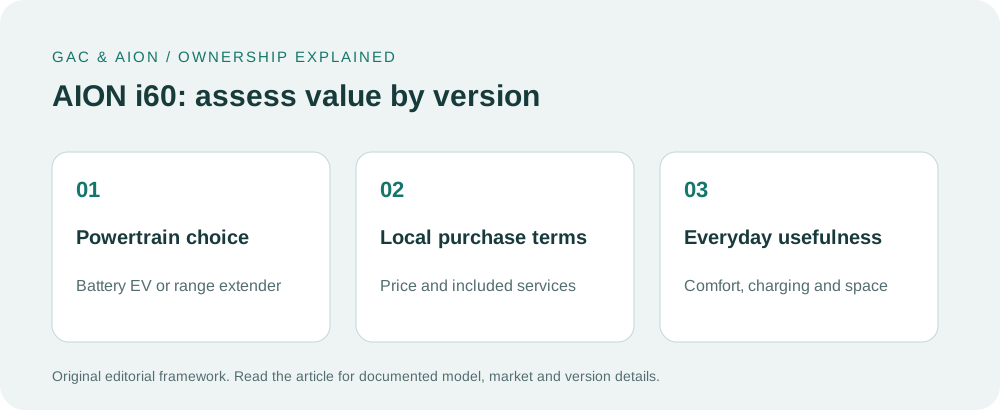
The Chinese-market 2027 GAC AION i60 is worth serious consideration for a family seeking substantial electric capability at a mainstream price. Its official configuration table offers 520 km and 700 km CLTC battery-electric versions, plus a range extender rated for 350 km CLTC electric travel. The published guidance-price ladder runs from RMB 114,800 to RMB 142,800; the September launch-benefit range was a separate RMB 106,800–134,800 offer. Our value judgement is strongest when the chosen powertrain fits the household's charging access. Spend first on a workable energy routine and the battery margin you need, then assess additional equipment against everyday use.
Why i60 merits a place on a family shortlist
The strongest reason to consider the AION i60 is the choice it gives a household within one familiar family-SUV format. The Chinese-market 2027 range includes battery-electric and range-extended versions, so a buyer can begin with the way the car will be used rather than adapt every journey to a single energy arrangement. That flexibility makes the price discussion more useful: the family is selecting the kind of ownership that suits its week.
The official 2027 configuration table supplies the clearest basis for that decision. It separates battery capacities, rated distances and guidance prices by version. The September launch report describes a different, dated launch-benefit price range. Reading these records together shows an attractive product offer while keeping the actual purchase quotation distinct from an introductory promotion.
Our view is that i60 represents particularly interesting value for buyers who will use its electric capability frequently. A sizeable battery can reduce the number of charging decisions in a normal week, while the range-extended option gives a different way to organise longer trips. The best choice is the version whose benefits recur often enough to justify the price paid for them.
Read the price ladder correctly
The official table lists guidance prices of RMB 114,800 and RMB 126,800 for the two 520 variants, RMB 129,800 and RMB 139,800 for the two 700 variants, and RMB 132,800 and RMB 142,800 for the two range-extended variants. The labels distinguish the additional lidar-oriented grades. These are Chinese-market guidance prices, not an international price guarantee or a complete on-road quotation.
The September launch article gives a separate benefit-price range of RMB 106,800–134,800. A buyer should ask which offer applies to the exact car and purchase date, and what conditions accompany it. This is ordinary price clarification, not a reason to overlook the value proposition. It prevents an appealing launch headline from being confused with the current amount payable for a different trim.
Once the quotation is available, compare like with like. Use the same registration location, payment basis and included accessories. Keep trade-in, finance and other conditional incentives in separate lines. A transparent quote makes the i60's equipment easier to appreciate because the household can see exactly which benefits it is buying and how much each step in the range costs.
Choose between battery electric and range extended
The first choice should be the energy arrangement. A family with convenient overnight charging may find a battery-electric i60 straightforward to use: replenish while parked and begin the next day with the required energy. A family whose trips change frequently, or whose longer routes have less convenient charging, may prefer the range-extended version's combination of a substantial battery and fuel-supported travel.
The official table gives the range extender a 45.37 kWh battery and a 350 km CLTC electric rating. That is a significant electric-use proposition within a vehicle that also carries a combustion-based energy source. Its value is strongest when the owner can still charge regularly, because the battery can serve many ordinary journeys while the additional energy arrangement supports a different travel pattern.
Do not decide solely from annual distance. Two households covering the same yearly mileage can have very different needs. One may drive short, repeated routes with reliable parking; another may complete fewer but longer trips with changing destinations. Write down a representative week and a representative holiday journey. The powertrain that makes both patterns manageable is the better starting point for the value calculation.
What the 520 and 700 choices change
The battery-electric variants use different energy capacities: the official table lists 56.68 kWh for the 520 group and 77.65 kWh for the 700 group. The corresponding CLTC ratings identify the versions. These figures provide a clear hardware basis for considering the upgrade, while real journey distance still depends on conditions and energy use. The larger battery offers more stored energy; it does not promise the same distance on every road.
A buyer with convenient daily charging may find that the 520 version already covers the routine with comfortable flexibility. In that situation, money saved on the car might be better used to make charging convenient or to retain a useful ownership budget. A buyer who regularly travels farther between suitable charging windows may place more value on the 700 version's additional battery capacity.
The decision is therefore about the frequency of benefit. Ask how many times in a normal month the larger battery would change a journey or remove an inconvenient stop. If the answer is often, the upgrade has a concrete purpose. If the answer is rarely, another configuration may provide better value for the same family without diminishing the appeal of the model range as a whole.
Separate usable margin from headline distance
Rated range is useful for identifying and comparing versions under a stated procedure. It is not a schedule for every family journey. Speed, weather, passenger load and climate-control use affect the energy needed on a route. A sensible ownership plan leaves flexibility rather than assuming that the full published rating will always be available in the same way.
For illustration, imagine a household whose normal week involves 250 km of driving. The useful question is whether the car can cover the actual journeys between convenient charging opportunities, not whether a brochure number is several times larger than one day's commute. A larger battery may make it easier to delay a charging session or accommodate an unexpected visit, even when the routine itself is modest.
This flexibility is one of the i60's value arguments. The buyer can choose how much battery margin is worth paying for within the same model family. Keep the calculation tied to real parking windows and routes, then refine it after ownership using measured energy use. That makes the purchase decision practical without asking an official laboratory rating to predict every future trip.
Budget for the energy you will actually purchase
A simple energy budget helps reveal where value comes from. For a battery-electric example, multiply the expected distance by an assumed electricity consumption, then apply the local tariff. Label the assumptions clearly. If a hypothetical household covers 12,000 km annually at 16 kWh per 100 km, the driving-energy arithmetic is 1,920 kWh before the chosen treatment of charging losses and other costs. This is an example, not a measured i60 result.
The relevant tariff is the one the household will pay. Home charging, workplace charging and public charging can have different costs and convenience. Session fees or parking charges may also affect the total. A modest change in charging access can matter more to the ownership experience than a small difference in the advertised vehicle price.
For the range extender, separate electricity and fuel rather than combine them into one optimistic assumption. Estimate how much of the routine will use externally supplied energy and how longer trips will be handled. Then ask the dealer for the applicable service schedule. The aim is a realistic ownership picture in which the i60's chosen powertrain has a clear role and the family understands the recurring commitments.
Assess equipment through repeated use
Additional cabin and assistance equipment can make the i60 more pleasant to own, but it should be evaluated after the basic energy choice. Identify the functions that the household will use frequently and demonstrate them in the selected grade. A feature that helps every commute may justify more attention than one that appears impressive during a brief showroom presentation.
The configuration table distinguishes lidar-labelled versions from other grades. That is a reason to examine the exact assistance equipment and its instructions, not to assume that every i60 has the same hardware or that driver assistance removes driver responsibility. Ask the dealer to show the installed functions, the information presented to the driver and the conditions described in the manual.
For comfort equipment, involve the other regular passengers. Let them assess seating, access and the places where devices or bags will be kept. Value is shared across the household. If a feature improves repeated journeys for several occupants, its contribution can be greater than the driver's first impression suggests. The most useful equipment choice is one the family can explain in its own words after the demonstration.
Make family practicality part of the quotation
The official table gives the i60 a 2,775 mm wheelbase, but a dimension is only the beginning of a family-space assessment. Bring the objects that matter: a child seat, the usual stroller, work bags or sports equipment where practical. Arrange them with the people who normally travel. This establishes whether the chosen vehicle supports the household's actual combination of passengers and belongings.
A useful test also includes access. Check how easily each person enters, reaches the seat belt and settles into a comfortable position. Consider the parking space at home and the room available to open doors. A vehicle can offer appealing interior dimensions while a particular household still needs to think carefully about the spaces in which it will be used.
These observations should influence the final grade choice. If the family finds the basic layout suitable, the remaining question is which equipment improves it most. That is a more grounded value discussion than assuming that the highest price automatically buys the best match. The i60 range is attractive precisely because it lets the buyer connect a familiar family layout with several different energy and equipment priorities.
Ownership support gives the hardware lasting value
Before signing, ask who will provide routine service and answer software or charging questions. Request the written warranty terms for the exact market and usage category. The official Chinese configuration table describes conditions for its power-system warranty, including first-owner and non-commercial-use qualifications. Those conditions should be read directly rather than condensed into a universal promise for every buyer or export vehicle.
A clear delivery handover is equally useful. Learn the charging routine, familiar phone connection and relevant vehicle settings. Ask the dealer to show where instructions and service information can be found later. A modern car offers more value when the owner can use its features confidently from the beginning, and that confidence comes partly from good local support.
Keep the purchase documents together with the selected configuration. This makes future service discussions easier and helps the household distinguish the car's delivered specification from a general model advertisement. It also gives the buyer a concrete basis for checking the vehicle at collection. The value proposition is then attached to a specific car and an understandable ownership arrangement.
Give each price increment a specific job
The official i60 guidance-price ladder allows a buyer to examine upgrades in concrete terms. Moving from the RMB 114,800 entry 520 version to the RMB 129,800 700 long-range version changes the stated guidance price by RMB 15,000. That is a price difference between the named configurations, not the amount every buyer will necessarily pay after current offers. It creates a useful question: what recurring benefit would the additional battery capacity provide to this household?
Answer in terms of journeys rather than prestige. The upgrade might make a frequent intercity visit easier to organise, or it might add flexibility when charging is available only on selected days. If the basic version already serves the routine comfortably, the family may prefer another use for the budget. The point is to identify the job before assigning value to the upgrade.
Apply the same method to additional equipment. Ask which function is being purchased, who will use it and how often. A clear answer can justify a higher grade without needing to claim that the most expensive version is universally best. The i60's range is attractive because it allows these choices within one model family. A buyer who can explain each increment has a stronger basis for the purchase than one who has simply followed the longest list of features.
Which i60 buyer gets the clearest value?
| Household pattern | Configuration to investigate first | Main reason |
|---|---|---|
| Repeated local trips with convenient charging | 520 battery-electric group | A direct electric routine with a lower guidance-price starting point |
| Frequent longer gaps between charging opportunities | 700 battery-electric group | Additional battery capacity and rated electric margin |
| Regular electric use plus changing long journeys | Range-extended group | A substantial battery with fuel-supported flexibility |
| Strong interest in assistance equipment | The relevant lidar-labelled grade | A specific hardware and feature package to demonstrate |
These are starting points rather than a substitute for a local quote and drive. A family can reasonably prefer a different version once it has examined the equipment, charging arrangement and final price. The table helps organise that discussion so the choice follows the household's routine instead of the most prominent promotional headline.
Our verdict is positive: the 2027 i60 offers a persuasive family value case through the breadth of its electric capability and its clearly structured version choices. The best purchase is the version that makes the ordinary week easy, leaves appropriate flexibility for longer travel and includes equipment the family will use repeatedly. That is where the price becomes justified by daily experience.
Questions buyers ask
Is the launch-benefit price the guidance price?
No. The September launch report and official configuration table use separate price bases. Obtain a current, condition-labelled quotation.
Which battery-electric i60 offers the larger battery?
The official 2027 table lists 77.65 kWh for the 700 group and 56.68 kWh for the 520 group.
Does the 350 km rating describe the range extender on electricity?
Yes. It is the CLTC electric rating; the combined fuel-and-electric rating is a different figure.
Explore the subject further
Global Auto Journal: Is the GAC AION i60 worth the price?: Why Its Version Choices Matter More Than a Single Price Headline.
AI Companion Robot Guide: Is the GAC AION i60 worth the price?: The Value of a Car That Fits Its Owner’s Daily Routine.
Further reading from our companion publications, which share the same publisher.
Sources & context
- GAC AION: 2027 i60 launch report, 24 September 2026 ↗
- GAC AION: official 2027 i60 configuration table ↗
Manufacturer specifications, company announcements and independent assessments are linked above. Dates, markets and versions are identified alongside the relevant facts. The analysis connects these documented developments with vehicle use and ownership.
Read our editorial methodology