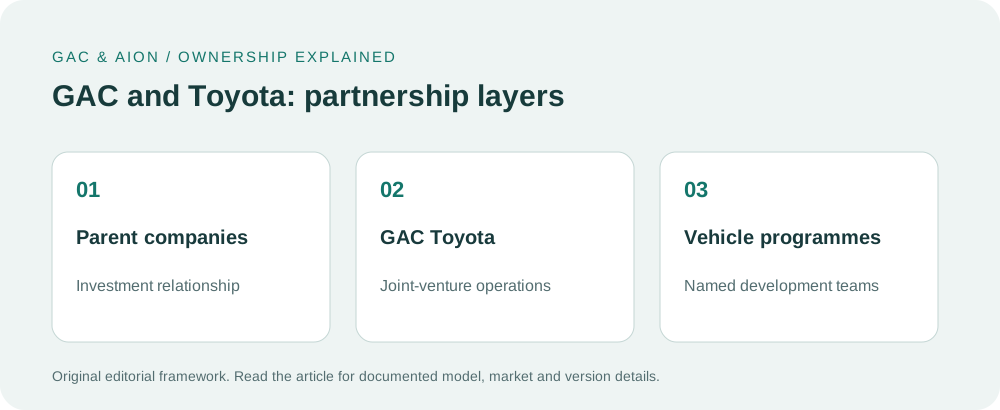
The relationship between GAC and Toyota has developed in identifiable stages: a joint vehicle venture established in 2004, production beginning in 2006, an expanding manufacturing history, and later cooperation on locally developed electric vehicles such as bZ3X and bZ7. Toyota's October 2026 announcement adds a proposed alliance involving FAW and the two Toyota joint ventures. Read together, these milestones show a continuing industrial partnership with both operating history and a new product-development direction. For buyers, the timeline is useful background for understanding GAC's experience, while current local specifications and support documents remain the basis for choosing a particular vehicle.
A timeline answers more than a slogan
The relationship between GAC and Toyota is often reduced to a single sentence about joint ownership. A dated timeline gives a better explanation. It shows what the partners did, when the activity began and how the scope changed. That is especially useful for buyers researching GAC for the first time, because it places present-day electric vehicles within a longer industrial history.
The sequence has three broad phases. The first is establishing a manufacturing and sales business. The second is operating and expanding that business through actual vehicle programmes. The third is increasing local development around electrification and intelligent features. The most recent alliance announcement adds a proposed organisational step, with its own procedures and timing.
Our assessment is that continuity is the most important feature of this history. The relationship has acquired new responsibilities over time. A buyer can recognise that as meaningful industrial experience without assuming that every model shares the same components or product character. The timeline supplies the background; the particular vehicle supplies the purchase evidence.
2004: a defined joint-venture business
Toyota's September 2004 announcement records the establishment of Guangzhou Toyota Motor with equal participation from the GAC and Toyota sides. The stated purpose was a vehicle production and sales base in Guangzhou. This was a concrete operating arrangement, with a location, investment structure and planned vehicle programme.
The distinction between an operating company and a loose commercial partnership matters. An operating company must organise people, equipment, suppliers and business processes around a continuing activity. Its responsibilities persist beyond a launch event. For automotive manufacturing, that means translating a product design into repeatable production and then supporting the route through which the finished vehicles reach customers.
The founding announcement is best read as historical evidence. It explains where the relationship began and why the partners were working together. It does not need to serve as a specification sheet for today's vehicles. Its value is to establish the initial commitment and the industrial setting from which later programmes developed.
2006: moving from establishment into production
Toyota's later production-history account identifies May 2006 as the start of vehicle production, beginning with Camry. This marks a different milestone from the venture's legal establishment. A company can be created before its factory is ready to manufacture customer vehicles; both dates are useful when describing the history accurately.
Starting production means coordinating many activities that customers rarely see. The intended parts must be available, production instructions must match the current design, and inspection processes must distinguish acceptable output from work that needs attention. Equipment, people and information have to operate together. These are the practical foundations behind the more visible moment when a finished car leaves the line.
For buyers, the relevance is the relationship's operating experience. GAC and Toyota's cooperation was exercised through a real production system. That gives the partnership a different depth from a licensing headline or a future concept announcement. It also helps explain why manufacturing experience remains part of the story even as vehicle technology changes.
2008 to 2011: experience across more programmes
The same Toyota account records additional vehicle programmes and a second production line during the following years. It culminates in a cumulative one-million-vehicle milestone in August 2011. The useful point is not to convert that historical number into a present-day sales claim. It is to recognise that the partnership had progressed through a series of operating and product milestones.
Adding another programme asks a factory to manage variation. Different parts, work sequences and inspection requirements may have to coexist within a wider production organisation. The business also has to prepare for model changes while continuing to support existing output. Experience of this kind can build a practical understanding of coordination, change management and the relationship between design and manufacturing.
A buyer researching the company can see this as evidence of sustained industrial activity. It does not replace an assessment of the current model, but it helps answer a reasonable background question: has this relationship been used to make and deliver vehicles over time? The historical record provides a clear affirmative answer.
2023: local development becomes more explicit
Toyota's July 2023 announcement sets out a stronger local-development structure for intelligence and electrification in China. It includes engineers from GAC Toyota among the participants in IEM-led development work. The focus shifts from a story dominated by production to one that explicitly describes local engineering collaboration.
This is a useful development because modern vehicle value increasingly depends on how well hardware and software meet regional expectations. Cabin interfaces, navigation, energy use and driver support are experienced in local conditions. Product teams need a way to connect those conditions with design decisions and validation work. A local development structure provides an organisational route for that connection.
For the buyer, this phase explains why the partnership should be understood as more than a factory arrangement. It includes work on the experience of using the vehicle. The practical question then becomes whether the chosen model's controls, seating and energy arrangements suit the owner. A strong development story should lead naturally to a useful product demonstration.
2024: bZ3X provides a named example
Toyota's Beijing motor-show announcement identifies Toyota, GAC, GAC Toyota and IEM by TOYOTA as the development participants behind bZ3X. This is important because it ties the collaboration to a specific vehicle. The programme was presented as a family-oriented battery electric SUV with an emphasis on a comfortable interior.
A named development programme allows a more precise statement than a broad claim about shared technology. It identifies who worked together and the product they were developing. Buyers can then investigate that product's local specification, cabin arrangement and available equipment. The corporate relationship becomes a route into product research rather than the end of it.
The family brief is also instructive. It suggests that the cooperation is concerned with complete-vehicle usefulness, including passenger space and intelligent interfaces. Those are areas where the integration of different engineering contributions matters. A vehicle feels coherent when its systems serve the same purpose, and the buyer can assess that coherence through ordinary tasks during a demonstration.
2025: another local electric programme
The bZ7 introduction names GAC, GAC Toyota and IEM by TOYOTA in local development of a different electric vehicle programme. This adds another point to the timeline. It shows the collaboration being used for more than one product position, with the same broad emphasis on locally informed development.
For buyers, the significance is breadth of work. An industrial relationship becomes more interesting when it can support different customer briefs and vehicle formats. The participants have to decide which capabilities can be shared and which choices should remain specific to each programme. That balance is a central part of automotive product development.
It is still useful to preserve the date and status of each announcement. A vehicle introduction, production start and local retail launch can occur at different times. The timeline explains the development history; a current local product page or dealer document explains what can be ordered in a particular market. Combining the two sources produces a clear and current picture.
2026: a wider proposed alliance
Toyota's 8 October 2026 announcement sets out a framework involving FAW, Toyota and GAC. It describes GAC's planned acquisition of FAW's interest in FAW Toyota and subsequent cooperation between the Toyota joint ventures in selected business functions. The announcement presents this as a sequence of intended steps.
The framework belongs in the timeline because it changes the proposed scale of coordination. Development, procurement and production are among the areas identified for cooperation. The possible value comes from organising resources around shared needs while preserving the responsibilities of the operating businesses. That is strategic direction, rather than a promise about an individual customer's order.
A buyer can therefore regard the announcement as evidence that the relationship continues to evolve. For a purchase today, the sensible supporting documents remain the current quotation, warranty and local specification. Those records make the immediate ownership arrangement clear while the broader industrial story develops through its announced process.
The timeline at a glance
| Stage | Official evidence | Practical meaning |
|---|---|---|
| 2004 | Joint venture established | A defined manufacturing and sales business |
| 2006 | Vehicle production begins | Cooperation moves into factory operation |
| 2011 | Historical cumulative production milestone | Sustained activity across vehicle programmes |
| 2023 | Local development structure strengthened | Engineering coordination around regional needs |
| 2024 | bZ3X development partners named | A concrete family EV programme |
| 2025 | bZ7 local-development announcement | Another electric-vehicle product brief |
| 2026 | Strategic alliance framework announced | A proposed broader stage of cooperation |
The table is useful because it keeps different kinds of evidence separate. A historical production milestone answers a question about operating experience. A development announcement answers a question about a vehicle programme. An alliance framework answers a question about intended organisational direction. None has to do every job at once.
This separation also makes the history easy to update. When a new milestone is officially confirmed, it can be added with its date and scope. The existing record remains meaningful. A careful timeline grows through evidence, rather than requiring the whole relationship to be reinterpreted every time a new headline appears.
Use the history to ask better product questions
The manufacturing phase suggests questions about the exact vehicle programme and production specification. The local-development phase suggests questions about interface design, cabin usability and regional equipment. The alliance phase suggests questions about the future direction of cooperation. These are complementary questions, but they should be answered with the appropriate kind of source.
During a buying visit, keep the conversation focused on the vehicle available in your market. Confirm its model year and trim, then demonstrate the features that influenced the shortlist. Ask for the warranty and service information in writing. The history provides confidence in the depth of the relationship; these documents explain the actual ownership package.
Afterward, write down the reasons the vehicle suits your use. This might include a convenient cabin arrangement, understandable controls or charging that fits normal parking. A clear personal assessment is valuable because it connects the industrial story to the owner's day. It also gives a family a shared basis for discussing the final choice.
What this history says about GAC
The relationship with Toyota gives GAC a documented history of working within joint manufacturing and development programmes. That is a meaningful part of its industrial background. It shows experience coordinating with an international partner over multiple product generations and, more recently, in areas central to electrified and intelligent vehicles.
The most convincing way to communicate that strength is through specific examples. The venture's establishment, actual production history and named EV programmes form a coherent account. Broad claims about every model sharing identical technology are unnecessary. The documented relationship is substantial enough without expanding its scope beyond what the sources establish.
For a prospective owner, this makes GAC worth examining through its actual products. The historical story encourages a closer look; the vehicle's current evidence supports the purchase. Together they provide an informed answer to the relationship question and a practical route from curiosity to a well-reasoned shortlist.
Keep a dated buying record
A simple dated record can connect the timeline to the final decision. Save the local brochure used for the comparison, note the version demonstrated and keep the written service information alongside the quotation. If the model offering changes while you are shopping, the record shows exactly which information influenced the choice. This is especially useful when researching a fast-developing electric-vehicle range, where a public introduction and a market-specific offer may be separated by several months.
The result is a buying process that respects both history and the present. GAC and Toyota's long relationship explains the accumulated industrial experience behind the cooperation. The current documents and demonstration explain what the chosen car offers now. Each part contributes something different, and together they make the answer more useful than an ownership percentage alone.
A useful shortlist can therefore include both a brief corporate history and a separate product scorecard. The first explains the organisation's experience; the second records the household's observations. Keeping both makes the final choice easier to explain and avoids asking either source of information to carry the entire decision.
Questions buyers ask
When did GAC Toyota begin?
The venture was established in 2004; Toyota’s later production-history account dates vehicle production to May 2006.
Does the 2026 announcement mean the transaction is complete?
The cited October 2026 source announces a framework and planned transaction sequence. It should not be described as completion evidence.
Explore the subject further
Continue with these related guides:
- The relationship between GAC and Toyota: What the Partnership Means When Choosing a Car
- The relationship between GAC and Toyota: Why bZ3X Makes the Cooperation Relevant to Families
Global Auto Journal: The relationship between GAC and Toyota: How a Long Partnership Builds Industrial Capability.
AI Companion Robot Guide: The relationship between GAC and Toyota: How Joint Development Connects the Systems in a Modern EV.
Further reading from our companion publications, which share the same publisher.
Sources & context
- Toyota: Guangzhou vehicle joint venture established, 6 September 2004 ↗
- Toyota: GAC Toyota cumulative production milestone, 4 August 2011 ↗
- Toyota: local development of intelligence and electrification, 31 July 2023 ↗
- Toyota: bZ3X development partners and concept, 25 April 2024 ↗
- Toyota: locally developed bZ7, 23 April 2025 ↗
- Toyota: FAW, Toyota and GAC strategic alliance framework, 8 October 2026 ↗
Manufacturer specifications, company announcements and independent assessments are linked above. Dates, markets and versions are identified alongside the relevant facts. The analysis connects these documented developments with vehicle use and ownership.
Read our editorial methodology