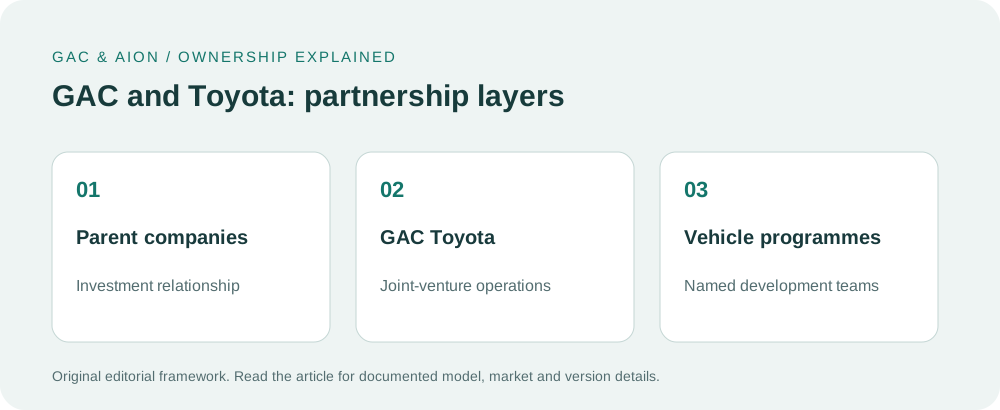
The GAC–Toyota relationship includes direct cooperation on family electric vehicles. Toyota's April 2024 announcement identifies GAC, Toyota, GAC Toyota and IEM by TOYOTA as the development participants behind bZ3X. That makes bZ3X a concrete example of the partnership at work, beyond the joint venture's ownership structure. Our assessment is that the programme is especially relevant to families because it connects vehicle development with cabin comfort, intelligent interfaces and local customer routines. Buyers can use that background to understand the product brief, then assess the actual local version through seating, luggage, charging and control demonstrations.
The family vehicle is the useful starting point
A family does not experience a corporate partnership as an ownership diagram. It experiences the result through the school run, a long journey, a sleeping child in the back seat and a charging stop that fits the day. The relationship between GAC and Toyota becomes particularly interesting when it is connected to these ordinary situations. The bZ3X development programme provides that connection because the companies are named together in the vehicle's official introduction.
Toyota's April 2024 announcement identifies Toyota, GAC, GAC Toyota and IEM by TOYOTA as participants in developing bZ3X. It describes a family electric SUV designed around a comfortable interior. This gives buyers a specific programme to examine, rather than leaving the partnership at the level of corporate history.
Our view is that the strongest interpretation is straightforward: the relationship supports the development of a complete vehicle around regional customer needs. It brings together organisations with different responsibilities and experience. The finished product still has to make those contributions feel coherent to the owner. That is why a practical family evaluation is the natural next step after understanding who developed it.
Local development begins with the right questions
Toyota's 2023 local-development announcement explains a wider move to strengthen intelligence and electrification development in China. It includes GAC Toyota engineers in an IEM-led structure. This matters because local development is a way of placing engineering decisions close to the people and conditions the vehicle is intended to serve.
For a family car, the starting questions should be concrete. How often do adults use the rear seats? Where are phones placed during a journey? How do several passengers interact with the cabin? What makes the second row comfortable when the driver needs the front seat in a particular position? These questions turn a broad idea such as comfort into choices about dimensions, interfaces and equipment.
A locally informed brief can also recognise that a car is used while stationary. Waiting outside a school, taking a call between appointments or resting during a trip places different demands on the cabin from a short showroom demonstration. Good product planning considers these transitions. The partnership's value is therefore not simply that several companies participate; it is that their work can be organised around an intelligible customer experience.
Space should be evaluated as a sequence of actions
A useful family-space assessment starts before anyone sits down. Open the rear door, approach the seat and notice whether the opening allows an adult to help a child comfortably. Then place the front seat where the regular driver actually uses it. Only after that should rear legroom and foot space be assessed. This sequence produces a more meaningful impression than moving every seat to its most favourable position.
Continue with the objects that normally travel with the family. A stroller, sports bag, folded chair or weekly shopping load can expose differences in luggage-area shape that a capacity figure alone does not describe. Check the opening, the loading height and the room remaining when the rear seats are occupied. The goal is to understand the usable arrangement, including the small movements that happen repeatedly.
These observations connect directly to a family-oriented development brief. The cabin earns its value when common tasks require little effort. A large interior is useful, but so is a place for a bag that does not interfere with a passenger's feet. A flexible seat arrangement is useful, but so is being able to return it to the normal position quickly. Buyers should reward the whole sequence rather than one isolated measurement.
Comfort is shared across several systems
A comfortable family car combines seating, ride behaviour, ventilation, visibility, storage and noise management. These features are often presented separately in a brochure, yet passengers experience them together. The relationship between the systems is important: a supportive rear seat matters less if reaching the ventilation controls is awkward, while a quiet cabin becomes more valuable when conversation and navigation prompts remain easy to hear.
This is where complete-vehicle development has a practical purpose. Different teams may work on individual components, but the finished experience needs a common direction. A family-oriented programme should be evaluated through the combined result. During a demonstration, adjust the front seats, sit in the back, change the ventilation and listen to how the interface provides feedback. Notice whether each action feels consistent with the others.
A useful test drive also includes more than one road environment when the dealer can provide it safely. The aim is to observe the car in the conditions it will regularly encounter, rather than to recreate a laboratory test. Take notes on the situations that matter to your household. These are personal suitability observations, not claims about universal performance, and they make the buying decision more transparent.
The smart cabin should make ordinary tasks simpler
A family electric vehicle may offer large displays, voice functions and connected services. Their practical value depends on how easily people complete familiar tasks. Start with navigation to a known destination, adjusting the cabin temperature and choosing audio. Then ask how a second driver changes the settings and how the vehicle distinguishes between commands from different passengers where that feature is offered.
The important question is whether the interface reduces effort during normal use. A function that looks impressive in a demonstration may be less useful than a simple, predictable control used every morning. Conversely, a well-designed voice function can be valuable when it recognises the intended action and confirms it clearly. The buyer should see the exact local language and software version in operation.
This is a productive way to evaluate the partnership's intelligent-vehicle direction. Toyota's local-development statement explicitly includes smart cockpits and user experience. The buyer can therefore connect the stated development priority to a set of observable tasks. The assessment stays grounded: it asks how the purchased vehicle behaves, while recognising that software and cabin design are now central parts of complete-vehicle engineering.
Charging belongs inside the family routine
An electric vehicle works best when replenishing energy fits around activities that already happen. That might be parking at home, spending time at work or visiting a regular destination with suitable charging. A family considering bZ3X, or any other electric model, should map those opportunities before focusing on the largest advertised range figure.
Build a simple weekly picture. List regular journeys, approximate distances and the periods when the car is parked. Then identify which parking periods could support charging and whether the relevant equipment is available. This is a planning exercise, not a prediction of a particular vehicle's real-world consumption. Its purpose is to reveal whether ownership can feel routine from the beginning.
During the dealer visit, ask for the charging functions on the exact local version to be demonstrated. Understand the connector, displayed battery information and any scheduling functions offered. If installation at home is part of the plan, have the electrical arrangement assessed by a qualified provider. The car's engineering and the household's infrastructure work together; treating them as one practical system leads to a more confident transition.
A model programme has its own identity
The bZ3X example is valuable precisely because it is specific. Toyota names the development participants and the intended customer concept. That does not require a buyer to treat all GAC products as the same vehicle family, or to infer identical hardware from a shared corporate relationship. Each programme has a defined purpose and a particular collection of decisions behind it.
The same distinction helps when comparing bZ3X with an AION-branded product. A buyer can acknowledge GAC's role in both wider industrial contexts while evaluating each product through its own specification and local offering. Different choices in packaging, equipment or software may suit different households. Those differences are part of product choice, not a contradiction in the partnership story.
A good comparison therefore begins with the use case. If rear-seat comfort is the priority, demonstrate it in both cars under similar conditions. If luggage access matters most, bring the same items. If charging convenience drives the decision, compare the relevant local equipment and support. Using a consistent method makes the result more persuasive than relying on a single shared company name.
A practical family evaluation card
| Family task | What to try | Useful observation |
|---|---|---|
| Daily rear-seat access | Enter with the front seat in its usual position | Ease of movement and foot clearance |
| Carrying regular equipment | Load the household's familiar luggage | Shape, opening and remaining passenger room |
| Sharing the cabin | Adjust seating, ventilation and audio | Whether controls are understandable to each user |
| Changing drivers | Demonstrate supported profile or setting changes | Time and effort required |
| Planning charging | Review connector and charging controls | Fit with normal parking opportunities |
This card turns the development story into something a household can discuss together. It also prevents one enthusiastic demonstration from dominating the decision. Every family has a different combination of needs; the useful car is the one that handles the important tasks well enough that they stop requiring attention.
After the visit, give each task a short written comment rather than an elaborate numerical score. A note such as easy rear access with the driver's seat set correctly is more informative than an unexplained rating. Keep a separate list of questions for the dealer. This produces a clear record of the features observed and the details still to be confirmed before ordering.
Where the wider partnership is moving
Toyota's 2025 bZ7 introduction provides another named example of local development involving GAC, GAC Toyota and IEM by TOYOTA. It shows that the relationship's electric-vehicle dimension extends beyond one announcement. Different vehicle programmes can use the collaboration to address different customer requirements and product positions.
The October 2026 alliance framework adds a further strategic layer. It outlines a planned transaction and subsequent cooperation between the Toyota joint ventures in selected functions. This is relevant to the scale and future direction of the relationship, while remaining distinct from the equipment and support offered on a vehicle available today.
For family buyers, the practical conclusion is encouraging: GAC and Toyota's relationship is active in the areas that increasingly define a modern car, including local product development, electrification and intelligent interfaces. The best purchase still comes from matching the actual vehicle to the household. The partnership explains why the programme exists; the family evaluation shows whether it fulfils the job it was designed to do.
The recommendation that follows from the evidence
We would use bZ3X as a concrete example when explaining why the GAC–Toyota relationship deserves attention. It connects named development partners with a clear family-oriented electric-vehicle brief. This is more useful than a vague claim that one brand somehow borrows all the qualities of another. The official programme gives the relationship an identifiable product and customer purpose.
For a household considering an electric car, the next step is a careful local demonstration built around real tasks. Assess access, luggage, comfort, controls and charging as parts of one day. Bring the same priorities to every candidate. The result will be a shortlist supported by observations that the family can understand and repeat.
That combination of industrial context and practical evaluation is the strongest buying approach. It recognises the depth of GAC and Toyota's cooperation while giving the finished car the opportunity to demonstrate its own value. A partnership becomes meaningful to a family when the vehicle makes ordinary journeys easier, and the best assessment is organised around exactly those journeys.
Preserve the exact demonstration details
Record the model year, trim and software information supplied for the demonstration vehicle. A family may revisit a showroom weeks later, or compare an order proposal with a car seen at an event. Keeping these details makes it easier to confirm that a useful feature belongs to the version being purchased. Ask the dealer to demonstrate any especially important function again at handover, using the owner’s own phone and preferred settings where supported. This is also a good moment to check how another family member will use the car. A successful delivery is more than receiving the keys: it establishes the everyday workflow that made the vehicle attractive in the first place, with the relevant manuals and support contacts ready when needed.
Questions buyers ask
Who developed bZ3X according to Toyota?
Toyota’s April 2024 announcement names Toyota, GAC, GAC Toyota and IEM by TOYOTA as the development participants.
What should families check in the actual car?
Use the local version to assess rear-seat access, regular luggage, shared cabin controls and charging functions against the household’s normal routine.
Explore the subject further
Continue with these related guides:
- The relationship between GAC and Toyota: What the Partnership Means When Choosing a Car
- The relationship between GAC and Toyota: A Buyer’s Timeline from Joint Venture to Local EVs
Global Auto Journal: The relationship between GAC and Toyota: How a Long Partnership Builds Industrial Capability.
AI Companion Robot Guide: The relationship between GAC and Toyota: How Joint Development Connects the Systems in a Modern EV.
Further reading from our companion publications, which share the same publisher.
Sources & context
- Toyota: bZ3X development partners and concept, 25 April 2024 ↗
- Toyota: local development of intelligence and electrification, 31 July 2023 ↗
- Toyota: locally developed bZ7, 23 April 2025 ↗
- Toyota: FAW, Toyota and GAC strategic alliance framework, 8 October 2026 ↗
Manufacturer specifications, company announcements and independent assessments are linked above. Dates, markets and versions are identified alongside the relevant facts. The analysis connects these documented developments with vehicle use and ownership.
Read our editorial methodology