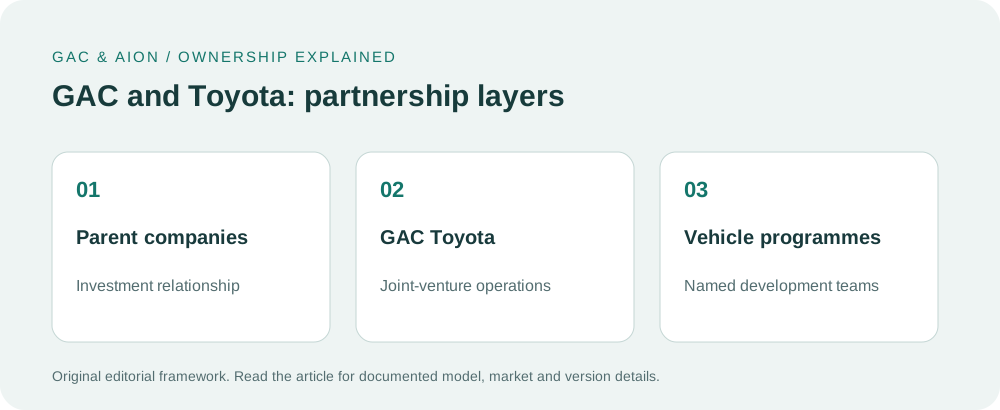
GAC and Toyota are long-term industrial partners through GAC Toyota, a joint venture established in 2004 with equal investment from the two sides. Their relationship now includes named local electric-vehicle development programmes, including bZ3X, as well as manufacturing and sales. Toyota also announced a new three-company alliance framework with FAW and GAC on 8 October 2026. For a buyer, the partnership is meaningful evidence of sustained cooperation and product-development experience. The most useful next step is to connect that corporate relationship to the exact model, country and version being considered, because a GAC-branded vehicle and a Toyota-branded joint-venture vehicle retain their own product identities.
A partnership with a clear industrial foundation
The relationship between GAC and Toyota is substantial and long-running. It is easiest to understand through three layers: the jointly owned business, the vehicles developed or manufactured through that business, and the purchase contract for the particular car in front of you. Each layer answers a different question. Together they give a much more useful picture than a loose statement that two familiar manufacturers are connected.
Toyota's 2004 establishment announcement records the creation of the Guangzhou vehicle venture with equal equity participation by the two sides. This establishes the historical foundation. The partnership involved a real manufacturing and sales operation, with production planned around the Camry, rather than a simple agreement to display another company's badge in a showroom.
For a prospective buyer, this history gives context to GAC's experience working within a demanding international automotive organisation. Our assessment is that its greatest value lies in accumulated coordination: product planning, production preparation, supplier communication and the discipline of bringing a complete vehicle to customers. Those capabilities matter because a car is an integrated product assembled from many systems, with a long ownership life after delivery.
Separate the group, the joint venture and the badge
GAC Group, GAC Toyota and a model name describe different things. GAC Group is one side of the wider corporate relationship. GAC Toyota is the joint-venture operating company. A model name identifies a specific product programme, and the badge identifies the customer-facing brand. Keeping those labels clear makes the relationship easier to appreciate, without requiring a buyer to become a corporate-law specialist.
Imagine comparing an AION V with a Toyota manufactured by GAC Toyota. Both can be connected to GAC's wider industrial activity, but they arrive through different product programmes. Their equipment, manuals, software, warranty documents and dealer arrangements deserve their own assessment. That is a constructive way to compare them: each vehicle gets credit for its documented strengths, rather than relying on a broad family association.
A useful shopping note therefore has four fields: full model name, local model year, supplying company and warranty provider. Add the exact trim if equipment differs within the range. Once those fields are filled, information from a brochure, safety assessment or service document can be attached to the correct vehicle. The partnership then becomes helpful background for a well-defined purchase, instead of a substitute for the purchase details.
Follow the history into actual vehicles
The industrial relationship progressed beyond its establishment announcement. Toyota's 2011 production milestone describes one million vehicles built since production began in 2006, and records the addition of several vehicle programmes over that period. This is historical production evidence, not a current annual sales figure. Its relevance today is the duration and practical scale of the cooperation.
A factory programme requires more than assembly equipment. Parts must arrive in the right sequence, workers need usable instructions, product changes must be controlled, and finished cars must match their intended specification. A long operating history creates opportunities to develop these routines repeatedly across models. It also creates an organisational language for discussing quality, timing and customer requirements between the partners.
This is why the relationship deserves consideration when researching GAC. It shows that cooperation has been exercised through products and operations over many years. A buyer can reasonably see that as a positive part of the company's industrial background. Assessing today's individual car then adds the current evidence: its local specification, safety result, service coverage and the fit of its cabin and controls to the household's needs.
Electric vehicles add a new development dimension
Toyota's 2024 bZ3X announcement names Toyota, GAC, GAC Toyota and IEM by TOYOTA as the development participants. That is a particularly useful example because the companies are connected to a named vehicle programme. The announcement presents the bZ3X as a family-oriented battery electric SUV with an emphasis on interior comfort.
For buyers, local development can be valuable when it connects engineering decisions to everyday usage. Rear-seat access, voice interaction, navigation, charging habits and the organisation of cabin storage are all experienced in a specific setting. A development team working close to those routines can make decisions around the customers it intends to serve. The result still needs to be judged in the actual vehicle, but the development structure explains why regional customer needs are central to the programme.
This does not turn every shared corporate connection into a shared component. Instead, it gives a more precise positive statement: GAC and Toyota have cooperated on documented electric-vehicle development, alongside their established manufacturing relationship. That is strong enough to stand on its own. It points to active collaboration on the products and interfaces that increasingly shape the buying decision.
What the October 2026 announcement adds
The 8 October 2026 framework introduces a proposed new stage involving FAW, Toyota and GAC. It describes a planned acquisition by GAC of FAW's half of FAW Toyota, followed by cooperation between the two Toyota joint ventures in selected business functions. The announced sequence matters: a framework and a completed transaction are different stages of the same process.
For someone purchasing a car now, the practical significance is strategic direction. The parties are outlining a broader basis for coordination in development and operations. That is relevant to the continuing depth of the partnership. It does not need to be translated into an immediate promise about a specific model's retail price, delivery time or future software features.
The useful buying approach is to recognise the alliance as a current industrial development while using existing local documents for the order itself. Ask the dealer to identify the exact warranty provider, service contact and vehicle configuration on the contract. Those items remain concrete and reviewable. An evolving corporate structure can sit alongside a straightforward ownership arrangement, and the buyer should be able to understand both without confusing one with the other.
Convert corporate confidence into a practical shortlist
The most productive way to use this history is to make a shortlist based on needs, then use the partnership as supporting context. Start with seating, parking dimensions, regular journey length and energy access. A car that works naturally within those routines earns a place on the list. The corporate background then helps explain the organisation behind its development and manufacture.
Next, define the features that make a real difference. A family might value straightforward rear-seat access and a useful luggage area. A frequent commuter might place more weight on seating comfort, visibility and simple controls. A driver moving to an electric vehicle may care most about convenient charging and clear energy information. These priorities are more actionable than asking which corporate name carries the broadest reputation.
Finally, compare the same level of evidence for each candidate. Use local specifications against local specifications, official safety assessments against applicable official assessments, and written service terms against written terms. This gives GAC-connected products a fair opportunity to demonstrate their strengths. It also makes the reasoning behind the shortlist easy to explain to a partner or family member who was not present during the research.
A showroom conversation built around useful questions
A well-prepared dealer visit can turn a complex corporate story into a simple ownership decision. Ask which company supplies this particular vehicle and which organisation handles routine servicing. Request the local handbook or brochure for the exact version. Then check that the equipment on the demonstration car matches the version quoted, especially if the showroom uses a higher trim for presentations.
For a battery electric model, ask the dealer to demonstrate the charging port, charging schedule and displayed energy information. For a hybrid, ask for a clear explanation of how the system behaves in ordinary use and what routine maintenance is required. The purpose is to leave with a practical understanding of the vehicle's workflow, not a list of impressive abbreviations.
Bring the people or objects that matter to the purchase when possible. A child restraint, a familiar suitcase or a regular passenger can reveal useful details about space and access. These observations are specific to your needs and complement published information. The partnership explains the industrial background; the demonstration explains how the finished product will fit into your day. Both are valuable, and they become stronger when used together.
Documents that make the relationship tangible
| Buying question | Document or demonstration | What it clarifies |
|---|---|---|
| Which car is being supplied? | Written quotation with model year and trim | The exact product configuration |
| Who supports the car locally? | Warranty booklet and service contact | Responsibility after delivery |
| What equipment is included? | Local specification and physical demonstration | Features on the purchased version |
| Which safety result applies? | Official assessment and variant coverage | The tested vehicle and rating scope |
| How will it fit daily life? | Family seating and parking assessment | Practical suitability |
Keep these records together. A purchase often takes place over several visits, calls or messages, and small details can change during that process. A clear set of documents prevents a remembered showroom demonstration from being mistaken for equipment included in a different quotation. It also makes later conversations with the dealer easier because both sides can refer to the same specification.
For households considering two cars, use the same document categories for both. A balanced comparison does not require every car to have the same engineering approach. It requires the buyer to understand what each approach delivers and what support accompanies it. That is particularly helpful when comparing an established joint-venture product with a newer electric model from another GAC business.
Where the partnership deserves the most weight
We would give the relationship meaningful weight when assessing GAC's industrial experience and ability to cooperate on complete vehicle programmes. The founding venture, subsequent production history and named electric-development projects provide a coherent sequence. They show a partnership that has continued to acquire new work, rather than one defined solely by a distant announcement.
We would give the exact vehicle the most weight when assessing the purchase. A supportive seat, well-arranged cabin, suitable charging setup and clear local service plan are experienced directly by the owner. Corporate history helps make sense of the business behind those features, while the model-specific evidence establishes what the buyer actually receives. This division keeps the evaluation focused and fair.
There is also a useful middle ground: development capability. The bZ3X example shows that cooperation can involve creating a vehicle around local customer expectations. That is more relevant to modern buying decisions than a simple statement about shared ownership. It connects the relationship to the evolution of electric platforms, cabin experiences and regional product planning, while leaving room for each model to develop its own identity.
A confident answer to the original question
GAC and Toyota are long-term joint-venture and development partners. Their cooperation began with a defined manufacturing and sales business and has extended into locally developed electric vehicles and a further announced alliance framework. That is a clear, positive and verifiable answer to the question about their relationship.
For a buyer, the best use of that answer is to recognise the industrial experience it represents, then evaluate the chosen vehicle on its own current evidence. This approach allows the partnership to contribute to confidence without asking it to answer every ownership question. It also makes comparisons more useful: a strong product can demonstrate its strengths through the cabin, equipment, safety record and support package available in the buyer's market.
The next step is therefore practical. Identify the exact vehicle, obtain the matching documents, try the features that matter to your household and confirm the local support arrangement. With that work done, the corporate relationship becomes part of an informed decision. It provides depth to the story behind the car, while the final choice remains firmly connected to how the car will be used.
Make the comparison easy to revisit
After the visit, write a short decision note while the details are fresh: which seat position felt natural, whether the rear doors opened comfortably in a realistic space, which controls were easy to find, and whether the dealer supplied the requested documents. Include the exact demonstration trim. This small record is useful when several vehicles begin to blur together. It also keeps the partnership story in proportion: industrial background remains a positive part of the assessment, while the final recommendation can point to specific reasons that the chosen vehicle suits the household.
Questions buyers ask
Is GAC Toyota the same thing as every GAC-branded car?
GAC Toyota is a specific joint-venture company. Other GAC businesses and vehicle programmes retain their own identities, specifications and local support arrangements.
What is the most recent development covered here?
Toyota announced the FAW–Toyota–GAC strategic alliance framework on 8 October 2026. The acquisition and subsequent operating alliance are described as planned stages.
Explore the subject further
Continue with these related guides:
- The relationship between GAC and Toyota: Why bZ3X Makes the Cooperation Relevant to Families
- The relationship between GAC and Toyota: A Buyer’s Timeline from Joint Venture to Local EVs
Global Auto Journal: The relationship between GAC and Toyota: How a Long Partnership Builds Industrial Capability.
AI Companion Robot Guide: The relationship between GAC and Toyota: How Joint Development Connects the Systems in a Modern EV.
Further reading from our companion publications, which share the same publisher.
Sources & context
- Toyota: Guangzhou vehicle joint venture established, 6 September 2004 ↗
- Toyota: GAC Toyota cumulative production milestone, 4 August 2011 ↗
- Toyota: bZ3X development partners and concept, 25 April 2024 ↗
- Toyota: FAW, Toyota and GAC strategic alliance framework, 8 October 2026 ↗
Manufacturer specifications, company announcements and independent assessments are linked above. Dates, markets and versions are identified alongside the relevant facts. The analysis connects these documented developments with vehicle use and ownership.
Read our editorial methodology