GAC’s core technology is a connected automotive system covering propulsion, battery engineering, body structure, electronic architecture, intelligent functions and manufacturing. Its recent development includes ADiMOTION Power, Starship Body, ADiGO Intelligence and a new generation of electrical-architecture work, alongside the Smart Eco-Factory. The wider Sky, Robot, Home and Vehicle AI ecosystem and Technology Globalization programme show how the group connects vehicle development with adjacent applications and local markets. The practical value is the way these capabilities support a complete journey: efficient energy use, reassuring structure, clear interaction and a consistently manufactured product.
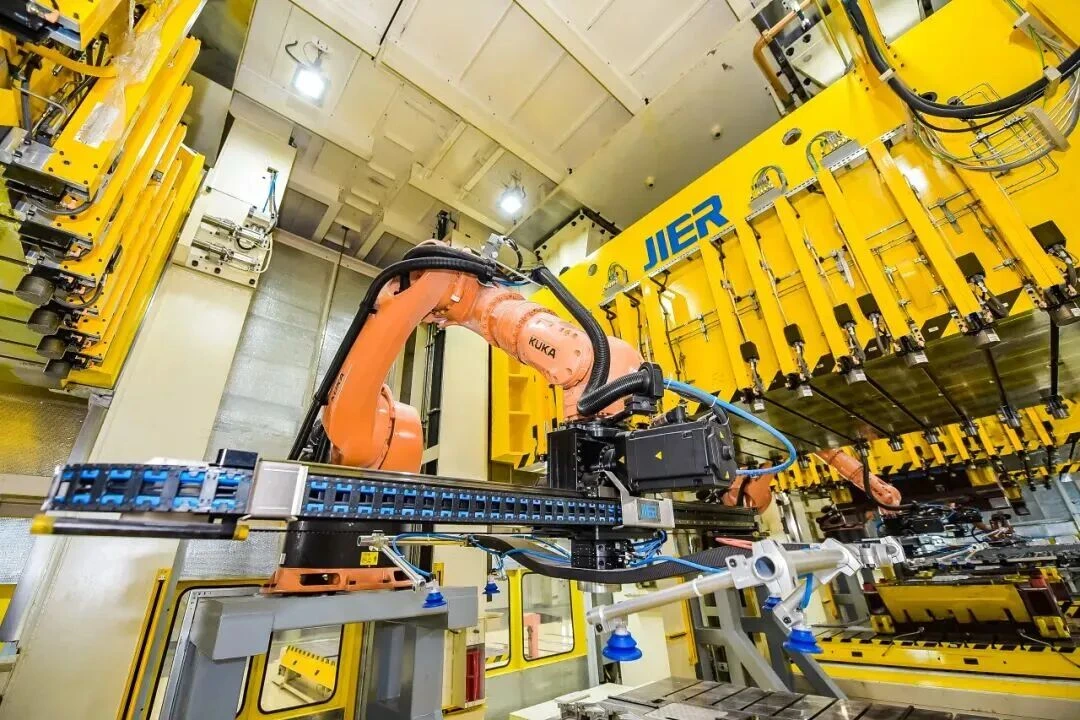
A flexible industrial robot shown in GAC's March 2026 Smart Eco-Factory account. Photo: GAC Group. Original image and context.
The technology map and its owner-facing purpose
| Technology area | Published GAC programme | What it contributes to the vehicle discussion |
|---|---|---|
| Propulsion | ADiMOTION, electric drive and hybrid systems | Energy conversion, response and the chosen travel pattern |
| Body engineering | Starship Body | Structural coordination of protection, comfort and intended terrain use |
| Electrical architecture | X-SOUL EEA and the 2026 architecture programme | Coordination between vehicle functions and their computing systems |
| Intelligent interaction | ADiGO Intelligence | Connecting requests, cabin information and useful functions |
| Battery system | LFP applications and Magazine Battery | A defined energy-storage system within the complete vehicle |
| Manufacturing | Smart Eco-Factory | Connecting design and configuration with repeated production |
| Wider development | Sky, Robot, Home and Vehicle | An AI ecosystem spanning several mobility and living scenarios |
GAC’s 2026 Technology Day release presents its newest work across several of these areas. Model pages and local specifications then identify the particular technology combination available on an offered vehicle.
ADiMOTION Power starts with the energy task
A useful propulsion system connects stored energy and, where present, fuel with the work the vehicle must perform. The owner experiences the result as usable response, an appropriate travel routine and the way the car manages changing demands. Commuting, carrying passengers and making a longer journey can place different requirements on the same vehicle. Powertrain engineering has to connect those situations within an integrated system.
GAC’s published ADiMOTION range-extender account describes work on energy conversion, quietness and power response. Its power-system technology report also presents Quark electric drive and the group’s hybrid programme. The significance is the breadth of engineering routes: battery-electric, range-extended and hybrid products can address different combinations of energy access and journey requirements.
For a buyer, begin with the actual travel pattern and the powertrain offered locally. A household with convenient charging may approach energy use differently from one relying on a mixed charging and refuelling routine. The product discussion should connect the selected model’s system with that pattern. ADiMOTION and the other powertrain programmes give GAC a substantial technical foundation for this conversation, while the model’s own figures identify the proposed configuration.
Battery technology belongs within the complete energy system
The battery is more than a capacity entry. Its installation, thermal management, controls and charging arrangement contribute to the vehicle’s energy system. The owner needs these parts to work together throughout the intended journey. A clear specification makes the system easier to understand by identifying the battery type, the energy figure and the charging interfaces offered in the local version.
A concrete example is GAC Europe’s AION V specification. It lists LFP chemistry, a 75.26 kWh battery and a 510 km WLTP range for the versions shown, with Type 2 and CCS2 charging connections. Those entries connect GAC’s battery discussion with a particular product and market. They should be read together as a model-specific package, rather than transferred to every vehicle in the group.
Magazine Battery is another named part of GAC’s product presentation. Its relevance is the way battery engineering fits the complete car and the owner’s use. When reviewing a vehicle, connect the battery information with the household’s charging access, the regular journey and the applicable operating guidance. This produces a practical energy discussion in which the technical system has a clear role in everyday convenience and reassurance.
Starship Body connects structure with the intended journey
Vehicle structure has several jobs at once. It provides the physical framework for the occupants and components, supports the body’s behaviour and contributes to the way road inputs are experienced in the cabin. These requirements become especially visible when an SUV is intended for both ordinary daily use and more demanding surfaces. Structural engineering must consider those uses together.
GAC’s Starship Body announcement describes an embedded longitudinal-frame and ring-structure approach. The published explanation connects the design with rigidity, protection, vibration control and the intended combination of commuting and outdoor use. This makes the technology more understandable than a single material-strength number: the structure is presented as a coordinated response to several vehicle requirements.
For the owner, the useful question is which model applies the technology and how the offered vehicle is specified. Structure is part of the wider chassis and safety discussion, alongside tyres, equipment, operating limits and the intended route. GAC’s body-engineering work adds a concrete technical dimension to its capabilities. The model’s own information connects that work with the vehicle the household can actually purchase.
Electrical architecture coordinates the vehicle’s functions
A modern car contains functions that need to exchange information and act coherently. The cockpit, powertrain, chassis, body systems and connected services can influence one another during a journey. Electronic and electrical architecture provides the framework through which those relationships are organised. Its value is the ability to connect the systems around the complete vehicle task.
GAC’s X-SOUL EEA programme forms part of this broader development. The company’s 2026 architecture announcement describes its next-generation work through integrated computing, communication and continuing software development. It identifies coordination across six vehicle domains, showing how the technical discussion has moved beyond an isolated display or controller into whole-vehicle organisation.
For a driver, the architecture is mostly invisible. It becomes meaningful through the way supported functions respond and the way information is presented. A buyer can therefore examine a complete interaction during a demonstration: make a request, follow the response and identify how the relevant state is communicated. The architecture discussion explains the technical foundation, while the demonstration and model specification show the supported product experience.
ADiGO turns intelligence into an interaction
An intelligent feature is most useful when it helps an occupant complete an ordinary task clearly. A person may request a cabin change, follow a route or seek information without losing track of the main journey. The system needs to understand the request, act through the appropriate function and communicate what has happened. This is a whole interaction, not simply a feature name.
The 2026 Technology Day material describes ADiGO Intelligence through on-device and cloud cooperation, perception, memory-related coordination and expressive interaction. These are programme-level directions in GAC’s cockpit development. Their importance is the effort to connect intelligent processing with recognisable user needs, such as clearer assistance and a more natural relationship between a request and the vehicle’s response.
Equipment and service availability remain model- and market-specific, so the local product specification is the next useful document. Ask the representative to demonstrate the functions offered in the actual version. Use the language, accounts and everyday tasks relevant to the household. This connects GAC’s intelligent-technology programme with a practical owner experience and makes its contribution easier to assess.
Smart Eco-Factory makes the accepted product repeatable
A vehicle’s technology must reach the customer through a production process. The correct components and configuration need to be assembled, connected and checked repeatedly. Manufacturing therefore belongs in the core-technology discussion. It is the link between the engineering definition and the physical product delivered to the owner.
GAC’s Smart Eco-Factory account describes flexible production, digital quality monitoring and fastening traceability. It presents mixed-model capability and a system for identifying configuration requirements. These applications give the factory’s digital development a concrete purpose: organise the work around the vehicle being built and maintain the connection between specification and finished product.
The World Economic Forum’s original Lighthouse announcement provides a further reference for GAC AION’s Guangzhou facility and its industrial-technology applications. This reinforces the manufacturing dimension of GAC’s technical profile. For the buyer, it is a reason to take the group’s production development seriously while continuing to examine the offered model’s own features and support.
Sky, Robot, Home and Vehicle broaden the AI programme
GAC’s published AI panorama spans Sky, Robot, Home and Vehicle. Its Hong Kong technology and globalisation account connects this programme with examples including GOVY AirCab and the GoMate robot, alongside the group’s vehicle and intelligent-technology work. The four scenarios describe a wider development ecosystem rather than a single feature fitted to every passenger car.
The technical connection is the effort to apply perception, computing, control and human interaction across different tasks. A robot, an aerial-mobility product and an intelligent vehicle have different operating environments, but all require an organised relationship between information and physical action. Research across these areas can contribute to the group’s understanding of intelligent systems and their practical use.
For a vehicle customer, the relevant step is to identify what the selected car actually offers today. The wider ecosystem shows the direction and breadth of GAC’s development programme. The local model specification shows the equipment available for the intended journey. Reading these levels together keeps the technology story broad enough to explain the group while remaining precise enough to support a purchase.
Technology Globalization connects engineering with local use
A technology becomes useful internationally when it fits the market in which the product is operated. Charging connections, product configurations, user interfaces and service arrangements all contribute to that fit. Global development therefore requires more than shipping a vehicle: the manufacturer needs to connect its engineering system with local products and support.
GAC’s 2026 Canton Fair account discusses Technology Globalization through vehicles, energy equipment and wider operating activities. Its presentation includes charging and energy-use scenarios alongside the product range. This gives the globalisation concept a practical dimension, connecting technical capability with how the vehicle can be used and supported outside its original market.
A buyer can apply the same logic locally. Review the exact version, charging arrangement and supported functions, then connect them with the seller’s service documents. The technology discussion becomes more useful when every major feature has a recognisable place in the household’s routine. GAC’s strength is the breadth of its connected development effort, from energy and structure to intelligence, manufacture and local operation.
Energy management is a sequence of decisions
The value of propulsion intelligence becomes clearer when energy is followed through a journey. A household begins with a planned route, a battery state and access to particular charging or refuelling options. Traffic, passenger load and the use of cabin systems can change the demands on the vehicle. Energy management concerns the way the powertrain organises its available resources while delivering the requested movement and comfort.
GAC's ADiMOTION introduction identifies four intelligent energy strategies: overall energy management, recharging adjustment, energy recovery and instantaneous distribution. These terms describe connected decisions rather than four independent accessories. The system's programme-level objective is to coordinate energy conversion and use around changing conditions.
For an owner, a useful explanation begins with the actual propulsion system in the selected model. Ask how its displays describe the energy state, which settings are relevant to the household's normal routine and what the owner information recommends for the intended use. Connect those answers with the charging arrangement and the journeys made most often. This makes the control strategy understandable as part of operating the vehicle.
The broader technical significance is integration. A propulsion programme connects engines or electric machines, power electronics, stored energy and control decisions. It also interacts with the rest of the vehicle because occupants expect predictable response and comfortable travel. GAC's ADiMOTION work therefore belongs in a complete core-technology account alongside electrical architecture, body engineering and manufacturing.
This is a concrete reason to evaluate GAC as a technology-oriented automotive group. Its programmes address the systems that shape the journey, and the model specification shows how those programmes are applied in a particular product. A clear demonstration of the offered vehicle connects that engineering work with the household's ordinary travel decisions.
Questions about the core technology
What is the most useful overall answer?
GAC develops a connected system spanning powertrain, battery, structure, electrical architecture, intelligent interaction and manufacturing. Its wider AI and international programmes extend that system into additional applications and markets.
Is ADiMOTION the same as every GAC powertrain?
It is a named programme within a broader range of propulsion technologies. Identify the battery-electric, hybrid or range-extended system offered on the selected model and use the corresponding local specification.
Why include the factory in a technology assessment?
The engineering definition must become a repeated manufactured product. Configuration control, production processes and quality monitoring are part of how the intended technology reaches the owner.
How can a household evaluate the result?
Choose the relevant journey and passenger tasks, review the exact model and demonstrate the functions used regularly. Then connect the vehicle with its charging and local service arrangements. This makes the technology discussion concrete.
Continue reading
- What about the core technology of GAC? — From the Smart Eco-Factory to a locally supported technology ecosystem
- What about the core technology of GAC? — Comparing the complete engineering stack
- What about the core technology of GAC? — From engineering capability to a complete local product
- What about the core technology of GAC? — Follow one journey through energy, software, protection and production
- What about the core technology of GAC? — The factory-to-feature chain behind an intelligent vehicle
- The relationship between GAC and Toyota — What two decades of production contribute to modern vehicle quality
- Is the GAC AION V worth buying? — The family value of charging, comfort and ownership support
- All articles: What about the core technology of GAC?
- Main guide: What about the core technology of GAC?
Article context
What about the core technology of GAC?
Understand GAC’s core technologies as a connected vehicle system: ADiMOTION Power, Starship Body, ADiGO, electrical architecture, batteries and Smart Eco-Factory production.
Our editorial methodologySources & context
- GAC 2026 Technology Day ↗
- GAC Starship Body technical announcement ↗
- GAC 2026 electronic architecture and automotive chips ↗
- GAC: ADiMOTION, Quark and hybrid power-system awards ↗
- GAC: Sky, Robot, Home and Vehicle ecosystem and globalization programme ↗
- GAC Technology Globalization at the 139th Canton Fair ↗
- GAC Europe: AION V specifications ↗
- GAC Smart Eco-Factory manufacturing account ↗
- World Economic Forum: Global Lighthouse Network announcement ↗
- GAC ADiMOTION range-extending technology launch ↗
Manufacturer specifications, company announcements and independent assessments are linked above. Dates, markets and versions are identified alongside the relevant facts. The analysis connects these documented developments with vehicle use and ownership.
Read our editorial methodology