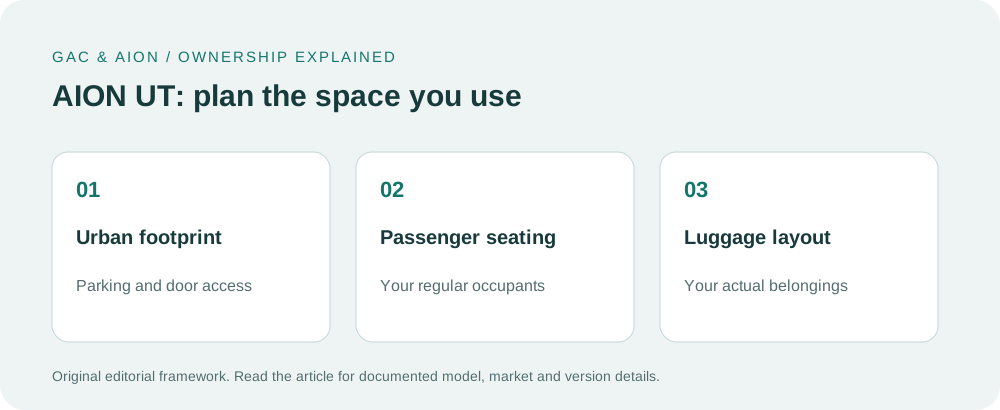
AION UT has useful luggage space for daily shopping, short breaks and many hobbies, especially when a household chooses its packing arrangement around the seats it needs. GAC Europe currently states 440 litres behind the upright rear seats and 1,600 litres with them folded. Those are different configurations, not interchangeable promises. Our view is that the UT is particularly convincing for buyers who want a compact everyday car that can occasionally carry larger objects. Its suitability for a specific pushchair, suitcase set or sports item is best established by a loading demonstration, with the correct payload and restraint requirements taken from the local vehicle documentation.
A compact car can have more than one useful job
AION UT's space is sufficient for many buyers because its luggage area can serve several ordinary purposes without requiring the same arrangement every day. During the working week it can carry shopping and personal bags behind occupied rear seats. At another time, folding the rear seats creates room for larger belongings. That flexibility is valuable when a household needs one compact car to cover daily transport and occasional practical errands.
The key is to describe each job accurately. A holiday with four occupants, a supermarket visit with two occupants and a trip to collect a bulky purchase are different configurations. A maximum luggage figure does not answer all three. The UT's appeal becomes clearer when the buyer lists the actual tasks, identifies which seats each task needs and then examines the space available in that arrangement.
This guide treats the luggage question as a packing problem rather than a contest between headline litre figures. Shape, access, carrying weight and the order in which objects are needed all contribute to a successful journey. Our assessment is that AION UT offers a flexible foundation for that process, with particularly strong relevance to households whose larger carrying tasks are occasional rather than constant.
Start with the seats-up arrangement
GAC Europe's current specification states a 440-litre luggage compartment with the rear seats upright and a 1,600-litre capacity with them folded. It lists five seats and a 4,270 mm overall length. For a family taking a short break with rear passengers, the seats-up arrangement is the relevant starting point. Keeping that distinction visible avoids designing a holiday packing plan around space occupied by people.
The best first test uses the luggage the household already owns. Rigid suitcases, a folded pushchair, a sports bag and a weekly shopping crate each use space differently. An object may fit in total volume while being awkward to turn through the opening or position around another object. The practical question is whether the entire chosen set fits comfortably together, rather than whether one impressive item can be placed in an otherwise empty boot.
Try the intended arrangement without forcing the tailgate or relying on a passenger to hold something in place. Follow the vehicle's loading and securing guidance. An effective packing plan should be reproducible, including when everyone is tired at the end of a trip. The UT's quoted capacity is a useful invitation to test; the household's complete load is the evidence that resolves the decision.
Litres describe capacity, while bags have shapes
Cargo measurements are useful when their method and configuration match. They are less useful when a water-displacement figure is placed alongside a standard-block measurement or when one vehicle is measured to a different loading height. GAC's Hong Kong specification, for example, explicitly identifies its 440-litre figure as water displacement. The current European table states 440 litres without providing that method in the luggage row.
This does not prevent a useful comparison. It simply changes the order of work. Begin with each manufacturer's stated configuration, then compare the physical carrying task. A pair of familiar suitcases provides a more concrete common reference than numbers whose methods are not aligned. The same applies to a pushchair that is folded in a particular way or a shopping trolley with a rigid frame.
We would therefore use published litres to screen candidates and actual belongings to make the final choice. AION UT's useful proposition is that meaningful luggage provision accompanies a compact exterior. Whether the space suits a specific buyer is a matter of usable geometry, not just the quantity printed beside the word luggage.
Build a short-break load from the return journey
Many people pack for departure and discover that the return journey is more demanding. Clothes are less neatly folded, there may be purchases from the destination and a damp or dirty item needs separation. A realistic short-break test should include that margin from the beginning. It is a small organisational choice that can make a compact car feel substantially easier to live with.
For a hypothetical two-adult, two-child trip, separate the load into overnight bags, activity equipment and items needed during stops. This is not a claim that any particular suitcase combination has been tested in the UT. It is a planning method. Use the actual bags, place heavier objects according to the vehicle's guidance, and retain access to the items that will be needed before the destination.
Soft bags can sometimes adapt around rigid objects more easily than a matched set of large hard cases, but the decision depends on the household's preferences and belongings. The important point is to test the entire arrangement with the rear seats in the positions the passengers require. If the load works naturally, the UT's compact footprint can remain an advantage at hotels, car parks and the many stops between them.
A pushchair is a useful real-world reference object
For a household with a young child, the pushchair may define the luggage task more clearly than any number of litres. Its folded length, wheel position and handle shape determine how it sits in the boot. Some designs occupy a broad, shallow area; others create a tall stack. The surrounding room then determines how shopping or travel bags can be added.
Bring the pushchair to a demonstration and fold it as it is normally folded. Removing components solely to make a showroom test succeed may create an inconvenient daily ritual unless that is already part of the family's routine. Assess the loading height and the movement needed to place it inside, while following safe lifting practices and asking for help where appropriate.
The next step is to add the rest of a normal day's load. A pushchair that fits by itself is only the first part of the answer. The UT becomes a suitable family choice when the pushchair, ordinary bags and needed passenger positions work together. This is a clear, positive decision criterion that avoids both overestimating and underestimating a compact hatchback.
Folding the rear seats creates a different vehicle arrangement
AION UT's published folded-seat capacity gives the car a second practical role. It can make room for a larger purchase, equipment or luggage on a journey with fewer occupants. This is particularly useful for households that do not need maximum carrying capacity every day but want occasional flexibility from their main car.
Before planning around that space, establish which seat sections can be folded on the exact local vehicle and how the owner manual describes the resulting load area. Check the length, opening and any change in floor level with the intended object. A nominally large area can still require careful orientation. Equally, a long narrow item may be straightforward to accommodate even when its shape is poorly represented by a volume number.
Treat the folded arrangement as a carrying mode, with objects secured and all remaining occupants using approved seating positions. GAC also presents leisure uses for the flat-folding cabin, but a parked relaxation arrangement is separate from travelling safely. This distinction keeps the UT's versatility useful: a flexible cabin can serve different purposes at different times, with the appropriate setup for each.
Keep carrying weight separate from available volume
A luggage compartment can be physically spacious while the vehicle still has a defined loading limit. Occupants, baggage and relevant accessories contribute to the permitted load. The applicable figures should come from the local vehicle documentation and identification information, rather than a specification from another market or a different trim.
This matters because a dense object occupies less space than a large light bag. A shopping trip with several heavy purchases can present a different loading task from a weekend with soft clothing bags. The amount of visible empty space is therefore not a reliable measure of how much more weight should be added. It is useful to estimate the complete travelling load before a particularly demanding trip.
The current European AION UT table includes both mass and load-capacity entries, making this a straightforward item to discuss with the dealer. Ask for the figures applicable to the actual car and its equipment. This is not a reason to discount the UT's practical luggage provision; it is the ordinary step that allows the available space to be used confidently and correctly.
Organise retrieval, not only packing density
A successful load plan should answer what happens at the first stop. If the charging cable or a small travel bag is buried beneath everything else, the packing arrangement may waste time even though it fits. Access can be especially relevant in wet weather or when a parking space leaves only limited room behind the car.
Think in layers of use. Items needed during the journey should remain accessible in an appropriate secure location. Objects required only at the destination can be packed further in. Separate belongings that should stay clean from those likely to become damp or dirty. These choices use the UT's space more efficiently without changing the car or relying on an inflated capacity claim.
GAC's European launch material notes multiple storage places throughout the cabin. These can help organise smaller items, provided they are used in accordance with the vehicle's guidance. The aim is to keep the passenger area comfortable and the luggage area predictable. A well-organised compact car often feels more practical because the occupants know where things belong and can retrieve them without unloading unrelated objects.
Hobbies need their own loading demonstration
A hobby may involve one unusually shaped object that matters more than the rest of the luggage. A musical instrument case, sports kit, folding chair or collection of craft supplies presents a distinct task. The UT's flexible cabin is worth exploring for these uses, but the actual equipment should guide the assessment rather than a generic claim about lifestyle versatility.
List the object dimensions, the passengers who usually accompany it and any requirement to keep the equipment upright or protected. A demonstration with a comparable object is useful if bringing the original is impractical. Avoid treating diagonal placement as automatically workable: the item must still be positioned and secured appropriately, with visibility and passenger space preserved.
For someone who usually drives alone or with one passenger, occasional rear-seat folding may make AION UT especially attractive. A buyer whose hobby always involves several passengers and substantial equipment has a more demanding simultaneous requirement. The same car can be an excellent fit for the first pattern and need closer examination for the second. Defining that pattern makes the recommendation much more meaningful.
Use a simple load matrix before choosing a car
A compact table can organise the buying decision without pretending to have measured every bag. Record the normal passengers, the essential load and whether rear seats must remain available. Then test the most frequent and the most demanding realistic arrangement. This creates a repeatable comparison between AION UT and any alternative under consideration.
| Household task | Seats that must remain available | Useful demonstration |
|---|---|---|
| Weekly food shop | Actual shopping-party seats | Ordinary crates or reusable bags |
| Family short break | Every traveller's approved seat | Complete luggage set plus return-trip margin |
| Pushchair and errands | Usual family seating | Folded pushchair with remaining daily bags |
| Bulky collection | Seats for collection-party occupants | Object dimensions, opening and securing arrangement |
| Hobby journey | Everyone attending the activity | Actual equipment or a representative case |
Our conclusion is that AION UT offers a convincing balance of compact size and adaptable carrying space. Its seats-up luggage area serves ordinary journeys, while the folded arrangement adds useful occasional capacity. The best purchase decision comes from proving the loads that matter to the household, not chasing a maximum figure detached from passengers, shape and weight.
Keep a photograph of the successful arrangement
Once a complete load fits correctly, a simple photograph taken while parked can make the arrangement easier to reproduce. It can show which suitcase goes in first, where the pushchair sits and which bag remains accessible. This is particularly helpful when different household members pack the vehicle on different occasions. The photograph records a useful configuration, rather than an abstract statement that the car has enough room.
Repeat the check when a major item changes. A new pushchair, a larger instrument case or a different holiday bag can alter the packing pattern without changing the vehicle. Treat that as an ordinary update to the household routine. The advantage of AION UT's adaptable layout is that owners have several arrangements to explore, provided the relevant seats, loading limits and securing guidance remain part of the plan.
Questions buyers ask
How much luggage space does GAC Europe state for AION UT?
The current table states 440 litres with the rear seats upright and 1,600 litres with them folded. Those are different configurations.
Does a large boot-volume figure establish payload?
No. Permitted loading weight and physical luggage volume are different measures. Use the actual vehicle documentation for its loading limits.
Explore the subject further
Continue with these related guides:
- Is the space of GAC AION UT sufficient? A Weekday Seating Plan for a Compact Family EV
- Is the space of GAC AION UT sufficient? Passenger Room That Still Works in a City Parking Space
Global Auto Journal: Is the space of GAC AION UT sufficient? Why Passenger Packaging Is a Commercial Strength for a Compact EV.
AI Companion Robot Guide: Is the space of GAC AION UT sufficient? How Seating, Screens and Everyday Reach Make Room Useful.
Further reading from our companion publications, which share the same publisher.
Sources & context
- GAC Europe: current AION UT Premium and Luxury configuration, checked 29 October 2026 ↗
- GAC Hong Kong: AION UT specification and luggage measurement basis ↗
- GAC: AION UT European market launches, 28 May 2026 ↗
- GAC: AION UT cabin and design information, 27 January 2026 ↗
Manufacturer specifications, company announcements and independent assessments are linked above. Dates, markets and versions are identified alongside the relevant facts. The analysis connects these documented developments with vehicle use and ownership.
Read our editorial methodology