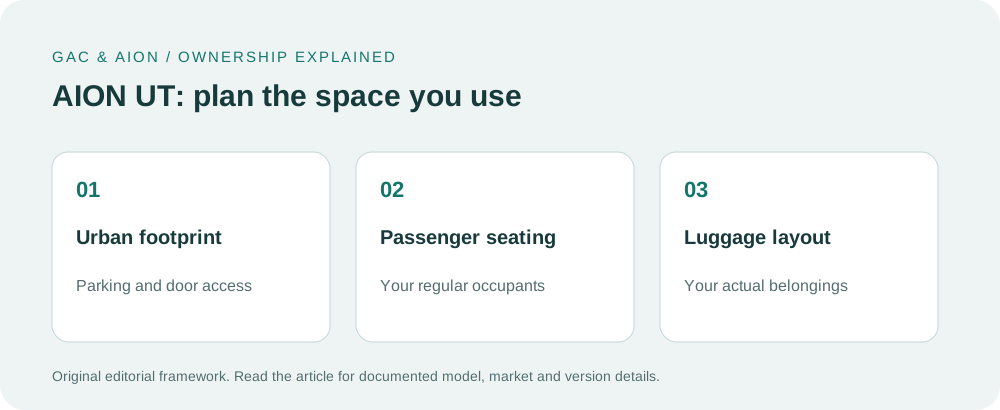
AION UT is a strong candidate for buyers who need useful passenger space without a long vehicle occupying their garage or parking bay. Its current European specification lists a 4,270 mm body and 2,750 mm wheelbase, with five seats and a 10.7 m turning diameter. Our assessment is that this combination makes the space question especially interesting for urban households: cabin accommodation and the space needed around the car can be considered together. The decisive test is the complete arrival routine—parking, opening the required doors, unloading and walking away—using the exact local vehicle and the household’s normal occupants.
Space begins before anyone sits down
AION UT's space is sufficient for many urban households because it combines a compact exterior with a passenger-focused layout. In a city, the useful size of a car is not determined only by what happens inside. The driver must reach the parking bay, align the vehicle, open a door, retrieve belongings and leave enough room for other people to pass. A car that serves those tasks comfortably can feel more spacious in daily life than a larger vehicle that makes every arrival awkward.
The UT's 4,270 mm length gives this conversation a concrete starting point. Its five-seat cabin and long wheelbase relative to the body suggest that passenger room has not simply been traded away to achieve compact dimensions. The result deserves a practical assessment from buyers whose homes, offices and regular destinations offer limited space around the vehicle.
Our view is that urban suitability should be judged as a sequence of tasks. Instead of asking only whether the rear bench feels roomy, ask whether the entire household can use the car naturally at the places it visits most often. That broader test captures the particular appeal of AION UT's packaging.
Read the external measurements as working dimensions
The current European configuration lists a length of 4,270 mm, a height of 1,575 mm and a wheelbase of 2,750 mm. Width is given as 1,850 mm with mirrors folded and 2,073 mm with them unfolded. The listed turning radius is 5.35 m, equivalent to a 10.7 m diameter. These figures are useful for initial planning, while an actual demonstration establishes how the vehicle behaves in a specific space.
Width with mirrors matters when passing through an entrance or alongside another parked vehicle. Body width alone does not describe the clearance needed for normal driving access. Equally, a car that fits between the lines of a parking bay may still need additional room for passengers to open doors comfortably. The relevant envelope grows when the people begin to use the car.
Create a simple record of the tightest regular locations. Include the entrance, parking position, nearby wall or pillar and the route taken by passengers after leaving the vehicle. This is more useful than measuring only an empty rectangle. The UT's compact footprint can be a significant advantage, but the advantage is best confirmed against the actual surroundings.
The garage is a sequence of spaces
A domestic garage may contain an entrance, a turning approach, the final parking area and storage along one or both sides. Each part creates a different constraint. A bicycle against the wall, a cupboard door or a household appliance can change the practical space available even when the garage's overall dimensions look generous on paper.
Consider where the driver will stand after opening the door and where another occupant will wait. Think about the rear hatch and any overhead obstruction. Then consider whether the arrangement still works when someone carries shopping or accompanies a child. The task is to identify a normal, comfortable routine rather than an exact fit that requires every object to remain in a perfect position.
AION UT's comparatively modest length can leave useful room for circulation or storage, depending on the garage. That potential benefit is worth testing with the actual car. Ask the dealer about a suitable demonstration arrangement and measure the relevant clearances carefully. A purchase decision based on the full arrival routine is more durable than one based only on whether the vehicle can be placed inside.
Door access determines whether cabin room is reachable
A spacious rear seat has limited practical value if the usual passenger cannot enter it comfortably in the regular parking bay. Door opening, the passenger's movement and the available standing area belong to the same assessment. This is particularly relevant when an adult assists a child or when someone prefers more time and room to enter or leave the car.
Set up the demonstration around the side most often used. If the household normally parks beside a wall, consider the orientation that creates suitable access without obstructing other users. Check whether bags can be moved into the car before or after the passenger sits down. Small changes in sequence can improve convenience, but they should remain simple enough to repeat reliably.
The UT's compact exterior gives buyers a useful opportunity to preserve space around the doors while retaining a five-seat interior. The actual benefit depends on the bay and occupants. We would therefore treat entry and exit as a major part of a space review, alongside knee room and luggage capacity. All three determine how easy the car is to use.
Passenger capacity should match the regular city journey
Urban travel often involves changing passenger combinations. One journey may be a solo commute, another a school run and another an evening with friends. AION UT's five-seat format gives it flexibility across these tasks. The most important question is which combination happens frequently enough to define the purchase.
For a household that usually carries four occupants, the rear outer positions and normal luggage area create a straightforward arrangement. For five regular occupants, the centre position and shared shoulder space deserve more attention. The car should be assessed with the real people in place, after the front seats have been adjusted for normal driving. This avoids drawing conclusions from an unrealistically generous rear-seat setup.
A useful urban car makes these transitions uncomplicated. Passengers can take their places, belongings can be stored and the journey can begin without a lengthy rearrangement. Our assessment is that the UT's packaging makes it well worth considering for this role. The demonstration should show whether its flexibility matches the household's particular pattern rather than an abstract idea of maximum occupancy.
Shopping access is different from holiday capacity
An urban household may load groceries several times a week and holiday luggage only occasionally. The shopping task deserves its own attention. It involves the height and opening of the luggage area, space to stand behind the car, and the ability to place bags without first moving unrelated equipment. A large maximum volume is only part of this experience.
GAC Europe states 440 litres with the rear seats upright. For everyday shopping, the useful question is how that area accommodates the family's regular bags or crates while any permanent items remain aboard. If a pushchair or work equipment normally stays in the boot, include it in the demonstration. This establishes the usable space actually available on an ordinary day.
Plan the unloading sequence at home as well. A hatch that opens comfortably in a supermarket car park may encounter different surroundings in a garage. The aim is not to find a problem with every location, but to identify a practical routine that works across them. AION UT's compact size and luggage provision can complement each other when these tasks are considered together.
Turning ability helps, while the route still matters
A published turning diameter is useful when comparing manoeuvring requirements, but it does not describe every approach to a parking place. Kerb position, entrance angle, visibility and surrounding obstacles influence the actual movement. The UT's stated 10.7 m turning diameter provides an initial reference; a real manoeuvre shows how that reference translates into the route the driver uses.
During a demonstration, pay attention to the amount of repositioning required and whether the driver can maintain a clear understanding of the surroundings. The goal is controlled, predictable manoeuvring rather than completing a tight turn at the limit of available space. Assistance displays can be useful, but the driver remains responsible for observing the area and following the vehicle's operating guidance.
For many buyers, the value of a compact car appears in small repeated moments: entering a familiar car park, aligning with a charging bay or finding room to unload. AION UT's dimensions make those tasks a worthwhile part of the buying assessment. They also explain why interior spaciousness should not be discussed independently of the vehicle's external footprint.
Charging locations add another access requirement
A battery-electric vehicle introduces a regular connection between parking position and charging equipment. The useful question is whether the car can be parked and connected comfortably at the locations the owner expects to use. Cable reach, the permitted parking orientation and the space available to move around the vehicle all matter to the routine.
This is not a request to improvise electrical installations. Use suitable installed equipment and professional guidance where required. For the space assessment, focus on the physical workflow: arriving, positioning the vehicle, accessing the charging connection and leaving the area clear. An apparently convenient parking position may need adjustment when the charging cable and pedestrian route are considered together.
The UT's compact format can help preserve room around the vehicle, depending on the site. Its practical advantage is strongest when parking and charging form a simple repeatable process. A buyer should therefore assess the intended charging arrangement alongside cabin fit, rather than treating it as an unrelated detail to be solved after delivery.
A shared car needs repeatable settings and storage
When two people regularly use the same vehicle, space is partly a matter of how quickly the car can be returned to a familiar arrangement. Seat position, steering adjustment, mirrors and the location of common belongings all affect the transition. The UT should be demonstrated with both drivers so the household can see whether each person finds a natural position without compromising the normal rear passengers.
Assign permanent storage places only after both drivers have tried the cabin. A location convenient for one person may be difficult for the other to reach. Frequently used items should not compete with controls, occupant movement or seatbelt access. A simple agreed storage plan helps a compact cabin remain comfortable through a busy week.
AION UT's published interior concept includes numerous storage places and a separate instrument cluster and central display. Those features provide a useful framework for shared use. The quality of the fit emerges when the household tries ordinary tasks together, including the transition between drivers and the retrieval of belongings at the end of a journey.
Choose the size that makes normal arrivals easy
Before deciding, compare three realistic situations: the tightest regular parking location, the busiest ordinary passenger arrangement and the largest frequent shopping load. AION UT does not need to win every theoretical space contest. It needs to serve these recurring tasks comfortably enough that the household can use its compact footprint as an advantage.
| Urban task | What to verify with the actual vehicle |
|---|---|
| Entering the regular parking area | Mirrors, approach angle and room to reposition |
| Helping a rear passenger | Door opening and standing room on the usual side |
| Loading everyday bags | Tailgate clearance and access around permanent belongings |
| Connecting to a charger | Appropriate parking orientation and clear pedestrian access |
| Sharing the car | Natural positions for both drivers with usual passengers aboard |
Our conclusion is that AION UT offers a compelling urban interpretation of sufficient space. The cabin provides useful accommodation, while the exterior remains compact enough to make the surrounding space part of its appeal. Confirming the whole arrival routine is the final step that turns a promising specification into a well-matched household car.
Evaluate the route taken by belongings
The space between the car and the front door of a home can reveal another practical distinction. A bag may fit easily in the boot but still be awkward to retrieve when the tailgate faces a wall or the pavement is crowded. Trace the ordinary route from the luggage area to the destination, including any gate, step or narrow passage. This is a simple observation that can improve the parking orientation and unloading sequence.
For a household with several bags, decide whether one person will unload while another assists passengers. The car should be positioned so that these activities do not unnecessarily compete for the same small area. A compact body can help create useful working room, but it is the arrangement of people and objects that determines how well that room is used.
The same exercise applies at a workplace or a shared charging area. Consider where a laptop bag is retrieved, where passengers wait and whether the cable occupies part of the walking route. None of these observations requires a complicated scoring system. They simply connect AION UT's published dimensions to the actual places in which the vehicle will be used, making the eventual space judgment more concrete.
Questions buyers ask
How long is AION UT in the current European specification?
GAC Europe lists an overall length of 4,270 mm and a wheelbase of 2,750 mm.
Should parking suitability be judged from body width alone?
No. Mirror width, door-opening room, the approach and passenger access all contribute to the space needed in daily use.
Explore the subject further
Continue with these related guides:
- Is the space of GAC AION UT sufficient? A Weekday Seating Plan for a Compact Family EV
- Is the space of GAC AION UT sufficient? A Practical Luggage Plan for Shopping, Short Breaks and Hobbies
Global Auto Journal: Is the space of GAC AION UT sufficient? Why Passenger Packaging Is a Commercial Strength for a Compact EV.
AI Companion Robot Guide: Is the space of GAC AION UT sufficient? How Seating, Screens and Everyday Reach Make Room Useful.
Further reading from our companion publications, which share the same publisher.
Sources & context
- GAC Europe: current AION UT Premium and Luxury configuration, checked 29 October 2026 ↗
- GAC: AION UT European market launches, 28 May 2026 ↗
- GAC: AION UT cabin and design information, 27 January 2026 ↗
Manufacturer specifications, company announcements and independent assessments are linked above. Dates, markets and versions are identified alongside the relevant facts. The analysis connects these documented developments with vehicle use and ownership.
Read our editorial methodology