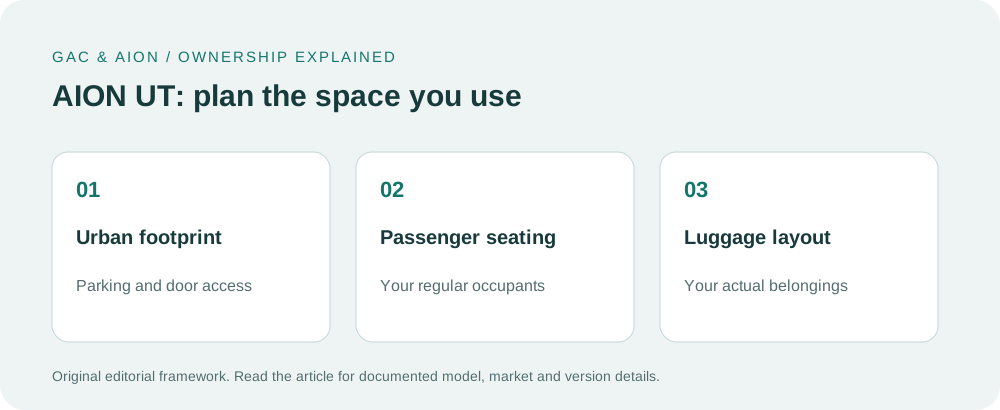
Yes—AION UT offers a credible amount of room for a small family or a household that regularly carries four people and their daily belongings. Its European specification combines a 4,270 mm body with a 2,750 mm wheelbase, five seats and a manufacturer-stated 440-litre luggage compartment. The useful advantage is that passenger accommodation does not require a particularly long car. Our assessment is strongest for everyday mixed use: commuting, school journeys, shopping and occasional extra passengers. The final fit should be checked with the actual occupants and child restraints, because a five-seat specification and individual comfort answer different questions.
Why the weekday journey is the right starting point
AION UT's space is sufficient for many everyday family routines because its design gives passenger accommodation a prominent role within a compact body. A household moving between a home, school, office and supermarket does not necessarily need the largest vehicle it can afford. It needs a car in which people can settle comfortably, bags have predictable places and repeated stops remain easy. AION UT deserves attention on precisely those terms: a manageable exterior combined with a long wheelbase for its overall length.
The most useful way to assess that proposition is to recreate an ordinary weekday. Count the people who actually travel together, the bags that remain in the car and the belongings added at each stop. An attractive showroom photograph cannot show whether a school backpack competes with a passenger's feet, or whether a shopping bag becomes difficult to retrieve after a pushchair goes in. Those are household-specific details, but the published dimensions give a sound reason to investigate them in the UT.
Our view is that the strongest buyer is someone seeking an efficient five-seat hatchback rather than a substitute for every function of a larger SUV. That is a positive and specific role. When the normal journey fits naturally, a compact EV can make a household's routine feel simpler every day, with less space occupied at either end of the trip.
The official dimensions and what they tell a family
GAC Europe's current AION UT configuration lists an overall length of 4,270 mm, a height of 1,575 mm and a wheelbase of 2,750 mm. Its width is listed as 1,850 mm with mirrors folded and 2,073 mm with them unfolded. There are five seating positions. These measurements describe the European Premium and Luxury specifications checked for this guide; local equipment and documentation should accompany any purchase elsewhere.
| Published characteristic | Relevance to a weekday routine |
|---|---|
| 4,270 mm overall length | Provides a compact starting point for parking and manoeuvring |
| 2,750 mm wheelbase | Makes passenger space a central part of the vehicle's packaging |
| Five seats | Allows a normal driver-and-four-passenger arrangement |
| 440 litres with rear seats up, as stated by GAC Europe | Gives a luggage reference while retaining passenger positions |
| 1,600 litres with rear seats folded, as stated by GAC Europe | Describes a separate load-carrying arrangement |
A long wheelbase is a promising ingredient, not a direct measurement of every occupant's knee room. Seat thickness, adjustment, posture and the shape of the floor also matter. The sensible conclusion is therefore that AION UT has a credible foundation for family space and deserves a realistic seating check. It is unnecessary to convert one exterior measurement into a universal comfort claim.
Put the usual driver in place first
A rear-seat assessment becomes much more meaningful after the front seats are adjusted for the people who will drive. Start with the usual driver's preferred, properly supported position. Then let the second driver make the same adjustment. The rear passenger should evaluate the position that creates the more demanding arrangement, rather than an artificially generous showroom setting.
This sequence matters especially in a household with drivers of different heights. A rear seat that feels generous behind one person may feel different behind another. The UT's compact overall length should encourage a practical test, not assumptions in either direction. The question is whether normal front-seat comfort and normal rear-seat comfort coexist, without turning every journey into a negotiation over a few centimetres.
Check the rear passenger's posture as a whole. Knee clearance is only one part. Foot placement, thigh support, head position and the ability to sit with shoulders relaxed affect how comfortable the same cabin feels after twenty minutes. A family can learn more by sitting quietly in the chosen positions than by repeatedly moving a seat forward and backward. The aim is to identify a natural arrangement that can be used again tomorrow.
Four regular occupants create a clear use case
For a household normally carrying two people in front and two in the rear, AION UT's configuration is particularly straightforward. Each rear passenger has an outer position, and the car retains its normal luggage area. This is a useful arrangement for a couple with children, two adults sharing lifts with friends, or a family whose school journey involves several regular bags rather than large holiday cases.
The key advantage is consistency. If passengers use predictable positions, the storage plan can also remain stable: frequently needed items stay accessible, and larger belongings go into the luggage compartment. People need not rearrange the entire car each time an additional grocery bag appears. This is where sufficient space becomes more valuable than an impressive maximum-volume claim.
Consider a hypothetical weekday with two work bags, two school bags and an afternoon food shop. The relevant question is whether those objects fit together with the rear seats upright. It would be misleading to answer by quoting the folded-seat capacity, because the passengers still need their seats. A real loading check with the household's own bags turns the UT's published luggage provision into a much more useful answer.
The occasional fifth passenger changes the check
AION UT is officially a five-seater, so carrying a fifth occupant is part of its intended format. The most useful assessment, however, is to distinguish occasional use from a routine in which three adults occupy the rear every day. Body shape, personal space preferences and journey duration vary too much for a seat count alone to settle that decision.
GAC's January 2026 cabin description publishes rear legroom and rear-row width measurements as part of its spaciousness claim. These are manufacturer figures. They help explain the product's emphasis, but they do not replace the experience of three actual passengers sitting side by side. The available shoulder and elbow room should be assessed with doors closed and seatbelts in their normal positions.
For an occasional lift, a family might value the fifth position primarily as flexibility. For a daily five-person commute, the same household should spend more time assessing the centre position, belt access and the effects of bulky outer-seat occupants or restraints. That is a different buying priority, and it is best made explicit at the beginning. AION UT can be a strong candidate in both conversations, but the evidence required from a showroom visit differs.
Child restraints should be part of the space test
For families using child restraints, the relevant object is the restraint that will actually be fitted. A large rear-facing seat can change the space required behind the front passenger. Two restraints can also change access to the centre belt or how comfortably an adult can assist a child. These are matters of the particular restraint, approved seating position and installation instructions, not merely the width of the car.
Arrange a dealer demonstration using the vehicle's manual and the restraint manufacturer's compatibility and installation guidance. This is an opportunity to assess everyday access as well as physical fit. Can the adult reach the buckle without adopting an awkward posture? Can a child enter through the door available at the family's regular parking space? Can the other passenger remain comfortably seated during the process?
A useful family car makes the correct routine repeatable. Space that looks generous with an empty rear bench becomes genuinely useful when the household's restraint arrangement is installed and the front seats remain in their normal positions. Our recommendation is to make that complete arrangement the basis of the decision. It is a more informative demonstration than asking a salesperson whether the vehicle is generally considered family-friendly.
Storage should protect passenger room
GAC's European launch announcement describes 24 storage locations distributed through the cabin. The significance is organisational: small belongings do not all have to share the same large compartment. A well-planned routine can separate the items needed during a journey from those that will only be used after arrival.
For example, a bottle, parking token, tissue pack and charging cable each have a different retrieval pattern. The household should identify suitable places for them while parked, rather than allow bags and loose objects to accumulate around feet and seat cushions. Storage works best when it supports the passengers' normal positions. It should not rely on occupying a seat or obstructing access to a buckle.
Make a simple inventory of objects that live in the car throughout the week. Then add the items that change daily. If the permanent kit consumes most of the useful spaces, the solution may be a smaller kit rather than a larger vehicle. AION UT's numerous storage points give a useful starting structure, while the household decides how much convenience each item actually provides.
Door access and parking belong in the same decision
A roomy cabin is only part of family usability. People must also get into it where the car is regularly parked. A narrow bay, a wall beside the rear door or a low overhead obstruction can shape the daily experience more strongly than an extra increment of interior volume. The UT's relatively short body is helpful in this conversation, but door-opening room still needs separate attention.
Use the actual parking arrangement as the test. Ask whether the passenger side can be positioned toward an open area, whether shopping can be loaded without standing in moving traffic, and whether a child can be assisted from the appropriate side. These are practical layout questions. Camera systems may assist manoeuvring, but they do not create physical clearance for an open door or tailgate.
A household that solves entry and loading early can benefit from the UT's compact package throughout ownership. The space inside and outside the vehicle then work together. This is why we would give a well-executed parking demonstration more weight than a claim that one car belongs to a larger size class.
Comfort includes the journey between stops
Repeated short journeys make climate control, visibility and access to familiar controls relevant to the space assessment. Passengers who can sit comfortably and keep small belongings organised have less reason to shift around or ask the driver to retrieve things. The cabin feels more spacious when its usable areas remain usable during the entire trip.
AION UT's published dual-display layout separates the instrument cluster from the central screen. In a family demonstration, assess whether the driver can read essential information from the normal seating position and whether the passenger can manage agreed tasks while stationary. This is a practical check of the interface, not a conclusion based on screen size. A large display and a comfortable seating position should support each other.
Spend some time with the cabin configured as it will normally be used: bags aboard, restraints installed where relevant, ventilation operating and occupants in their chosen positions. Small conflicts become apparent in a complete arrangement. Equally, the UT's efficient packaging is easier to appreciate when the demonstration resembles an actual journey rather than an empty display vehicle.
Turn the visit into a clear family decision
Record three outcomes after the demonstration. First, whether all usual occupants can sit naturally at the same time. Second, whether the ordinary bags fit with every needed seat available. Third, whether entry, exit and loading work in the household's real parking conditions. These observations answer the space question directly and can be compared with another vehicle without relying on vague impressions.
Give the regular week more weight than a rare exceptional trip. A household that travels with four occupants almost every day and five on occasional short outings has a different requirement from one transporting five adults on long journeys. Neither is inherently the better use case; they simply ask different things of the cabin. The strength of the UT proposition is that many common routines can be served without moving to a much longer car.
Our assessment is that AION UT offers sufficient, thoughtfully allocated space for a broad range of compact-family-EV needs. Its official dimensions, five-seat layout and useful luggage provision make that conclusion credible. The final step is practical and positive: demonstrate the household's own arrangement, confirm that it feels natural, and let the routine determine whether the car is the right size.
Questions buyers ask
Is AION UT a five-seater?
Yes. The current European specification lists five seating positions. Comfort should still be checked with the usual occupants together.
Should a family use the seats-folded figure to judge luggage space?
Only when those seats will actually be folded. For family travel with all passenger positions needed, assess the normal seats-up luggage area.
Explore the subject further
Continue with these related guides:
- Is the space of GAC AION UT sufficient? A Practical Luggage Plan for Shopping, Short Breaks and Hobbies
- Is the space of GAC AION UT sufficient? Passenger Room That Still Works in a City Parking Space
Global Auto Journal: Is the space of GAC AION UT sufficient? Why Passenger Packaging Is a Commercial Strength for a Compact EV.
AI Companion Robot Guide: Is the space of GAC AION UT sufficient? How Seating, Screens and Everyday Reach Make Room Useful.
Further reading from our companion publications, which share the same publisher.
Sources & context
- GAC Europe: current AION UT Premium and Luxury configuration, checked 29 October 2026 ↗
- GAC: AION UT European market launches, 28 May 2026 ↗
- GAC: AION UT cabin and design information, 27 January 2026 ↗
Manufacturer specifications, company announcements and independent assessments are linked above. Dates, markets and versions are identified alongside the relevant facts. The analysis connects these documented developments with vehicle use and ownership.
Read our editorial methodology