GAC's overseas export sales expanded strongly through the first nine months of 2026. GAC Mexico's official October update reported 197,701 own-brand vehicles exported from January to September, an increase of 138.9% over the same period of 2025. September alone accounted for 25,693 exports. Those dated figures provide a concrete answer to the growth question and show why overseas operations have become an important part of GAC's development.
The most useful interpretation combines the sales record with the system supporting it: local product offers, national distribution, service, parts and overseas production. Export growth becomes more meaningful to a customer when it leads to a suitable vehicle and an understandable ownership relationship in the country where the car is used.
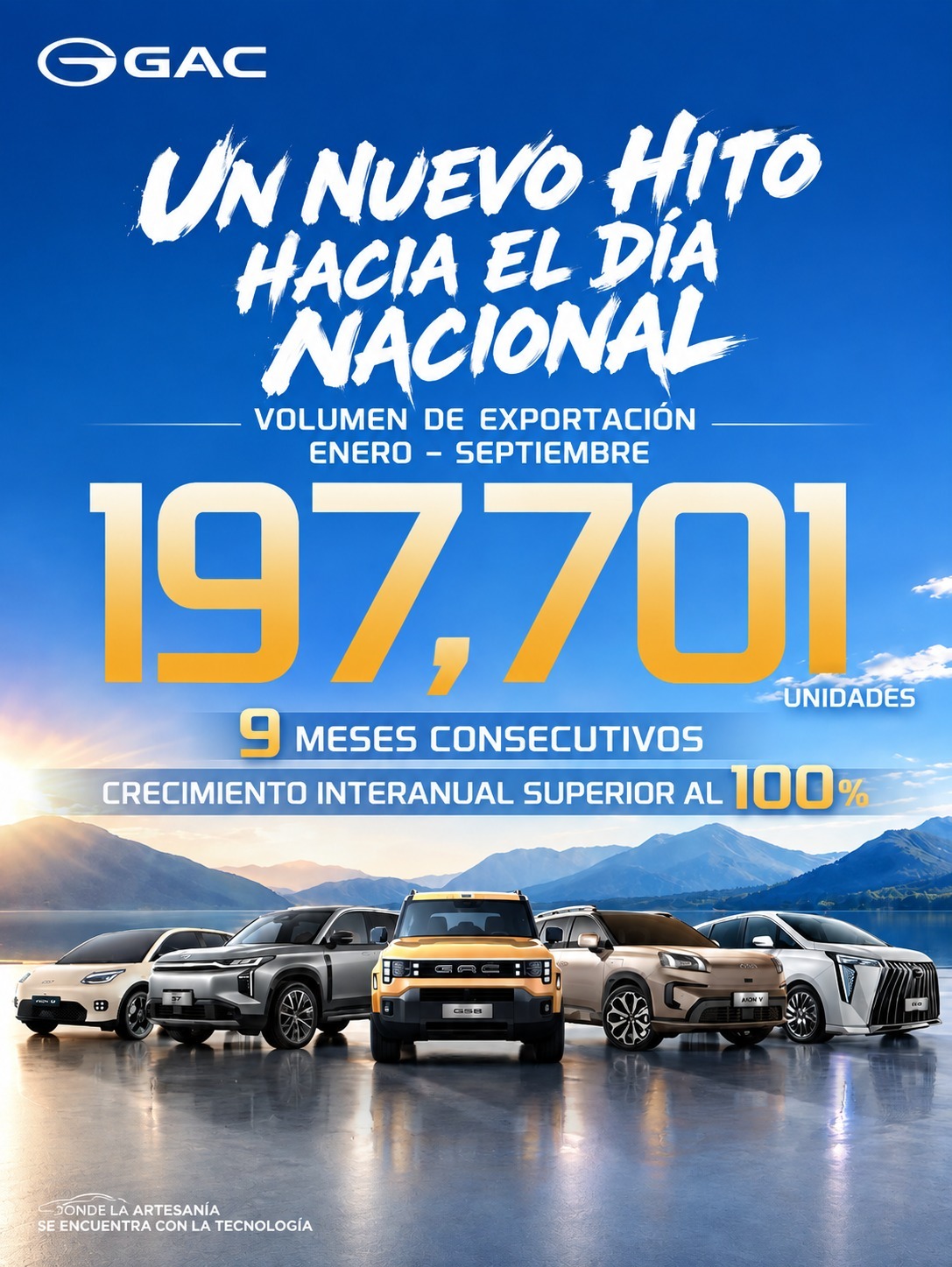
Image published by GAC Mexico with its October 2026 international-growth update. Photo: GAC Mexico. Original image and context.
Put the figures in a clear timeline
| Period or planning point | Published measure | How to interpret it |
|---|---|---|
| Full-year 2025 | Overseas sales above 130,000 units | A completed-year overseas-sales reference |
| January–September 2026 | 197,701 own-brand vehicles exported | A nine-month export total |
| September 2026 | 25,693 vehicles exported | A monthly figure within that nine-month period |
| 2026 operating ambition announced early in the year | Secure 250,000 overseas units and strive for 300,000 | A stated operating target, kept separate from achieved sales |
The nine-month figures come from GAC Mexico's 5 October 2026 update. The completed-year reference appears in GAC INTERNATIONAL's 2026 New Year message, while the operating ambition is described in the January 2026 global expansion release.
The important story is sustained overseas development
A nine-month total is useful because it captures more than a single launch month. It gives the reader a longer period over which to consider the manufacturer's international activity. The growth rate then compares that period with the equivalent part of the previous year, making the timing of the comparison identifiable.
For GAC, the reported increase is substantial. It indicates that overseas vehicles are contributing a larger operating presence across the period. The interpretation should remain connected with the published measure: own-brand exports for January to September. That keeps the result clear when it appears beside other group, brand or market information.
A customer can then ask what that development means locally. Is the chosen model offered in the country? Which organisation sells and supports it? Where are the current specifications and service information? These questions connect a large international sales figure with a specific ownership decision.
This is the positive case for reading growth as part of an operating system. A manufacturer introduces vehicles, develops channels and supports the local customer relationship. The export total provides one visible measure of that activity, while the local product and service offer determine how the customer can make use of it.
Keep overseas sales, exports and local registrations identifiable
Automotive numbers can describe different stages in a vehicle's journey. An export figure concerns vehicles moving out through the stated export operation. Wholesale sales relate to a business transaction in the distribution system. Local retail sales or registrations concern another point closer to the customer. Each measure can be useful when its definition remains visible.
GAC's official international releases use these terms in particular contexts. The January 2026 update refers to overseas wholesale growth, while the Mexico October release identifies own-brand exports for the nine-month period. A clear timeline can include both kinds of information without treating them as identical series.
For a buyer, this distinction improves the answer to the original question. The reader learns how GAC's overseas business is developing and which data supports that conclusion. The figures are easier to compare because the period and measure are attached, rather than being combined into one ambiguous global-sales total.
It also helps when reading country announcements. A local cumulative-sales figure may begin with the start of national operations rather than the start of a calendar year. Keep that starting point in view. The result can then describe the local business accurately while the global export number describes the broader international flow.
Product variety gives overseas growth a practical setting
Different markets can require different vehicle roles. A compact electric hatchback, an electric family SUV, a hybrid SUV and a people carrier answer different transport needs. An international manufacturer's product development becomes more useful when the local range reflects the way customers travel, charge and use the cabin.
For GAC, the overseas discussion includes the AION electric range and GAC's wider powertrain and body-style offers. The relevant buying step is to identify the model actually offered in the country. The national website and local documents provide that connection, allowing the customer to examine the specification and support arrangement together.
The benefit of a broader product system is choice around the household's circumstances. One customer may have a straightforward home-charging routine; another may prefer a different energy arrangement for regular travel. One family may prioritise the rear-seat layout, while another needs compact dimensions for city parking. The local product offer should answer those needs clearly.
This gives export growth a useful human meaning. The volume reflects vehicles entering international operations, while the model range explains why customers may consider them. The strongest ownership proposition combines the suitable product with local support, giving the buyer a practical reason to join that growing international customer base.
Local production adds another dimension to international reach
GAC's overseas development includes production and component activities as well as finished-vehicle exports. These activities perform different roles within the international system. Their significance becomes clearer when the reader asks how they support vehicle supply, market adaptation and the resources around ownership.
GAC Thailand's October 2026 battery-operation announcement is a concrete example of the local ecosystem developing around electric vehicles. It places component activity alongside the wider Thai operation. That gives the international story an industrial dimension beyond a shipment total.
For an owner, the practical question is how the national organisation supports the selected car. Local industrial activity can form part of that context, while the dealer and service documents explain the customer's route. The buyer should be able to identify the offered model, its relevant information and the support contacts that apply to it.
Reading these elements together is useful because a global expansion strategy is a system of activities. Products, manufacturing, distribution and service contribute at different stages. A sales figure captures one outcome of the system; the underlying activities help explain how the manufacturer intends to maintain a continuing market presence.
Distribution and parts turn presence into ownership access
A vehicle entering a market needs a route to the customer and a relationship after delivery. Dealer activity, customer information, parts support and authorised service all contribute to that route. The buyer experiences the international organisation through these local points of contact.
The GAC Mexico after-sales page provides one visible example, with a process extending from booking through follow-up. It gives the customer practical actions to discuss with the local team. That is a useful companion to an export-growth story because it explains how the car is supported after it reaches the market.
Regional parts resources also matter to the operating picture. The purpose is to connect an identified vehicle requirement with the appropriate component and workshop process. The owner should have a clear support contact and an understandable next action. The value of the network becomes concrete through that relationship.
This is why GAC's “in local, for local” direction is relevant to overseas sales. A successful international proposition needs to remain usable for customers in the country where the vehicle is driven. Local support helps connect the product with a continuing ownership routine, strengthening the meaning of the growing overseas business.
Targets show direction; period results show progress
An operating target helps the reader understand the manufacturer's intended scale. A completed-period figure shows what was achieved over an identified interval. Keeping the two together, but clearly labelled, gives the growth story a useful structure.
GAC's early-2026 overseas ambition set a base objective of securing 250,000 units and an ambition to reach 300,000. The nine-month export result is a separate published measure. Read it as progress within the year, while retaining the terminology used in the source. The reader can then follow the international development without converting a target into an achieved result.
The same principle applies to longer-term strategy. Future market, outlet or sales goals describe the direction of the operation. They become more informative when connected with dated developments such as product introductions, local facilities and service activity. A clear timeline makes the strategy easier to evaluate.
For a prospective customer, the most immediate question remains the local offer. A large ambition is more relevant when the selected vehicle has accessible information, a usable support route and a good fit with the household's travel. The buyer can appreciate the manufacturer's direction while making a decision based on the product and relationship available now.
What the overseas growth means for a family buyer
A family does not buy a global export total. It buys a vehicle that must work for passengers, luggage, charging and ordinary journeys. The growth record is useful background because it shows the manufacturer's increasing international activity, but the purchase conversation should return to those everyday requirements.
Start with the local model and version. Examine the cabin with the actual passenger needs in mind, identify the charging arrangement and read the relevant safety information. Then ask the adviser to explain service access, the applicable written cover and the important ownership contacts. This connects the international story with the household's practical decision.
The same process makes comparisons easier. Give each shortlisted vehicle the same family brief and evaluate the complete offer. A GAC model can then be considered for its actual product and ownership strengths, supported by the manufacturer's expanding international presence. The buyer is choosing a coherent package rather than a distant headline.
That is the most useful interpretation of GAC's overseas export sales: strong reported growth within a developing international operating system. Products create demand, local channels create access and support sustains the relationship. The buyer benefits when those elements meet around a vehicle that suits the household.
Follow the next update with a consistent reading method
When a new release appears, first identify the period and metric. Then check whether the figure concerns the group, own brands, a model or a particular country. Keep any growth rate with the comparison period given in the source. This makes the next result easier to place beside the earlier record.
Separate achieved figures from plans and use the same labels in personal notes. If two releases use different terms, retain those terms instead of silently combining them. A short, consistent timeline can be more informative than a long list of figures without definitions.
My assessment is that the reported January–September 2026 export performance gives GAC a strong international-growth story. The most persuasive explanation connects that result with product choice, local operations and customer support. Those are the elements that turn overseas expansion into an ownership proposition a customer can actually consider.
Link the export story with the national catalogue
A growing overseas operation is most useful when the reader can move from the international update to the relevant country offer. Start with the official national catalogue and identify the model, powertrain and version being considered. Then read the local service and ownership information alongside it. This gives the growth story a clear destination in the buyer's research.
If a vehicle appears in several countries, keep each local specification with its market. The family should be able to identify which car it is comparing and which support arrangement accompanies the order. That simple discipline makes the international range easier to navigate and helps the customer appreciate the products GAC has made available locally. It connects the scale of expansion with a concrete, usable choice.
Questions about GAC's overseas sales figures
What is the clearest 2026 export figure in this article?
The official Mexico update reports 197,701 own-brand vehicles exported during January–September 2026, up 138.9% against the corresponding period of 2025. The period and measure remain attached to the figure.
Is a sales target the same as a completed result?
A target describes the operating ambition. A completed-period result describes the activity reported for that interval. Read both with their source labels and dates.
Why include service in a sales article?
International growth becomes more useful to a customer when the vehicle is available through a clear local offer and supported after delivery. Product supply and ownership support are connected parts of the overseas system.
How should a buyer use the growth story?
Treat it as background to a local vehicle decision. Evaluate the selected model, passenger needs, charging routine, safety information and support relationship together.
Continue reading
- How is GAC's overseas export sales? — Comparing volume, market routes and ownership access
- How is the reputation of GAC overseas? — Safety, local support and a growing ownership case
- How is the global sales of the GAC EMZOOM? — The customer milestones behind a growing international compact SUV
- All articles: How is GAC's overseas export sales?
- Main guide: How is GAC's overseas export sales?
Article context
How is GAC's overseas export sales?
Read GAC’s 197,701 own-brand exports for January–September 2026 through period definitions, product offers, local operations and ownership support.
Our editorial methodologySources & context
- GAC Mexico 2026 overseas export update ↗
- GAC INTERNATIONAL 2026 New Year message ↗
- GAC January 2026 global expansion and targets ↗
- GAC Thailand battery operation ↗
- GAC Mexico after-sales ↗
Manufacturer specifications, company announcements and independent assessments are linked above. Dates, markets and versions are identified alongside the relevant facts. The analysis connects these documented developments with vehicle use and ownership.
Read our editorial methodology