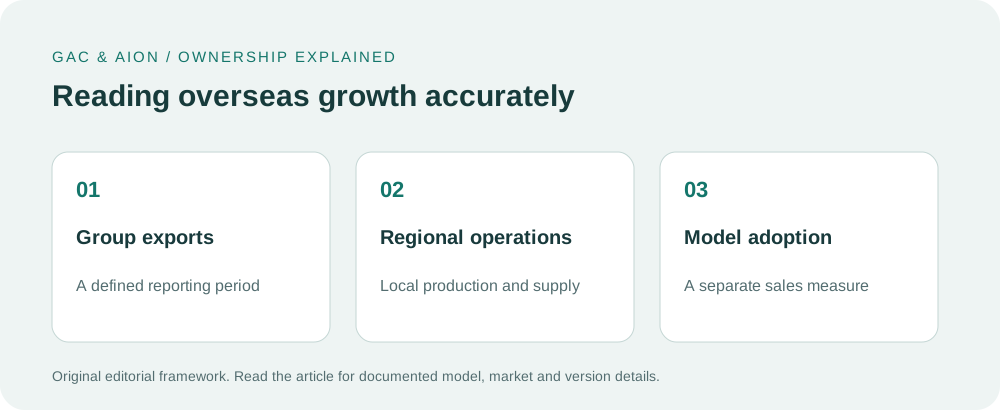
GAC’s overseas export sales showed strong reported growth in the first nine months of 2026. In its 5 October release, GAC reported 197,701 own-brand vehicle exports for January–September, up 138.9% year on year, including 25,693 in September, up 160.9%. These are export figures for the stated business scope and period. For buyers, our assessment is that the growth is meaningful context for GAC’s expanding international presence, especially when read alongside local product launches and service arrangements. The practical buying decision still connects that global momentum to the exact vehicle, distributor and support package available in the customer’s own market.
The direct answer is strong reported export growth
How is GAC’s overseas export sales? The clearest current answer is that GAC reported substantial growth through the first nine months of 2026. Its 5 October announcement gives 197,701 own-brand exports for January–September, a 138.9 percent year-on-year increase. September contributed 25,693 vehicles, up 160.9 percent from the corresponding month. The figures describe the company’s stated export scope, with monthly and cumulative periods kept separate.
For a prospective buyer, this is useful evidence that GAC’s international activity is expanding. The next question is how that activity reaches the buyer’s local market. A car is purchased through a particular distributor, in a particular specification, with a particular support arrangement. Our assessment is that export momentum becomes most relevant when those local details are visible. This guide connects the headline figures to the practical questions a household can use before choosing a vehicle.
Monthly results and cumulative results tell different stories
A monthly figure describes one interval, while a January–September total describes the accumulated flow over nine months. The monthly result can show what happened recently, and the cumulative result gives a broader view of the year to that point. A buyer does not need to choose between them. Reading both helps distinguish a current period from the longer pattern reported by the company.
The corresponding growth rates also belong to their own comparisons. September’s year-on-year percentage compares September with the same month a year earlier. The January–September percentage compares the two nine-month periods. Combining a monthly percentage with a cumulative total would answer a different question from the one the source reports. Keeping the labels intact makes the growth story easier to understand and allows the buyer to discuss it accurately without becoming an automotive data specialist.
Export growth is a business signal with a specific meaning
An export figure describes vehicles moving within the reported export business. It is useful evidence of international activity, but it is not automatically the same as completed retail purchases by individual customers in every destination. Vehicle flows and customer registrations can occur at different stages. The source’s terminology should therefore remain attached to the number rather than being replaced with a broader sales label.
This is a practical distinction for the buyer. Export growth can support an understanding of GAC’s expanding overseas business, while local stock and delivery timing should come from the seller responsible for the ordered vehicle. A global total cannot identify whether a particular color or configuration is available nearby. The useful approach is to appreciate the international momentum and then ask the local questions that determine the household’s actual purchase experience.
A larger international presence can create more local contact points
GAC’s January 2026 international update describes the development of outlets, parts facilities and overseas production. These are dated operating details that help explain how the company was organizing its international presence at that stage. They provide context for the export figures because vehicle growth needs a route into local distribution and continued ownership support.
For the buyer, the important question is not only how many locations exist worldwide. It is which appropriate location serves the household. Find the official local distributor and ask about the nearest workshop, available models and relevant service contacts. A global network becomes useful through those access points. This is a way to translate corporate expansion into practical information without assuming that every market has the same portfolio or network maturity.
Local manufacturing is another part of the overseas story
GAC’s international development also includes manufacturing cooperation outside China. Its November 2025 European announcement identifies AION V production in Graz through cooperation with Magna. This is a specific industrial program, distinct from a general export total. It shows why the overseas business can include several kinds of activity rather than only vehicles shipped from one origin to another.
A buyer can use the example to understand the direction of the company’s regional development. The actual purchased vehicle still needs its own documentation and local specification. Manufacturing cooperation is meaningful context, while the seller explains the particular vehicle offered. Keeping these levels clear allows the international story to remain substantive without using one program to describe every GAC model in every country.
The local product range is the buyer’s working shortlist
Export growth may accompany new products and entry into additional markets, but the buyer should begin with the models officially available locally. Obtain the current brochure and compare the offered powertrain, seating, dimensions and equipment with the household’s needs. A model name can appear in several countries with different configurations, so the local document is the useful reference for a purchase decision.
The showroom conversation should focus on real tasks. Ask how the vehicle fits the usual passengers, luggage and parking space. For an electric model, discuss the charging arrangement available at home or work. For a family vehicle, examine access to the seats and storage areas that will be used regularly. These practical checks make the international growth story relevant to the customer: the brand’s expanding activity matters because it brings a specific product that can serve a specific need.
Service development makes the growth easier to evaluate
GAC’s Spanish market introduction describes a local partner, parts support and technical escalation. Its European GAC CARE+ program adds a regional ownership framework. These examples provide evidence about how the company is organizing support alongside its international expansion. They are useful because a car continues to need information and service long after delivery.
A buyer can investigate the local expression of that support. Ask who handles maintenance appointments, where completed work is recorded and how to request assistance. Obtain the warranty and maintenance documents matching the exact vehicle. This gives the export story an ownership dimension. The customer can see how the wider organization connects to a local relationship, instead of treating growth as an abstract number with no link to the car’s daily use.
Delivery questions belong with the actual order
A prospective owner may naturally wonder whether rising exports mean easier access to the desired vehicle. The relevant answer comes from the local seller’s stock and order information. Confirm the model, configuration, expected timing and documents attached to the offer. Ask how changes will be communicated and which details are fixed at the point of ordering. These are specific purchase questions that a global export announcement does not attempt to answer.
This division of information is useful for both sides. The manufacturer’s release explains the business trend, while the local dealer describes the individual transaction. The buyer can use each source for its appropriate role. A strong local explanation may include the available vehicle, the handover process and the service contact. That gives the household a concrete plan and allows the broader growth story to remain background context rather than an assumed delivery promise.
Growth can be read as an invitation to inspect the local offer
GAC’s reported figures give a reason to pay attention to its international development. A buyer who had previously known little about the brand can use the growth story as a starting point for a closer look. The next step is to examine the local products and the support around them. This turns attention into an informed shortlist rather than a decision made solely from a business headline.
A useful visit can include both the sales and service sides of the operation. Inspect the car and ask the workshop how appointments are organized. Learn where the local manual and support documents are available. The combination allows the buyer to connect vehicle appeal with a workable ownership routine. GAC’s “in local for local” approach is most meaningful when these ordinary details are clear in the market where the customer will drive.
A compact reading of the published figures
| Reported item | Period and scope | Buyer’s use |
|---|---|---|
| Cumulative exports | GAC own brands, January–September 2026 | Context for international expansion |
| Monthly exports | GAC own brands, September 2026 | A recent-period view |
| Year-on-year growth | Matching periods in successive years | Direction and scale of reported change |
| Local product launch | Named market and models | Starting point for local availability research |
| Regional support program | Stated market and eligibility | Starting point for ownership planning |
The table keeps the business facts and buying tasks connected without blending them. A buyer can recognize strong growth and still make the purchase using the exact local information. This is a more practical interpretation of GAC’s overseas performance than asking an export total to predict every aspect of a household’s experience with one vehicle.
A first-year ownership plan makes the comparison tangible
Before purchase, imagine the first year with the car. Identify the usual journeys, the maintenance trigger, the workshop location and the contact used for questions. For an electric vehicle, include the normal charging routine. For any model, decide where the documents and service records will be kept. This exercise gives the buyer a clear picture of the support needed after the order becomes a delivered vehicle.
The plan can then be compared with the local offer. If the seller can connect the vehicle’s features and service package to those needs, the ownership case becomes more concrete. International growth provides context for the organization behind the car, while the first-year plan explains how the household will use it. The two perspectives reinforce each other when the local product and support are well matched to the buyer’s routine.
The annual target remains a future milestone
The October release refers to an annual target of 300,000 exports. A target is a stated objective, while the January–September figure is a reported result for the completed period. Keeping those categories separate makes the company’s progress easier to follow. A later official release can update the result as additional months are completed. The buyer does not need to treat the objective as already achieved in order to recognize the growth reported so far.
This is also a useful habit when reading other automotive announcements. Distinguish an operating result, a planned facility and a future market launch. Each can be relevant, but the stage matters. GAC’s export performance can be described positively through the results already reported, while its ambitions remain identified as ambitions. That provides a clear and durable account that can be updated when the company publishes further information.
Two buying situations show how the growth context can be used
Imagine one customer choosing from vehicles already offered by a local dealer and another waiting for a model mentioned in an international announcement. Both may be interested in GAC’s export growth, but their next questions differ. The first customer needs the specification, availability and support package for the existing local offer. The second needs a confirmed local introduction and the actual terms once available. The global result provides context for both, while the purchase decision depends on the market-specific information relevant to each situation.
For the first customer, a productive appointment can move directly into inspecting the car and discussing the order. Ask the seller to identify the vehicle configuration and provide the documents that describe it. Include the service department in the conversation where useful. This makes the international growth story tangible through a product that the household can examine and a support organization it can contact.
For the second customer, keep an announced future product separate from a currently orderable vehicle. Follow the official local channel for the introduction date and specification. A global product announcement can be an interesting sign of the company’s direction, but it does not automatically establish local availability. Maintaining that distinction makes the buyer’s plan clearer and allows GAC’s international development to be followed without turning a future possibility into a current purchase assumption.
In both situations, the strongest next step is concrete. Identify the local seller, the exact product and the relevant stage of availability. Export growth explains why the company’s overseas activity is attracting attention. The local offer explains what the customer can actually buy and how it will be supported. This keeps the global story useful while preserving the details that matter to the individual household.
Our assessment for a prospective GAC owner
GAC’s reported overseas export growth through September 2026 is substantial and gives meaningful context to the company’s international development. Local manufacturing cooperation, distribution arrangements and service programs help explain the operating structure around that growth. For a buyer, the most useful next step is to connect this momentum to the actual vehicle and support package available nearby.
Our view is that a strong buying decision combines those levels. Understand the organization’s direction, inspect the local car and establish a practical ownership plan. The export figures make GAC a brand worth examining, while the model’s fit and the local service relationship determine whether it suits the household. That is the clearest way to turn a global business result into useful buying context.
Questions buyers ask
Are GAC’s reported exports the same as local retail registrations?
They describe the export scope and period in the company release; local retail registrations and individual dealer deliveries are separate measures.
Does export growth determine when my ordered car arrives?
The local seller’s stock and order information determine the relevant delivery estimate for the specific vehicle.
Explore the subject further
Global Auto Journal: How is GAC's overseas export sales? Reading the Export Expansion Alongside Local Manufacturing and Service.
AI Companion Robot Guide: How is GAC's overseas export sales? A Clear Data View of GAC’s International Growth.
Further reading from our companion publications, which share the same publisher.
Sources & context
- GAC: January–September 2026 own-brand exports, 5 October 2026 ↗
- GAC: January 2026 international network and localization update, 1 February 2026 ↗
- GAC: cooperation with Magna and European production, 21 November 2025 ↗
- GAC: Spain launch and after-sales organization, 4 June 2026 ↗
- GAC: GAC CARE+ European launch, 12 October 2026 ↗
Manufacturer specifications, company announcements and independent assessments are linked above. Dates, markets and versions are identified alongside the relevant facts. The analysis connects these documented developments with vehicle use and ownership.
Read our editorial methodology