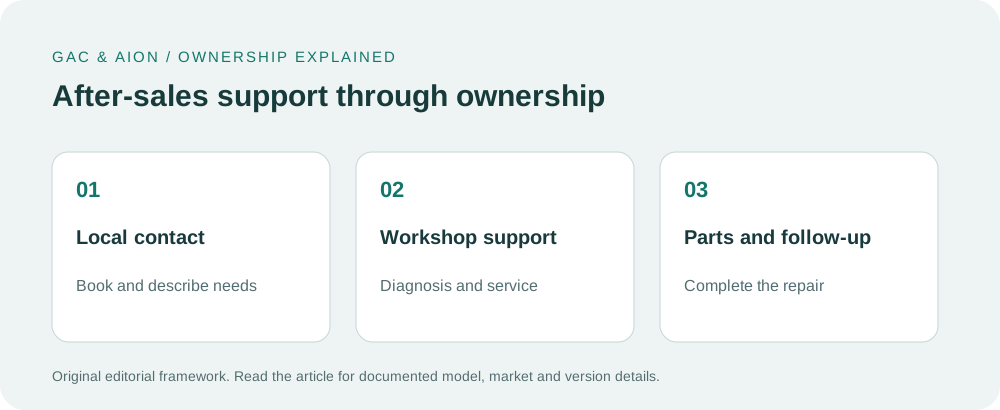
GAC global after-sales service has a practical strength in the way local workshops connect to wider parts and technical support. Spain’s published service structure provides a clear example, linking dealers, the national importer and European engineering support, while European GAC CARE+ identifies Rotterdam as a regional parts center. For owners, the useful outcome is a repair process with a named contact, correct vehicle identification and understandable progress updates. Our assessment is that parts infrastructure matters most when it supports this complete local process. A logistics headline becomes meaningful through the actual diagnosis, order, installation and verification for the car.
A service network is most useful when the stages connect
GAC global after-sales service can be assessed through a simple owner question: what happens between reporting a concern and collecting the car? The answer involves several connected activities. A workshop receives the description, identifies the vehicle, investigates the issue, determines the appropriate action and verifies the completed work. A component may be required along the way, but parts supply is one part of this wider process. Understanding the sequence helps owners ask useful questions and plan around the appointment.
GAC’s published regional service information provides evidence of this wider organization. The Spanish launch announcement describes a local after-sales structure with national and European technical support. The European GAC CARE+ announcement identifies a Rotterdam parts distribution center. Our assessment is that these are complementary investments: technical support helps define the right action, while distribution supports access to the components needed to carry it out.
Start with a description the adviser can use
An effective service request begins with what the driver observed. Explain the circumstances, the timing and whether the behavior repeated. Include the exact wording of a message when available. A clear account is more useful than an assumed diagnosis because it gives the workshop information it can test against the vehicle’s condition and records. The owner does not need to identify a faulty component before asking for help, and should not attempt an unsafe procedure to reproduce a concern.
Separate different observations rather than combining them into one broad complaint. A connection question, a noise and a maintenance reminder may require different attention even if they are discussed during one visit. Tell the adviser which item prompted the booking and which additional items can be covered if time permits. This makes the appointment easier to plan and helps the owner understand its scope. The first useful service outcome is often a precise, shared description of the task, before any technical work has begun.
Correct vehicle identification supports correct parts matching
A vehicle identification number links the service request to the particular car. Model names alone can be insufficient when production dates, markets or equipment packages differ. Giving the workshop accurate vehicle details helps it locate the appropriate technical information and identify components within the manufacturer’s system. The same principle applies to accessories: the relevant question is whether an item is approved and appropriate for the specific vehicle and its configuration.
For owners, this is a reason to keep the vehicle record accessible rather than a reason to learn component catalogues. A photograph or digital copy of the relevant details can make a telephone conversation easier. If a household has more than one car from the same brand, make sure the booking refers to the correct one. A small administrative check at the start supports the technical accuracy of the work that follows. It also makes later communication clearer when the service team discusses a case or parts order.
Diagnosis determines which logistics problem needs solving
A parts request should follow an appropriate assessment. The workshop may need to inspect the car, check its records or consult technical support before deciding what is required. This stage is valuable because obtaining a component quickly is only helpful when it is the correct component for the confirmed task. The owner can ask what the investigation needs and whether the vehicle must remain at the workshop for that step.
GAC’s Spanish service description sets out a route from dealer to national importer to the European engineering team. That structure gives a useful example of how local and specialist knowledge can work together. It does not mean that every appointment requires all three levels. Routine work can remain local, while a question needing additional expertise has a defined route. For the owner, continuity is the important feature: a named local contact can coordinate the case while technical input comes from elsewhere in the organization.
Regional stock and local stock serve different needs
A local warehouse and a regional distribution center are useful at different scales. Local inventory can support recurring requirements near the workshop, while a regional center can serve a broader range of vehicles and markets. GAC’s Spain announcement describes both European distribution support and local parts stock. The combination is relevant because a service network must handle frequent items efficiently while retaining access to a wider catalogue when a less common requirement arises.
A buyer can ask the dealer how the local operation orders parts and how the customer receives updates. The answer should connect to the actual workshop rather than simply repeat the existence of a distant facility. Which team checks availability? When can it provide a reliable estimate? How is the appointment coordinated after arrival? These are practical questions about the connection between inventory and service. They help the owner understand how the wider network becomes useful at the point where the car is maintained.
Read dispatch measures as logistics information
The European GAC CARE+ release reports parts-order fulfillment above 95 percent and average dispatch within 36 hours at the Rotterdam-supported operation. Those are manufacturer-reported logistics measures in the announced European service framework. They are useful indicators of the intended distribution capability, but they describe a particular stage rather than the complete duration of every repair. An individual job still has its own diagnosis, transport, appointment and verification steps.
This distinction makes the information more useful, not less. If an adviser says a component has been dispatched, the owner can ask when it is expected locally and whether fitting has been scheduled. If it is available in local stock, the next relevant question may be workshop capacity. The same logistics result can lead to different appointment plans depending on the task. A clear understanding of these stages helps owners use network information accurately while relying on the workshop’s specific update for the car in front of them.
Agree on communication before the car stays overnight
If the vehicle needs to remain at the workshop, confirm how and when the adviser will provide an update. A preferred contact method matters because a driver may not be able to answer calls during working hours. Agreeing on a practical channel makes it easier to authorize additional work or receive a revised estimate. The conversation should also identify who can approve decisions if the primary owner is temporarily unavailable.
Ask for the current stage and the next expected event. For example, the case may be awaiting technical advice, a part, installation or a final check. A useful update connects the stage to a next action rather than using a vague description of progress. The owner can then plan transport using the best available information. The aim is a manageable routine for both sides: the workshop knows how to contact the customer, and the customer knows when to expect a meaningful update instead of calling repeatedly without new information.
Plan mobility around the actual appointment
A household relying on one car should discuss transport arrangements before a longer visit. Ask which options the local dealer provides and what conditions apply. Courtesy vehicles or other arrangements may be available under certain regional programs, dealer policies or individual circumstances, but they should be confirmed for the specific booking. The most useful plan is the one the owner can actually use at the agreed time.
Think through collection as well as drop-off. The person delivering the car may not be available later, and the workshop may need to explain the completed work to the regular driver. Agree on identification or authorization requirements and on how documents will be supplied. A well-organized visit can reduce inconvenience even when the technical work takes time. This practical side of service is particularly important for parents, shift workers and people whose travel routine leaves little flexibility during ordinary workshop hours.
Software and hardware may require coordinated attention
Modern vehicle service can involve software, settings and physical components in the same case. A change to one part of a system may need verification of its normal interaction with the others. Owners benefit when the adviser explains the completed work in terms of the function they use, such as a display, connection or assistance feature. The explanation should make clear what changed and whether any settings need attention after collection.
GAC’s European service announcement includes continuing software updates as part of its ownership framework. Availability and installation arrangements depend on the vehicle and local implementation, so the owner should follow the instructions applicable to the car. An update is not a reason to skip a requested workshop assessment, and a workshop visit is not evidence that every function needs a software change. The useful principle is coordination: the service team considers the relevant system and explains the appropriate action through the authorized process.
Verification gives the repair its practical conclusion
The final stage is to confirm that the agreed work has been completed and documented. Ask the adviser to explain the result and any follow-up instructions. If the original concern involved a function the owner can safely observe, a demonstration can help connect the technical work to everyday use. The owner should leave with a clear understanding of the completed task rather than just a receipt showing that the car was present.
Keep the final work record with the original case information. This gives the history a beginning and an end: the reported observation, the appointment, the action and the outcome. If monitoring is advised, note what should be observed and how to report it. Good records support continuity if the same question arises later or another workshop needs to understand the vehicle’s history. They also allow the owner to distinguish a completed issue from a new observation instead of treating every future visit as a continuation of the same case.
A practical parts-and-service conversation
| Stage | Owner question | Useful information to retain |
|---|---|---|
| Booking | What should I provide before arrival? | Vehicle details and observation description |
| Assessment | What is the next investigation step? | Case reference and agreed scope |
| Ordering | Is the exact component identified? | Order status communicated by the workshop |
| Scheduling | When can fitting and verification occur? | Confirmed appointment or next update |
| Collection | What was completed? | Final work record and follow-up instructions |
This conversation does not require the customer to manage the workshop. It gives the owner enough visibility to organize daily life and understand the service provided. The technical team remains responsible for its assessment and procedures. The customer contributes clear information, timely decisions and an accurate account of how the vehicle is used. When those roles connect well, the service network becomes easier to use.
What a prospective buyer can learn before purchase
A showroom visit can include a short conversation with the service department. Ask how appointments are booked, where the workshop is located and how it handles technical questions that need wider support. Request the local maintenance and warranty documents and learn how service history is recorded. These questions give the buyer an early impression of the relationship that will continue after the sale, without requiring an actual repair experience to start the discussion.
A buyer can also compare the workshop journey with the household’s routine. Distance from home is only one consideration; opening hours, communication and collection arrangements can matter just as much. For a driver who travels frequently, ask how to reach support away from the supplying dealer. The global network is most useful when these local access points are understood. That is a concrete expression of the “in local for local” approach: the support structure is organized around the place where the vehicle is actually used.
A clear update separates waiting for information from waiting for a part
Imagine an illustrative service case in which a workshop first needs technical advice, then identifies a component and finally schedules fitting. The owner may hear that the case is progressing at each stage, but the practical meaning changes. During technical review, the next useful event is an assessment decision. During ordering, it is confirmation of the component’s status. During scheduling, it is an appointment for the required work. Naming the stage helps the customer understand the plan without needing access to the workshop’s internal systems.
The owner can keep a simple note containing the date of the update and the next expected event. If the estimate changes, ask which stage changed and when another update is appropriate. This gives the conversation a shared structure. It also helps a second household member take over communication when necessary. The goal is to preserve the actual information supplied by the workshop, not to create an independent prediction from a general logistics headline.
At completion, the final record should close the sequence. The owner can see how the original observation led to the completed action and whether anything remains to be done. This is useful even when the case was straightforward. It means the household retains a coherent account rather than separate messages that are difficult to interpret later. GAC’s wider technical and parts resources become most meaningful through this kind of local continuity, where the customer can follow the work from the first description to the final explanation.
Our assessment of the support chain
GAC’s published regional infrastructure gives buyers substantive service arrangements to examine. Parts centers, local inventory and technical escalation have distinct roles, and their value grows when they connect through an effective workshop. Our view is that a complete service chain is a stronger ownership consideration than any isolated logistics claim. It explains how a manufacturer’s resources can reach the driver through a specific appointment and a specific vehicle.
The practical conclusion is to establish that chain early. Know the local contact, keep the vehicle record ready and ask for understandable updates when work is required. Evaluate the process through its observable stages: clear booking, accurate assessment, appropriate parts support, coordinated fitting and documented completion. This gives GAC global after-sales service a useful meaning for the owner and a fair basis for comparing the support available with different vehicles.
Questions buyers ask
Does a parts dispatch target equal a repair completion time?
No. Dispatch is one logistics stage; diagnosis, transport, workshop scheduling, installation and verification also affect an individual job.
Why does the service department ask for the VIN?
The vehicle identification number helps match the request to the correct vehicle configuration, technical information and parts.
Explore the subject further
Continue with these related guides:
- GAC global after-sales service: The Local Owner Journey from Handover to the First Service
- GAC global after-sales service: Matching Warranty, Maintenance and Vehicle Use to Your Ownership Plan
Global Auto Journal: GAC global after-sales service: Why Local Service Is Becoming Part of GAC’s Global Operating Model.
AI Companion Robot Guide: GAC global after-sales service: A Clear Support Path for Connected-Car Questions.
Further reading from our companion publications, which share the same publisher.
Sources & context
- GAC: Spain launch and after-sales organization, 4 June 2026 ↗
- GAC: GAC CARE+ European launch, 12 October 2026 ↗
- GAC: overseas service framework, 27 May 2026 ↗
Manufacturer specifications, company announcements and independent assessments are linked above. Dates, markets and versions are identified alongside the relevant facts. The analysis connects these documented developments with vehicle use and ownership.
Read our editorial methodology