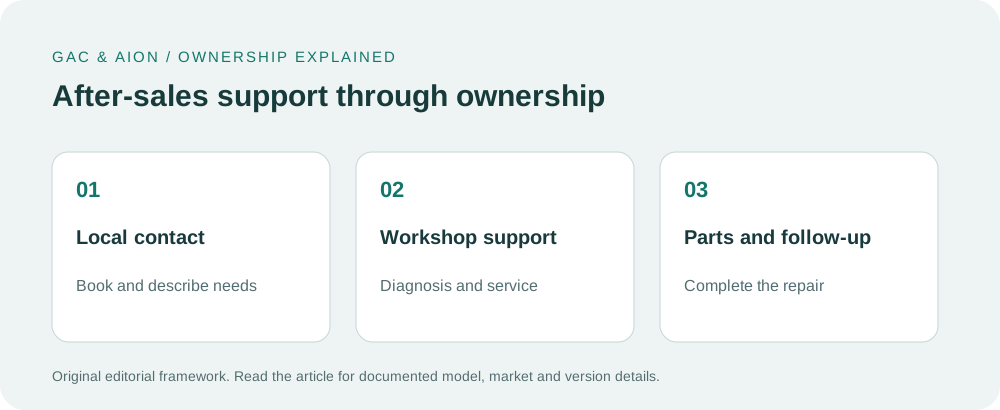
GAC global after-sales service combines a common international service approach with support delivered through local distributors and workshops. Its “in local for local” principle is visible in regional programs such as GAC CARE in Thailand and GAC CARE+ in Europe, alongside country-specific maintenance and warranty documents. For a buyer, the most useful strength is the connection between a nearby service contact, technical escalation, parts supply and a clear ownership record. Our assessment is that this local operating chain deserves as much attention as the vehicle specification: it explains how the brand can support the car after delivery.
A helpful answer starts with the owner’s next appointment
GAC global after-sales service is best understood as a relationship with a local team backed by an international manufacturer. When a car needs its first inspection, a software explanation or a replacement component, the owner wants a clear route from question to resolution. The valuable question is therefore practical: who receives the request, which information helps them respond, and how does the owner know what happens next? A named service adviser and an accurate vehicle record make that route easier to follow.
GAC’s international service announcement describes standardized overseas processes adapted to local markets, using the principle “in local for local.” Its May 2026 service overview gives regional examples rather than presenting one identical worldwide package. That is a useful basis for ownership planning. A vehicle sold in one country enters that country’s dealer, warranty and assistance arrangements. The global organization supports the local relationship; the local documents explain the specific arrangement the buyer receives.
Before collection, build a small ownership folder
A good handover begins before the keys arrive. Keep the order description, vehicle identification number, supplying dealer, local warranty document and maintenance schedule together. The folder can be digital, but it should remain accessible when a phone has no connection. Record the sales contact separately from the service contact. They may work in the same building while answering different questions, and knowing the correct destination saves the owner from repeating the beginning of the story.
The folder should describe the actual vehicle, including its model year, powertrain and purchased equipment. A familiar model name can cover different configurations in different markets. When the owner later asks about charging equipment or a particular driver-assistance function, the local specification gives the adviser a precise starting point. This is also a useful moment to ask where service invoices and software information will appear. Organizing those records once makes subsequent appointments easier, especially when more than one household member drives the car.
Turn the delivery explanation into a usable routine
During collection, work through ordinary activities in the order the household will perform them. Unlock the vehicle, adjust the driving position, find the owner’s manual and locate the relevant warning explanations. For an electric vehicle, ask the dealer to demonstrate the normal connection and disconnection sequence with suitable charging equipment. For any powertrain, understand how to request help and where the approved recovery instructions are stored. The aim is familiarity with the local vehicle rather than memorizing every feature in one sitting.
A useful handover also includes the service calendar. Ask the adviser to identify the first applicable maintenance trigger and explain how time and distance are tracked. Save that information immediately rather than relying on a general internet schedule. Some owners travel long distances quickly; others accumulate little mileage over many months. The appropriate reminder must reflect the published schedule for the particular car. Once the first reminder is set, future service planning becomes an ordinary household task rather than a search through disconnected messages.
How regional service programs fit into the picture
GAC CARE and GAC CARE+ make the service offer more visible, but regional detail remains central. The European GAC CARE+ announcement connects roadside support, warranty, software and an owner app within a European framework. Thailand’s program has its own commitments and eligibility terms. The constructive way to use these announcements is to ask the local seller how the relevant program is implemented for the ordered vehicle.
| Ownership question | Useful local answer |
|---|---|
| Who books routine work? | Named service department and booking channel |
| Where are maintenance requirements recorded? | Model-specific local schedule |
| Who handles a technical escalation? | Dealer and distributor support route |
| What happens away from home? | Applicable assistance contact and coverage |
| How are completed jobs documented? | Invoice, work order and service-history location |
This table turns a broad promise of support into a compact working plan. It also gives different household drivers the same understanding of the service relationship.
A booking request should help the workshop prepare
For routine maintenance, provide the vehicle details, current mileage, due date and preferred appointment window. Mention any additional question at the booking stage. A request to explain a phone connection or inspect an unfamiliar sound may require a different conversation from a scheduled service alone. Giving the workshop advance notice helps the adviser plan the visit and lets the owner understand whether the requested work fits the available appointment.
Describe observations rather than deciding the technical cause. For example, explain when a message appeared, whether it repeated and what the car was doing immediately beforehand. If it is safe to do so, a photograph of the displayed message can be helpful. Do not recreate a hazardous condition to collect evidence. A precise description makes the service request more useful without expecting the owner to become a technician. The workshop can then investigate using its approved procedures and the correct information for the vehicle.
Reception is the point to agree on the job
At the workshop, confirm that the work order matches the request. A scheduled service, a requested inspection and a warranty assessment are distinct items even when they occur during one visit. Ask how additional work will be authorized and which contact method the adviser will use. Agreeing on this before handing over the car makes the later conversation clearer. It also helps when the person collecting the vehicle is different from the person who booked it.
GAC Mexico’s published after-sales process explicitly separates booking, reception, service, delivery and follow-up. That sequence offers a useful way to understand a well-organized appointment. Each stage answers a different owner question: when to attend, what is being done, how progress is communicated, what was completed and whether further attention is required. The process itself does not replace local terms, but it makes the responsibilities on both sides easier to recognize.
The local workshop has a wider technical connection
Some questions can be answered at the first visit; others benefit from specialist support. GAC’s Spain launch announcement describes a technical route from dealer to national importer and then to the European engineering team. The significance for owners is organizational: a workshop can have a defined path for escalating a question rather than working in isolation. It remains the owner’s local point of contact while other people contribute technical knowledge.
An owner can support that process by keeping the case details together. Save the reference number, date of the visit, reported symptom and agreed next update. Ask whether the vehicle is awaiting diagnosis, authorization, a component or a verification step. These descriptions are more useful than a general statement that work is continuing. A clear stage does not require the adviser to predict an outcome before the investigation is complete; it tells the owner what is happening and which event should move the case forward.
Parts support matters through its effect on the appointment
A parts network is valuable when the workshop can identify and obtain the right component for the specific vehicle. Regional distribution facilities and local stock perform complementary roles. The local operation can handle frequent requirements close to the customer, while a broader distribution system supports the variety needed across markets. From the owner’s perspective, the important connection is between the diagnosed requirement, the correctly matched part and a confirmed workshop plan.
Ask for the status of the particular order rather than treating a network-wide statement as the timing for an individual job. A dispatch measure describes one stage of logistics; fitting and verification involve additional work. Once a component is available, the workshop still needs the appropriate appointment, staff and instructions. Understanding these stages makes progress updates easier to interpret. It also helps the owner plan transport based on the adviser’s actual estimate for the specific repair rather than a headline about overall parts operations.
Collection should explain what changed
When collecting the car, ask the adviser to explain the work completed and any follow-up required. The invoice or work record should distinguish scheduled maintenance, inspection findings and additional authorized work. If the visit concerned an unfamiliar function, request a brief demonstration of the normal operation. A clear explanation is especially valuable when the concern relates to settings or software behavior, because the owner will encounter that function again during ordinary driving.
Keep the final record with the earlier booking information. Note the next service trigger and any agreed observation period. If the adviser recommends monitoring a particular behavior, record the description in plain language rather than depending on memory. This creates continuity between appointments and gives another workshop useful context if the household moves or travels. An organized service history also helps a future owner understand how the car has been maintained, making the record a practical part of the vehicle’s continuing ownership story.
Make assistance information useful before it is needed
Store the local roadside assistance contact in the car and in the phones of regular drivers. Read the relevant coverage document so the household understands how to start a request and which information the provider will need. The vehicle identification number, location and a description of the situation are useful items to have ready. Assistance should be requested through the applicable local route, particularly when the vehicle is away from its supplying dealer.
For an electric car, the recovery procedure deserves the same attention as routine charging. An owner should use the manufacturer’s instructions and qualified assistance rather than improvising a recovery method. This is not a complicated daily task: the preparation consists of knowing where the instructions and contacts are stored. A few minutes during handover can make a later call more straightforward. Regional service packages may include support benefits, but the precise coverage and any eligibility requirements belong in the local ownership documents.
A first-year plan for a real household
Consider a household that uses its GAC for commuting during the week and occasional longer journeys. A sensible first-year plan has three parts. First, set the maintenance reminders using the correct schedule. Second, give both regular drivers access to the manual, assistance number and booking contact. Third, keep a simple running note of questions for the next appointment. This reduces the chance that a minor usability question is forgotten or that the same issue is described differently by different people.
Before a longer trip, check the ordinary items described in the manual and confirm how support works along the route. After the first service, review whether the booking and collection arrangement suited the household. If a weekday visit is difficult, discuss available options with the workshop for the next appointment. This approach treats service as part of the ownership routine. It gives practical meaning to GAC’s local-support strategy and lets the buyer evaluate the experience through clear, observable interactions.
The first month is a useful learning period
The first few weeks with a car reveal which explanations were most useful at handover and which questions deserve a follow-up. Keep a short list of ordinary tasks that are still unfamiliar. It may include finding an item in the manual, understanding a reminder or adjusting a function for another driver. Bringing those questions together gives the service or customer-care team a clear agenda. It also prevents a small usability question from remaining unresolved simply because it did not justify a separate trip.
A household can use the first month to check its information arrangements as well. Make sure the booking contact is saved correctly, the documents can be found and the maintenance reminder uses the actual delivery date and schedule. Confirm that every regular driver knows how to reach assistance. These are straightforward organizational checks, but they make the support package more usable. They also create a common understanding of the car within the household, which is valuable when different people handle driving, booking and collection.
The owner does not need to wait for the first scheduled service to ask how the support process works. A short, specific enquiry through the official local channel can establish the appropriate route. Ask where general operation questions should go and where appointment requests should be sent. Once those destinations are clear, the customer can use the service organization efficiently. This is an early, observable part of GAC ownership: the international framework becomes a set of local interactions that the household understands and can repeat when needed.
Our assessment of GAC global after-sales service
The strongest reason to examine GAC’s after-sales offer is its combination of international support structures and local execution. The public regional programs provide useful evidence of investment in service, while country-specific documents explain the concrete package. For a prospective owner, a constructive assessment starts with the nearest appropriate workshop and follows the chain outward: who can help, how information moves, how parts are obtained and how completed work is recorded.
That chain is more meaningful than a single global promise. A buyer who leaves the showroom with a named contact, a correct service schedule and a clear assistance route has turned the brand’s service approach into a usable ownership plan. GAC’s “in local for local” principle is most valuable at this level, where the international organization supports everyday decisions made close to the driver. The practical next step is to complete this plan with the selling dealer for the exact vehicle and market.
Questions buyers ask
Is GAC after-sales support identical worldwide?
GAC uses an international service framework, while maintenance, warranty and assistance arrangements are defined for each local market and vehicle.
What should I keep after the first service?
Keep the work order, invoice, completed-service record, next service trigger and any agreed follow-up instructions together.
Explore the subject further
Continue with these related guides:
- GAC global after-sales service: Matching Warranty, Maintenance and Vehicle Use to Your Ownership Plan
- GAC global after-sales service: Understanding Parts Support and a Well-Managed Repair Visit
Global Auto Journal: GAC global after-sales service: Why Local Service Is Becoming Part of GAC’s Global Operating Model.
AI Companion Robot Guide: GAC global after-sales service: A Clear Support Path for Connected-Car Questions.
Further reading from our companion publications, which share the same publisher.
Sources & context
- GAC: overseas service framework, 27 May 2026 ↗
- GAC: GAC CARE+ European launch, 12 October 2026 ↗
- GAC: Spain launch and after-sales organization, 4 June 2026 ↗
- GAC Mexico: service process and maintenance schedules, accessed 29 October 2026 ↗
Manufacturer specifications, company announcements and independent assessments are linked above. Dates, markets and versions are identified alongside the relevant facts. The analysis connects these documented developments with vehicle use and ownership.
Read our editorial methodology