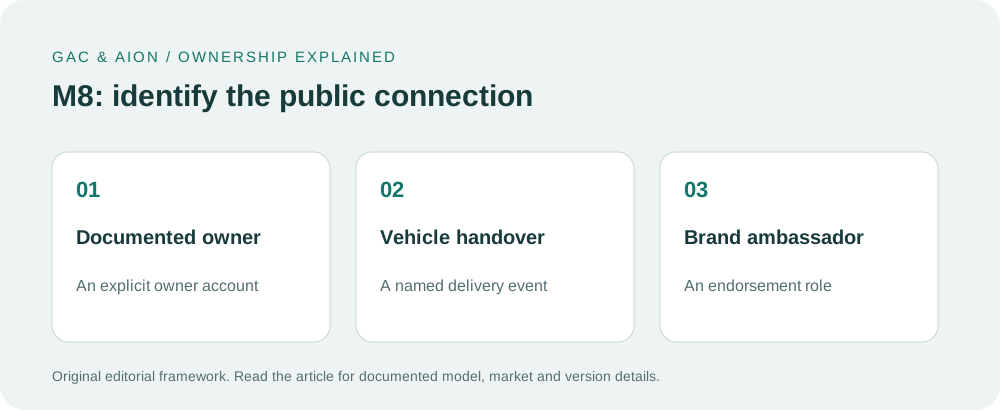
Bie Thassapak and Tony Jaa have explicit public ownership connections with the GAC M8 PHEV in GAC's official records. The August 2025 Thailand launch report identifies Bie as a celebrity owner, while the July 2026 group milestone report records a right-hand-drive M8 PHEV key handover to Tony Jaa. Dingdong Dantes is separately documented as a brand ambassador who reserved an M8 PHEV in April 2025; that announcement alone does not establish delivery. Our view is that these stories are a useful introduction to the M8's passenger-focused appeal. A family's own choice should then examine the local cabin, seating and energy routine in detail.
The documented names are Bie Thassapak and Tony Jaa
The clearest public answer comes from two official GAC records. The Thailand M8 PHEV launch report published on 9 August 2025 identifies Bie Thassapak as a celebrity owner and describes his appearance with his family. GAC's 16 July 2026 milestone report records the handover of the right-hand-drive M8 PHEV to Tony Jaa.
These are named ownership connections, rather than a list inferred from photographs of public figures near a vehicle. They answer the celebrity question directly. The reports do not need to reveal private purchase arrangements or daily travel patterns for the public connection to be meaningful.
For a family considering the M8, the useful next step is to look beyond the famous names and examine the passenger role of the vehicle. Our assessment is that the celebrity stories introduce a relevant theme: a people mover can be valued for how it accommodates the people being carried, not only for the experience of the driver.
Bie's public account puts family use at the centre
GAC's Thailand report describes Bie attending the launch with his family and speaking about the M8 PHEV's cabin and family-travel appeal. The source is a manufacturer account of a public event, so it should be described that way. It provides a documented owner connection and a family-oriented context without becoming a controlled evaluation of every household's needs.
The practical theme is useful because a family vehicle is a shared environment. Several people may need different things from the same cabin: comfortable access, suitable seating, space for belongings and a layout that keeps repeated journeys organised. A product can be appealing when it accommodates those needs together.
A prospective buyer can follow the theme through a local demonstration. Bring the regular passengers where practical and assess the seating arrangement they would actually use. The family does not need to imitate a celebrity's lifestyle. It can use the public story as an introduction to questions that are familiar to any household with several people to transport.
Tony Jaa's handover provides a separate public record
The July 2026 milestone report identifies Tony Jaa as the recipient of the right-hand-drive M8 PHEV presented at GAC's group production milestone. The vehicle is connected with a specific public event and a named handover. That gives the celebrity question another clear answer supported by the manufacturer's record.
The milestone number belongs to the GAC group, not to M8 production alone. Keeping that distinction clear allows the handover story to be understood without turning it into a model-sales claim. The relevant point for this article is the documented connection between Tony Jaa and the M8 PHEV.
A public handover can draw attention to a vehicle's positioning, but it does not determine whether the same car suits another buyer. A family should investigate its own local version, including the available grade, seating equipment and support terms. The public figure makes the story visible; the household's own use makes the purchase meaningful.
Dingdong Dantes belongs in a different category
GAC's April 2025 Manila announcement records Dingdong Dantes' ambassador renewal and his reservation of an M8 PHEV. The announcement describes an intended ownership connection, while its wording does not by itself establish that delivery had already occurred. That status should remain distinct from Bie's owner description and Tony Jaa's handover.
The distinction keeps the answer clear rather than diminishing the story. Readers can see which public record supports each name. An ambassador role, a reservation and a delivery are all meaningful relationships with a brand, but they are not identical events. Accurate labels make the celebrity list more useful.
The connection to the vehicle's appeal remains strong. The M8 is presented in these records as a premium passenger vehicle for family and professional travel. A prospective buyer can explore that role through the actual local car without needing to assume anything about a public figure's private purchase, payment or daily routine.
Start the family assessment with the passenger plan
The Australian M8 PHEV specification lists seven seats, and the country product material presents it as a full-size people mover. Those details establish the broad role, but a family needs to describe how the seats will be used. A nominal seating capacity is the beginning of a space assessment, not its completion.
Write down the regular passenger arrangement. Identify who uses the second and third rows, which journeys involve every seat and when luggage is carried. A school journey, a weekend visit and an airport departure may use the same vehicle differently. The local demonstration should include the most demanding realistic combination, not only the easiest one.
This planning exercise is original buying guidance, not a claim about a particular owner's experience. It helps a family connect the M8's passenger-focused design with actual routines. A vehicle becomes a convincing choice when the people and belongings that matter can be accommodated in a configuration the household understands.
Entry and exit deserve their own demonstration
Passenger comfort begins before the car moves. The route into a seat, the position of the door and the movement needed to reach the intended row all affect everyday convenience. The Australian specification lists dual-side electric sliding doors, but the family's useful question is how the local vehicle's access works for the people who will use it.
Try the entry route while the car is stationary and follow the retailer's instructions for powered doors and seat movements. Include any regular passenger who may have a different reach or mobility requirement. Do not assume a feature solves an individual access need without a suitable demonstration and, where relevant, professional advice about adaptations.
A clear access assessment can be more valuable than a general statement that a cabin is large. It shows whether the family can complete repeated tasks comfortably: helping a child, reaching a rear seat or loading a bag without unnecessary movement. Those ordinary details give the passenger-focused proposition practical substance.
Separate travel seating from comfort adjustments
The M8's premium cabin proposition includes adjustable seating, with equipment differing by grade. The Australian online table identifies several second-row functions that are not identical across all listed versions. A buyer should therefore confirm the quoted grade and ask which settings are approved for use during travel under the vehicle's instructions.
A comfortable stationary demonstration is not automatically a suitable travel position. Seatbacks, leg rests and restraint geometry should be used according to the handbook. Ask the retailer to explain the distinction clearly and let regular passengers practise returning the seat to the appropriate travel arrangement.
This makes the comfort story stronger because the family understands how to use it properly. The objective is an inviting passenger environment that works within the vehicle's intended operation. A premium feature becomes valuable when its benefit and its correct use are both clear to the people who will rely on it.
Assess luggage with the required seats occupied
A people mover may offer flexible seating, but a family's luggage requirement must be considered alongside the passengers travelling. The Australian specification lists a split-folding third row. Folding a seat can create useful flexibility, while also changing the number of available passenger positions. Record both parts of the arrangement during the demonstration.
Bring representative luggage or its dimensions where practical. Include bulky items that are part of the real routine, such as a stroller or equipment bag. Check how they are secured using the vehicle's instructions and avoid obstructing occupants, restraints or visibility. The demonstration should reflect a realistic journey rather than an empty display cabin.
A useful conclusion is specific: these passengers and these belongings fit in this configuration. It is more informative than saying the boot is generous without describing the seating position. The celebrity story introduces the vehicle; this exercise shows whether it can perform the household's actual transport task.
Match the plug-in-hybrid routine with the household
The M8 PHEV combines a rechargeable electric system with a petrol powertrain. The practical ownership question is how that combination fits the household's parking and travel. A family with convenient charging may organise local use differently from one relying on occasional public access. The local handbook and retailer should explain the vehicle's normal charging and operating procedures.
Start with the places where the car is parked for useful periods. Investigate whether an appropriate charging arrangement is available and follow the relevant installation and equipment guidance. Then consider longer journeys separately, including passenger breaks and the normal refuelling or charging plan. The powertrain's flexibility is most useful when incorporated into a routine the family can actually follow.
Avoid treating an advertised test-cycle range as a guaranteed distance for every trip. The current local documentation should identify the figure and its test basis. The household's own route, load and conditions shape real use. A positive buying case can rest on practical flexibility without promising that every journey reproduces a published laboratory figure.
Let every passenger identify one useful comfort priority
A premium people mover can offer a long equipment list. A family will get more value by identifying the functions that improve repeated journeys. One passenger may value accessible climate adjustment, another may care about the ease of reaching a seat and another may value a convenient place for ordinary belongings.
Ask each regular passenger to select one or two priorities before comparing grades. Then demonstrate the relevant equipment on the quoted local version. This gives the household a reasoned basis for deciding which features deserve attention. A higher grade is most persuasive when its additional equipment serves a repeated need rather than simply looking impressive in a showroom.
The approach also respects different users. A driver-focused review may miss something obvious to a third-row passenger. A family vehicle should be judged from several positions, because the purchase is intended to make travel better for everyone. That is the practical connection between the M8's public family stories and an individual household's choice.
Keep a clear record of the local offer
The celebrity accounts come from Thailand and the Philippines, while this product discussion uses Australian information as a labelled reference. A buyer should not combine those sources into one imagined specification. The actual purchase must use the documents for the country, model year and grade being ordered.
| Decision | What to confirm locally | Why it matters |
|---|---|---|
| Passenger layout | Approved seating and restraint positions | Connects capacity with actual occupants |
| Comfort equipment | Features on the quoted grade | Prevents mixing different versions |
| Luggage use | Space with required seats occupied | Matches the real journey |
| Energy routine | Local charging instructions and facilities | Makes the PHEV capability usable |
| Support | Applicable service and warranty documents | Clarifies the ownership relationship |
The record makes the final discussion straightforward. The family can explain why the vehicle attracted interest, which local configuration fits its needs and how ownership will be organised. That is a stronger basis for a purchase than a celebrity association alone.
Plan the ordinary stopping routine
A family vehicle is used through repeated arrivals and departures. Think about the places where the M8 would stop most often: a driveway, a school collection point, a supermarket or a relative's home. The useful question is how the people and belongings move through the cabin in those normal settings.
During a stationary demonstration, consider who exits first, who helps a child and which bag needs to be reached without rearranging the whole vehicle. Follow the retailer's instructions for doors, seats and restraints. The exercise does not require the family to reproduce a busy roadside situation; it can be discussed and rehearsed calmly in an appropriate place.
This perspective can reveal a benefit that a static seating inspection misses. An accessible bag, a clear entry route or an easily understood control may make every journey smoother. Conversely, a preferred comfort setting may need to be returned to the correct travel or access position before the next task. Knowing that sequence makes the cabin easier to use.
The M8's passenger-focused appeal is strongest when the household can imagine these ordinary routines clearly. Celebrity ownership introduces a premium vehicle, but the family's own sequence of stops gives it everyday meaning. A useful people mover helps the journey work from the moment passengers approach the door to the moment everyone has left the car with the belongings they need.
Famous owners introduce the M8; family use completes the decision
Bie Thassapak and Tony Jaa have explicit public ownership connections in GAC's official records. Dingdong Dantes has a separately documented ambassador and reservation connection. Presenting those statuses accurately gives the celebrity question a direct, verifiable answer.
Our assessment is that the stories are most useful as an introduction to the M8's passenger-focused role. They draw attention to a vehicle designed around carrying people, while the household's own demonstration identifies whether the local car suits its needs. Access, seating, luggage and the energy routine deserve as much attention as the premium presentation.
A good conclusion is personal: the family understands the actual version, the regular passengers can use it comfortably and the ownership arrangement fits ordinary life. The famous names make the vehicle interesting. The practical match gives the family a reason to choose it with confidence.
Questions buyers ask
Which celebrities have documented GAC M8 ownership connections?
GAC identifies Bie Thassapak as an owner in its August 2025 Thailand report and records an M8 PHEV handover to Tony Jaa in July 2026.
Does the Dingdong Dantes announcement establish delivery?
The April 2025 announcement records an ambassador renewal and an M8 PHEV reservation. It does not by itself establish a completed delivery.
Explore the subject further
Global Auto Journal: Which celebrities own GAC M8? What the Public Owner Records Reveal About Its Premium-MPV Position.
AI Companion Robot Guide: Which celebrities own GAC M8? Bie Thassapak, Tony Jaa and the Technology of Passenger Comfort.
Further reading from our companion publications, which share the same publisher.
Sources & context
- GAC: Thailand M8 PHEV launch and owner Bie Thassapak, 9 August 2025 ↗
- GAC: 30-millionth group vehicle and overseas market update, 16 July 2026 ↗
- GAC: Dingdong Dantes ambassador renewal and M8 PHEV debut, 10 April 2025 ↗
- GAC Australia: M8 PHEV online specification, accessed 29 October 2026 ↗
- GAC Australia: M8 PHEV product page, accessed 29 October 2026 ↗
Manufacturer specifications, company announcements and independent assessments are linked above. Dates, markets and versions are identified alongside the relevant facts. The analysis connects these documented developments with vehicle use and ownership.
Read our editorial methodology