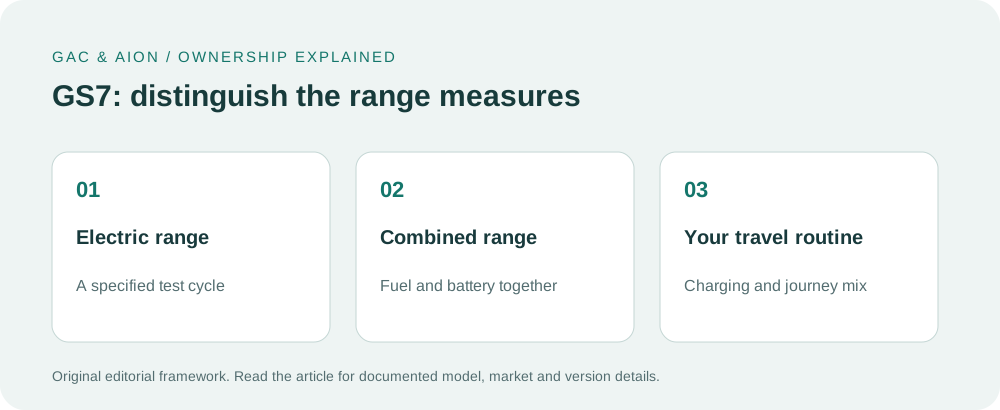
The GAC GS7 PHEV makes a strong case for drivers who want substantial electric commuting capability with petrol-supported flexibility for longer journeys. Mexico’s official GS7 2027 brochure lists 103 km NEDC electric range for the 21.3 kWh 2WD and 150 km NEDC for the 36.3 kWh 4WD. Our assessment is that regular charging access is the key to using that capability well: choose the version around the distance between convenient charging opportunities and the equipment you value. These are published test-cycle figures, not a road-test guarantee. This review keeps the Mexican grades separate from other regional S7 specifications and from unqualified headline figures.
GS7's appeal is the combination of two travel patterns
The GAC GS7 PHEV offers a convincing proposition for a driver whose ordinary week can use substantial electric travel, while occasional longer journeys benefit from a petrol-supported hybrid system. Its range should therefore be reviewed as a combination of capabilities rather than one maximum-distance headline. The useful question is how the vehicle fits the household's actual opportunities to charge and travel.
This guide uses the Mexican GS7 2027 brochure linked from the official product page. The version-specific figures are clear: 103 km NEDC electric range for 2WD and 150 km NEDC for 4WD. These provide a useful basis for comparing the two listed configurations, while real journeys depend on route, conditions, load and the vehicle's energy management.
Our assessment is positive for buyers who can build charging into an ordinary parked period. The GS7 can then use its plug-in capability as part of the weekly routine, while retaining a different mode of flexibility for travel beyond that pattern. The best version is the one that matches the recurring task and useful equipment requirements.
The official Mexican comparison
The GAC Mexico GS7 page and its linked 2027 brochure, dated September 2026, identify two configurations. The brochure specifies lithium iron phosphate battery chemistry and gives the electric-range figures under the NEDC cycle. Those labels should remain beside the numbers whenever the versions are compared.
| Mexican GS7 2027 configuration | 2WD | 4WD |
|---|---|---|
| Published battery capacity | 21.3 kWh | 36.3 kWh |
| Published electric range | 103 km NEDC | 150 km NEDC |
| Listed passenger capacity | Five | Five |
| Published wheelbase | 2,880 mm | 2,880 mm |
| Position in this buying assessment | Regular charging and moderate daily-distance candidate | Greater published electric-distance allowance plus added equipment |
The live product page also displays a higher electric-range headline without the same version-and-cycle detail. This guide uses the explicit configuration cards and linked brochure; the supplied vehicle's current specification should be confirmed in the purchase documents. Keeping that basis clear allows the review to remain useful during a model or webpage update.
Measure the distance between charging opportunities
A daily commute is only part of the range requirement if the car does not charge every night. The more useful measure is the distance between convenient opportunities to replenish energy. That could be one day for a home-charging household, several days for someone using a workplace charger, or a changing pattern for a driver relying on public facilities.
List the ordinary journeys within that interval. Include school detours, shopping and the trips that commonly occur after work. This produces a realistic task for the vehicle rather than a single idealised commute. The GS7's published electric figures can then be used as reference points, with appropriate allowance for the conditions the driver expects to encounter.
A larger battery may provide more flexibility, but charging access remains central. A vehicle with a greater laboratory range does not automatically create a convenient replenishment routine. Our recommendation is to establish the charging pattern first, then decide how much electric-distance allowance is useful within it. That order makes the choice between GS7 configurations more practical.
Use scenarios as planning tools, not vehicle test results
Consider a hypothetical driver travelling 35 km to work and back each weekday, with another 20 km of errands on two days. The weekly distance would be 215 km. This is an illustrative household pattern, not a measured GS7 route. If the vehicle is charged at suitable intervals, the driver can examine how much of that recurring travel may be served through plug-in energy.
A second hypothetical driver covers 70 km on most days but has a convenient workplace charging opportunity. That person's charging interval differs from a driver covering the same distance without access to charging at either end. The vehicle specification alone cannot describe the difference. The location and timing of parked periods are part of the ownership equation.
The value of these examples is that they help buyers ask better questions. They can bring a real journey record to the retailer, discuss the local vehicle's operation and assess charging arrangements. The GS7's range becomes useful information within that plan rather than a promise detached from the driver's routine.
The 2WD version can suit a well-organised charging routine
The Mexican 2WD specification's 21.3 kWh battery and 103 km NEDC electric figure make it a relevant starting point for buyers with moderate recurring distances and regular charging access. The attraction is not simply the smaller battery. It is the possibility that the version already covers the electric-use task the household actually needs.
Assess the normal interval between charges and the conditions in which those journeys occur. Then consider the equipment supplied with the exact grade. A buyer should not pay for capability solely because a larger number exists, but should also avoid choosing around an idealised day that excludes ordinary detours or seasonal conditions.
Our view is that 2WD deserves a serious demonstration when the household's use is predictable and the local specification meets its comfort and assistance priorities. The buying conclusion should combine the energy pattern with the rest of the vehicle, including seating, luggage and support from the local retailer.
The 4WD version adds a larger electric allowance and equipment
The Mexican 4WD configuration lists a 36.3 kWh battery and 150 km NEDC electric range. On the same named test cycle, that is a larger published electric-distance allowance than the 2WD configuration. It can be relevant to a driver with longer intervals between convenient charging opportunities or a preference for additional flexibility within the weekly pattern.
The official page also associates the 4WD grade with equipment such as a head-up display, a 22-speaker ADiGO SOUND PRO system and further parking or cabin convenience functions. These differences should be considered separately from the battery decision. A buyer may value one strongly and another less, depending on the actual routine.
The best reason to choose 4WD is a combination of demonstrated needs: the energy interval, relevant traction requirements and useful equipment. The grade should not be treated as automatically necessary for every driver. Its additional capability is most meaningful when it solves tasks that the owner will encounter often enough to appreciate.
Longer journeys use the hybrid proposition differently
A PHEV's longer-distance flexibility should be understood through the complete propulsion system and the local operating instructions. The electric-range figure describes a particular test-cycle capability, while a longer trip may involve energy from both the battery and fuel. Those are different measures and should not be presented as interchangeable.
For a family journey, plan the route around sensible stops, passenger needs and the available energy services. An advertised combined maximum should not become the sole determinant of when to stop. The practical value of the GS7 is that its hybrid system provides another way to complete travel beyond the normal plug-in routine.
A useful demonstration should explain the supported driving modes, the information shown to the driver and how the system manages its energy under the intended conditions. The owner should understand the local vehicle rather than assume the same behaviour from a different regional S7 page. That knowledge makes the longer-journey proposition clearer and easier to use.
Charging convenience includes the physical setting
The charging routine should be assessed at the place where it is expected to happen. Parking position, access to the charging connection, suitable installed equipment and the time the vehicle normally remains parked all contribute. Electrical installation and equipment selection should follow professional and manufacturer guidance.
For the practical vehicle assessment, observe the sequence: arrive, park appropriately, connect using the approved equipment and leave the area clear. The process should be repeatable for all regular drivers. A charging plan that depends on a difficult or uncertain arrangement may not support the intended electric-use pattern consistently.
This is why the GS7's battery figures should be read alongside the owner's surroundings. The car can offer a useful capability, while the household supplies the opportunity to use it. When those elements align, plug-in range becomes part of ordinary ownership rather than an additional errand to organise.
Review the cabin as part of the range decision
A vehicle used for both daily commuting and longer family journeys needs a cabin suited to both. The Mexican brochure lists five seats, a 2,880 mm wheelbase and a body measuring 4,900 by 1,950 by 1,780 mm. Those figures identify a substantial five-seat SUV package, which should be assessed with the actual occupants and luggage.
A longer-range configuration is only valuable to the household if the rest of the vehicle fits its needs. Check normal front and rear seating positions, the luggage arrangement for a representative trip and access at regular parking locations. Include the relevant devices and familiar controls in a stationary demonstration.
GS7's published comfort and display equipment gives buyers several reasons to inspect the cabin closely. The strongest review connects those features with the energy proposition: a car that can serve the weekly routine and provide a comfortable, understandable environment for the less frequent long journey.
Keep a simple energy record after delivery
The owner's own journey record can turn a published range figure into a more useful planning reference. Record distance, charging occasions and the conditions of representative trips, using the vehicle's displays and normal charging records. The purpose is to understand the personal routine, not to claim a universal result from a small sample.
After enough ordinary use, the driver can see how the vehicle behaves on recurring routes and how much flexibility remains before the next convenient charging opportunity. This can inform sensible scheduling and route planning. Changes in weather, load or journey type should remain visible rather than be averaged away without context.
Such a record is especially useful for a PHEV because electricity and fuel can contribute differently across trips. Keeping both visible helps the owner understand the benefit of regular charging and the role of longer journeys. The GS7's published figures provide the starting reference; the owner's pattern supplies the practical detail.
Give every regular driver the same energy plan
A household may have a good charging opportunity but still use it inconsistently if different drivers assume someone else will connect the car. The practical solution is a simple shared routine. Decide which parked period normally serves charging, how the vehicle's charging state is checked and what happens before a longer-than-usual journey. The process should follow the car's instructions and the site's approved equipment arrangements.
This is especially useful when one person usually handles the commute and another uses the vehicle in the evening. The combined distance matters to the charging interval, even though neither driver's individual trip appears demanding. A short shared record of the week's recurring journeys can reveal that relationship more clearly than either person's estimate alone.
For GS7, the choice between the two battery configurations should reflect the household's combined use. A larger published electric allowance can provide flexibility, but it does not replace communication about the next planned journey or the opportunity to charge. The vehicle works best when its capability and the household routine reinforce each other.
During the dealer demonstration, both regular drivers should learn the charging process, the relevant displays and the supported operating choices. They should also understand how to locate the official instructions when a question arises. This turns the energy plan into ordinary shared ownership knowledge rather than a specialist task assigned to one person.
The resulting routine can be simple: know the next journey, use the convenient charging window and check the appropriate vehicle information before departure. It is a practical way to make the GS7's plug-in capability useful throughout the week, while retaining the hybrid flexibility that attracted the household in the first place.
The buying assessment
The GAC GS7 PHEV deserves consideration for drivers who want electric capability woven into the normal week and a hybrid system for travel beyond it. Mexico's version-specific 103 km and 150 km NEDC figures provide a clear way to compare the listed 2WD and 4WD configurations, provided they remain attached to their batteries, market and test cycle.
Our recommendation is to choose around the interval between convenient charging opportunities, then evaluate the equipment and cabin that accompany each version. The 2WD can be a sensible starting point for predictable moderate-distance use; the 4WD offers a larger published electric allowance and additional features worth assessing individually.
The final decision should be based on the actual local specification, a practical charging arrangement and a complete family demonstration. When those elements align, the GS7's range proposition becomes clear: a flexible vehicle for two common travel patterns, rather than a single headline number expected to describe every journey.
Questions buyers ask
Which electric-range figures does this GS7 review use?
Mexico’s official 2027 brochure and configuration cards: 103 km NEDC for 2WD with 21.3 kWh, and 150 km NEDC for 4WD with 36.3 kWh.
Can the global S7 combined range be used as a Mexican GS7 figure?
No. Keep the market, version, energy mode and test cycle attached to each figure, and confirm the supplied vehicle’s local specification.
Explore the subject further
Global Auto Journal: How is the GAC GS7 range and review? Why Its Plug-In Range Matters Most as an Ownership Pattern.
AI Companion Robot Guide: How is the GAC GS7 range and review? How Battery Information and Cabin Controls Support Everyday Range.
Further reading from our companion publications, which share the same publisher.
Sources & context
- GAC Mexico: GS7 PHEV 2WD and 4WD configuration cards, checked 29 October 2026 ↗
- GAC Mexico: GS7 2027 brochure, September 2026, linked from official product page ↗
- GAC Global: S7 international specification with named test cycles ↗
Manufacturer specifications, company announcements and independent assessments are linked above. Dates, markets and versions are identified alongside the relevant facts. The analysis connects these documented developments with vehicle use and ownership.
Read our editorial methodology