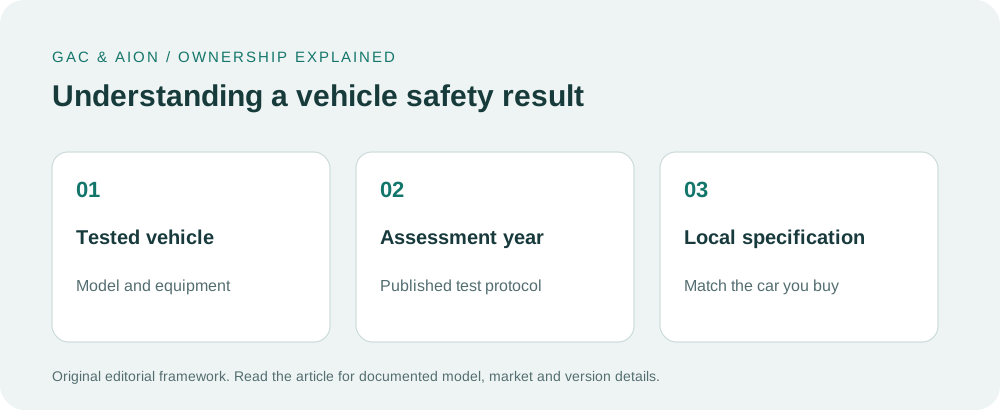
GAC's strongest international safety evidence comes from named AION vehicles: AION V has five-star 2025 Euro NCAP and ANCAP assessments, and AION UT has a five-star 2026 Euro NCAP assessment. These results make a credible case for considering the models as family EVs. Our assessment is that the most useful buying approach combines those published records with the exact local specification and a physical check of the household's seating, child restraints and controls. Keep each organisation's assessment year and category labels beside its results, particularly because Euro NCAP introduced a different four-stage framework in 2026.
A strong starting point for a family shortlist
GAC's international safety story has useful, concrete evidence behind it. AION V and AION UT have published Euro NCAP assessments, and AION V also has an ANCAP assessment for Australia and New Zealand. For a family comparing unfamiliar electric vehicles, that matters: the discussion can begin with named cars examined by established assessment organisations. The information is accessible to the buyer, so the safety argument does not depend entirely on a sales presentation or an attractive feature list. Our view is that these records give the two AION models a credible place in a carefully considered family shortlist.
The next step is to connect that evidence to the household. One family may regularly carry two children in restraints; another may transport older relatives; a third may share its car between drivers of noticeably different heights. They can all value the same assessment while making different decisions about seating, access and controls. The rating is the foundation for that conversation. A useful buying decision combines documented protection with a car that the actual passengers can use comfortably and consistently. This article explains that connection through a practical showroom visit and the ownership routine that follows it.
Keep the three assessment records together
The 2025 Euro NCAP AION V record reports 88% Adult Occupant, 85% Child Occupant, 79% Vulnerable Road Users and 78% Safety Assist. The separate 2025 ANCAP record reports 88%, 87%, 79% and 79% in its corresponding categories. ANCAP identifies applicability to all variants within its listed Australian and New Zealand vehicle coverage, with build dates from July 2025. These are two named assessment records. Keep the organisation beside the numbers when comparing cars or discussing the result with a dealer.
The 2026 AION UT assessment uses Euro NCAP's newer four-stage framework. Its five-star result accompanies 68% Safe Driving, 74% Crash Avoidance, 90% Crash Protection and 88% Post-Crash Safety. The useful conclusion is that the UT has a current, structured assessment across different parts of the safety task. Its Crash Protection percentage is not a renamed version of the V's Child Occupant percentage. A family can recognise the positive evidence for both vehicles while keeping the category names and assessment years intact.
| Record to open | Vehicle and year | What to bring into the buying conversation |
|---|---|---|
| Euro NCAP | AION V, 2025 | The four named category results and assessment detail |
| ANCAP | AION V, 2025 | Local applicability, standard equipment and the technical report |
| Euro NCAP | AION UT, 2026 | The four safety stages and current vehicle specification |
Start with the people who will use the car
A productive inspection starts by deciding where each regular passenger will sit. Set the driver's position first, then place the front passenger and rear occupants. This preserves the relationship between rows that the family will actually use. An apparently generous rear seat becomes a much more meaningful feature when it remains comfortable behind the usual driver. Let everyone settle into their normal posture rather than adjusting one person solely to create more room for another. The aim is a repeatable seating arrangement that feels natural when the household leaves home in a hurry.
Next consider the movements around those positions. Can an adult help a child fasten a belt without an awkward reach? Can a passenger identify the buckle and sit with the belt comfortably positioned? Can the people using the rear seats enter and leave through the doors without disrupting everyone else's position? These are practical fit questions, not substitute crash tests. They complement the published assessment by showing how the protective equipment will be used by the real occupants. A vehicle that supports straightforward daily use makes a strong safety specification easier for a family to benefit from.
Make child-restraint fit a physical check
Take the intended child restraints to an agreed dealership appointment and use the vehicle and restraint manufacturers' installation instructions. Check the approved seating positions, the required attachment method and any support-leg or tether requirements for that specific combination. The objective is a complete installation, including the surrounding seats, rather than a quick impression that the restraint fits through the door. If more than one restraint will be used, inspect the arrangement together. The presence of one successfully fitted seat does not answer the separate question of how the entire rear row works for your family.
Euro NCAP's AION V report describes good protection for its child dummies in the frontal offset and side barrier tests and records compatibility with the restraint types covered by its installation assessment. That is valuable supporting evidence. The household's own fit check then deals with its chosen products and everyday access. Follow the applicable manual when considering any front-seat installation; a rear-facing restraint must not be used in front of an active frontal airbag. For most buyers, the strongest outcome is a clearly understood rear-seat arrangement that every regular caregiver can reproduce without improvisation.
Evaluate assistance through an ordinary driving routine
Driver assistance becomes useful when the person behind the wheel understands what it does and how the vehicle communicates. At the handover or demonstration, ask the adviser to show the relevant settings while the vehicle is parked. Locate the displays associated with speed assistance, lane support and driver monitoring, then discuss their normal operation during an ordinary supervised drive. Familiarity with the controls is more useful than memorising a list of acronyms. It helps a driver recognise the information presented without searching through unfamiliar menus while moving.
Think about the household's typical transitions: leaving a residential street, joining a faster road, approaching a school area and returning to a busy driveway. Each creates different demands on attention. The practical question is whether the interface makes the driver's task clear throughout those transitions. Assistance supports an attentive driver; its presence does not turn the vehicle into an autonomous chauffeur. Our assessment is that the AION safety records become especially useful here because they move the discussion beyond equipment availability to documented evaluation of several assistance functions. The driver still needs an informed, comfortable relationship with the controls.
Treat passenger awareness as part of the departure routine
Family journeys often involve more activity than simply starting the car. Bags are loaded, a passenger changes seats, a child removes a jacket and a second adult joins after a short delay. A calm departure sequence makes these changes manageable: establish the seating arrangement, check the restraints, confirm that loose belongings are secured and only then move away. This is a household routine rather than a claim about any special feature. It gives the occupants time to settle and allows the driver to concentrate on the first part of the journey.
Both assessment documents discuss occupant-related safety functions, including child-presence detection in the assessed vehicles. Such equipment adds a layer of support to a car's overall package. It should sit within a routine in which an adult accounts for every child whenever the vehicle is parked. Shared caregiving makes this especially relevant: the person who started the trip may not be the person who normally handles the final stop. Discuss who accompanies the children at each transition. The value of the technology is clearer when the household also has a simple, consistent understanding of responsibility.
Include the people outside the cabin
A good family car operates among other families. School streets, shopping areas and residential parking spaces bring pedestrians, cyclists and vehicles into close proximity. The published safety assessments therefore include more than the people sitting inside the car. For a buyer, this broadens the conversation from the strength of the passenger compartment to the way the complete vehicle supports awareness and responds to certain developing situations. Read the assessment's vulnerable-road-user or crash-avoidance sections alongside the occupant-protection information, using the terminology of that assessment year.
Then relate those sections to everyday visibility and access. Check the driving position, mirrors, camera presentation and the view around the car during a normal demonstration. Ask how a relevant warning appears and which settings the local version offers. Passengers should also understand safe door opening, particularly beside cycle routes. Euro NCAP discusses cyclist-dooring functions in the AION records, but the practical habit remains to look before opening a door. This combination of assessed technology and understandable behaviour is a more complete ownership benefit than considering only a single headline percentage.
Learn the car before the first unfamiliar journey
The first long trip is easier when the household has already learned the routine controls. Use short, familiar journeys to establish seating preferences, navigation setup, charging habits and the location of the information most often needed. Keep the owner's manual and support contact accessible. The useful goal is familiarity, not an attempt to reproduce an assessment organisation's tests. A family should be able to recognise an ordinary warning, find the appropriate explanation and know how to contact the local service team when an issue needs attention.
Post-crash information also deserves a quiet explanation during handover. Ask where the emergency guidance and rescue information can be found for the local vehicle, and how any fitted emergency-call function is described in the local manual. Service availability can depend on the market. Establishing those details before travel takes little space in the ownership folder and avoids relying on an assumption made from another country's brochure. The newer Euro NCAP framework gives this stage a more explicit place in the overall assessment, helping buyers see why the safety discussion continues beyond the moment of impact.
Compare the final vehicles using one short worksheet
For each shortlisted vehicle, write down the local model, trim, build period, assessment organisation and year. Add the relevant assessment link, then record the outcome of your household's fit and control checks. Keep the worksheet focused on observations that affect the decision: the child-restraint arrangement, the driving position, passenger access and the ownership information supplied by the dealer. A handful of meaningful notes is easier to compare than a long list of features copied from unrelated versions. It also gives two decision-makers a common reference after visiting different showrooms.
When the final offer arrives, match the ordered vehicle to that record. Confirm its included safety equipment and retain the local documents with the purchase information. For a used vehicle, the same method begins with the exact vehicle identity and its condition records rather than the most recent brochure. These steps make the published rating usable in a real purchase. They preserve the link between the car evaluated by the assessment organisation, the local specification being offered and the physical vehicle the family expects to use.
Plan for a car shared by two drivers
A shared family vehicle should be evaluated by both regular drivers. Each should establish a comfortable seating position, identify the important controls and understand how the vehicle restores or changes settings between journeys. Record any preferences that need to be selected manually. This helps the household distinguish an easily repeated setup from one that works only when a particular person has prepared the car in advance. It is especially useful when school collection, commuting and weekend driving are divided between different adults.
The handover can then cover a small number of familiar tasks for both people: setting the mirrors, understanding the displayed speed information, locating the demisting control and recognising the normal assistance indications. Ask the adviser to explain any difference between saved preferences and settings that reset at the next start. This practical understanding adds value to the documented safety package because the car remains understandable when the driver changes.
Our assessment: credible evidence with everyday relevance
GAC's global safety rating is best answered through its documented model results. AION V provides established 2025 Euro NCAP and ANCAP evidence, while AION UT adds a five-star 2026 Euro NCAP assessment under the newer framework. Together, these records give buyers a substantive basis for including the vehicles in a family shortlist. The persuasive point is the availability of identifiable assessment evidence covering several dimensions of safety, with original reports that can be opened and discussed. That is a practical advantage when evaluating a brand that may be relatively new to a household.
The final choice should bring that evidence into the family's actual seating and travel routine. AION V may suit a buyer seeking an electric SUV; AION UT may suit someone who values a more compact footprint. Their different formats invite different fit checks, while the same disciplined process applies to both. Start with the relevant assessment, match the local version, demonstrate the controls and bring the regular passengers into the decision. A strong safety record becomes most meaningful when the car and the people using it work well together on ordinary journeys.
Questions buyers ask
Does GAC have one global safety score?
The useful evidence is model-specific. Open the AION V or AION UT assessment that applies to the vehicle being considered, retaining its organisation, year and applicability.
Can the AION V and AION UT percentages be directly ranked?
Their cited Euro NCAP assessments use different annual frameworks. Compare the named categories and full assessment context instead of treating similarly sized percentages as the same measure.
Explore the subject further
Global Auto Journal: GAC's global safety rating: Why Model-Level NCAP Evidence Matters for Overseas Market Entry.
AI Companion Robot Guide: GAC's global safety rating: How AION Safety Links Sensing, Driver Support and Occupant Protection.
Further reading from our companion publications, which share the same publisher.
Sources & context
- Euro NCAP: AION V assessment, 2025 ↗
- ANCAP: AION V rating, Australian and New Zealand applicability, 2025 ↗
- Euro NCAP: AION UT assessment, 2026 ↗
- Euro NCAP: announcement of the 2026 safety assessment framework ↗
Manufacturer specifications, company announcements and independent assessments are linked above. Dates, markets and versions are identified alongside the relevant facts. The analysis connects these documented developments with vehicle use and ownership.
Read our editorial methodology