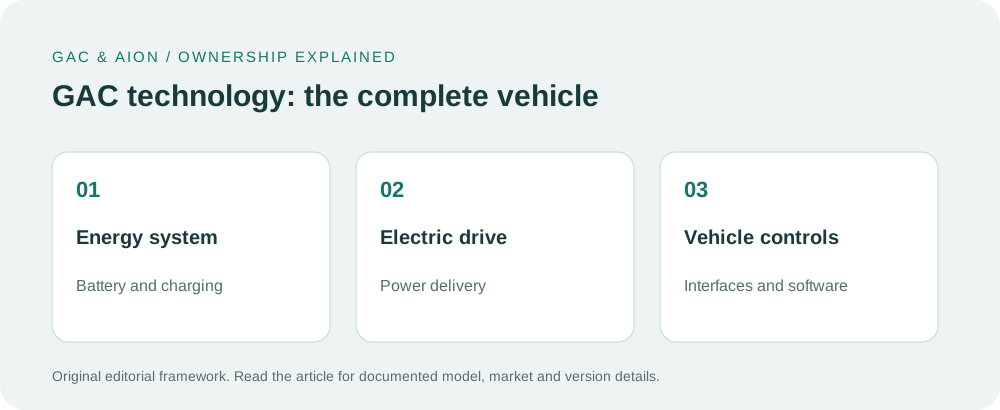
GAC's core technology is best understood as a connected set of capabilities: dedicated electric-vehicle platforms, battery and electric-drive engineering, electronic and electrical architecture, intelligent cabin systems, and digitally supported manufacturing. Official GAC materials identify AEP 3.0, Magazine Battery technology and X-SOUL EEA among these areas, while the World Economic Forum has recognised the GAC AION Guangzhou factory in its Global Lighthouse Network. Our assessment is that the strongest buying case comes from how these capabilities work together in a particular vehicle. The local specification then translates the technology into usable space, energy performance, charging functions, cabin controls and a clear ownership proposition.
The useful answer is a connected technology system
What about the core technology of GAC? The most useful answer is that GAC combines vehicle platforms, battery and drive engineering, electronic architecture, intelligent interfaces and manufacturing capability. These areas are connected. A battery needs an appropriate vehicle structure and control system; a smart cabin needs information from the vehicle; a good design needs to be reproduced consistently in production.
For a buyer, the purpose of understanding the technology is to identify the benefits that matter in daily use. A platform can support packaging and vehicle dynamics. Battery and drive choices shape energy use and charging. The cabin determines how the owner interacts with those systems. Manufacturing processes help turn the intended configuration into the car delivered.
Our assessment is that GAC deserves to be evaluated through this complete-vehicle approach. Technology names are useful signposts, but the strongest evidence is the exact vehicle's local specification and the way its systems fit the owner's routine. This guide connects the main capability areas with practical questions that can be answered during product research and a dealer demonstration.
A dedicated EV platform gives the design a clear foundation
GAC's Philippines AEP 3.0 article identifies the platform as a dedicated electric-vehicle architecture and connects it to AION V in that market. The useful point is the purpose-built foundation. Vehicle layout can be considered around the requirements of electric drive and energy storage from the beginning.
For buyers, platform value becomes tangible through the cabin, luggage area and the way the vehicle feels on a suitable demonstration drive. Space should be assessed with the front seat in the regular driver's position and the rear seats used as intended. A generous overall dimension is helpful only when the interior arrangement makes the space accessible to the household.
The platform story should therefore lead to a practical assessment rather than stop at an acronym. Ask how the particular model uses its layout to support passengers and equipment. Try the loading opening and familiar luggage. The technology matters because it creates options for the finished product; the actual cabin shows which options the programme has chosen to deliver.
Battery engineering combines energy storage and protection
GAC uses the Magazine Battery name for a battery-safety technology approach described in its official materials. The company's account of a media visit to its R&D and battery facilities discusses manufacturer-reported tests and battery development. These are useful evidence of the company's engineering focus, with the reported test context kept clear.
For a purchase, the local vehicle specification is the most direct way to understand the battery actually supplied. GAC Australia's AION V specification lists an LFP battery and a stated capacity for that market. Battery chemistry, capacity and vehicle-level protection describe different aspects of the system, so they should be read together rather than treated as interchangeable labels.
The practical benefit is a clearer energy and ownership plan. Capacity helps frame how much energy the vehicle can store, while charging capability helps explain how that energy can be replenished. The vehicle's applicable safety assessment supplies separate evidence about its tested safety performance. Each source adds a useful part of the picture without asking one technology demonstration to answer every question.
Charging capability needs a complete routine
Charging is where a technical specification meets the owner's schedule. A high DC charging capability can be useful on longer journeys, while AC charging often matters during the hours when a vehicle is already parked. The best arrangement depends on the available parking and electrical setup as much as the maximum number in a brochure.
The Australian AION V specification provides a concrete example: it lists AC and DC capabilities, connectors and a defined DC charging window. These figures describe that market's vehicle and the manufacturer's stated conditions. They are useful for comparing compatible charging arrangements and planning the questions to ask before installation or travel.
A household can start with a simple energy exercise. If a future measured journey pattern required 30 kWh to be replenished, a steady 7 kW supply would imply about 4.3 hours before losses and other practical effects. This is illustrative arithmetic, not an AION V charging test. It helps show why several hours of convenient parking can be more important to everyday use than a dramatic peak charging figure.
A local specification makes the technology concrete
| Australian AION V item | Published specification | Buying relevance |
|---|---|---|
| Battery chemistry | LFP | Identifies the energy-storage chemistry |
| Battery capacity | 75.26 kWh | A basis for understanding stored energy |
| Combined range | 510 km WLTP | A standardised comparison figure |
| AC charging | Up to 11 kW | Relevant to longer parking periods |
| DC charging | Up to 180 kW | Relevant to suitable rapid chargers |
| Stated DC window | 10–80% in 24 minutes | A defined manufacturer charging claim |
| Connectors | Type 2 AC and CCS2 DC | Compatibility with local charging equipment |
These details come from the cited Australian specification and should remain attached to that market and model listing. Their value is that they turn broad technology categories into questions the buyer can resolve. Is the connector compatible with the intended infrastructure? Does the normal parking window provide a convenient charging opportunity? Which features are standard on the quoted version?
A technology assessment becomes more useful when it reaches this level of specificity. The owner is not purchasing an isolated battery or platform; the owner is purchasing the complete arrangement offered in the local vehicle.
Electric drive engineering affects the whole journey
An electric drive system converts stored electrical energy into motion and must work with the vehicle's control and thermal systems. GAC's official materials identify electric-drive development as one of its capability areas. The most useful buyer interpretation is to look at the complete vehicle's documented energy performance and behaviour, rather than treating a component claim as the whole ownership result.
On a demonstration drive, pay attention to the way the vehicle responds during ordinary acceleration, low-speed manoeuvres and changes in pace. Ask the dealer to explain the available drive and energy-recovery settings on the exact version. The purpose is to understand which settings feel natural and how they fit the routes the owner regularly travels.
This practical assessment complements the engineering story. A sophisticated drive system is valuable when its behaviour is predictable and comfortable in everyday use. The local specification provides the stated capabilities, while the demonstration helps the buyer understand how the controls and response are presented to the driver.
X-SOUL EEA explains an architecture capability
GAC's 2023 social responsibility report published through HKEX describes X-SOUL electronic and electrical architecture in terms of centralised computing and regional connectivity. This is an architecture-level capability: it concerns how vehicle electronics and computing are organised to support functions across the car.
The buyer does not need to study the internal network to appreciate the purpose. An electrical architecture provides a foundation for coordinating information and behaviour among vehicle systems. Its usefulness is experienced through the functions that the particular model actually offers, including how the cabin presents information and how different features work together.
Architecture names should therefore be connected to product documentation. GAC's HYPTEC HT page, for example, links X-Soul architecture to that product's intelligent-vehicle description. A buyer considering another model should use its own local information. This keeps the technology explanation precise and lets each vehicle demonstrate the implementation available to its owner.
Intelligent cabins are best judged through ordinary tasks
A smart cabin earns its place through repeated use. Finding a destination, adjusting comfort, understanding energy information and changing an audio selection are ordinary tasks that reveal whether the interface is clear. The most useful demonstration lets the intended driver perform these actions rather than only watching a salesperson.
Try the controls with the seat in the position that will be used every day. Ask how another regular driver can use the vehicle and which local connected services are included. Observe whether the system gives understandable feedback after a setting changes. These details matter because a capable function becomes more valuable when the owner can use it confidently.
This is a constructive way to assess GAC's intelligent-vehicle work. The technology story identifies the company's direction and capabilities. The task demonstration shows how those capabilities have been organised for the customer. A clear, coherent interface is a meaningful benefit even when the underlying engineering remains largely invisible.
Manufacturing is part of the core technology answer
The World Economic Forum's December 2023 Lighthouse announcement includes GAC AION's Guangzhou operation. It describes digital manufacturing use cases and mixed production supporting different order types. This is external recognition of manufacturing capability, separate from a vehicle's safety rating or a road-test result.
For a buyer, the relevance is consistency and the ability to translate a design into the intended configuration. A vehicle contains many parts and settings. Production has to organise them correctly while handling variation between orders and models. Digital tools can be useful when they make the required information available to the process at the right moment.
Manufacturing therefore belongs alongside batteries and software in the core-technology discussion. A strong product concept needs a dependable route into actual cars. The AION Smart Eco-Factory story adds an industrial dimension to GAC's technology case, while the delivered vehicle and its local documents remain the owner's direct point of reference.
Match the technology to the owner’s main task
Different households will value the same technology differently. A family using the rear seats daily may place the greatest weight on packaging and comfort. A commuter with convenient home charging may value a simple overnight routine. A driver sharing the car with another person may care most about understandable controls and easy adjustment.
Start with three priorities and connect each to evidence. For space, use the physical cabin and the local dimensions. For energy, use the relevant range cycle and charging specification. For safety, use the applicable official assessment. For support, use the local written terms. This makes the decision concrete and avoids allowing one impressive technology claim to dominate unrelated needs.
The result is a positive, evidence-led shortlist. GAC's capabilities are given a fair opportunity to demonstrate value in the areas that matter to the owner. The recommendation becomes stronger because it explains why the complete product suits the task, rather than merely repeating a catalogue of technical names.
A coherent set of capabilities is the main strength
Our assessment is that GAC's core technology is most persuasive when presented as a connected system. Dedicated EV platforms provide a foundation, battery and drive engineering support energy use, electronic architecture coordinates functions, intelligent cabins make the functions usable, and manufacturing turns the design into a consistent product. The areas reinforce one another when they serve a clear vehicle brief.
That does not require every model to use every named technology in the same way. The local specification identifies the implementation being purchased. Keeping the market, model year and version clear makes the explanation more useful and protects the strength of the supported claims.
For a buyer, the practical conclusion is to move from capability to configuration to routine. Understand the company's main technology areas, identify what the local vehicle includes and try the tasks that will matter every week. That sequence turns a broad question about GAC technology into a confident assessment of a particular car.
Turn the demonstration into a useful handover
Before ordering, record the functions that influenced the decision and ask for them to be demonstrated again on the delivered vehicle. Confirm the charging arrangement, the basic cabin workflow and the local support contacts. If several people will use the car, include them in the handover. This small step helps convert the technology's potential into ordinary habits from the first week of ownership, which is ultimately where the value of the engineering is experienced.
Read energy and power as different quantities
Battery capacity is expressed in kilowatt-hours, while charging power is expressed in kilowatts. Capacity concerns an amount of energy; power concerns the rate at which energy is transferred. Keeping the distinction clear helps a buyer understand why a large battery and a high charging-power figure answer different questions. The practical charging time also depends on the relevant charging window and conditions, so the local manufacturer's stated window is a more useful comparison than dividing two headline values without context. This simple distinction makes specification tables easier to read and supports a more realistic discussion of the owner's routine. It also keeps the technical conversation focused on useful planning rather than treating every large number as the same kind of advantage.
Questions buyers ask
What are the main areas of GAC core technology?
Dedicated vehicle platforms, battery and electric-drive engineering, electronic and electrical architecture, intelligent cabins and digitally supported manufacturing are the main areas covered by the cited official sources.
How should a buyer use those technology names?
Connect each name to the exact local vehicle specification and then test the everyday benefit through space, charging, controls, applicable safety evidence and support.
Explore the subject further
Global Auto Journal: What about the core technology of GAC? Why Manufacturing Belongs Beside Batteries and Software.
AI Companion Robot Guide: What about the core technology of GAC? How the Physical, Digital and Human Systems Work Together.
Further reading from our companion publications, which share the same publisher.
Sources & context
- GAC Philippines: AEP 3.0 and AION V, 11 May 2026 ↗
- GAC: Indonesian media visit to R&D, AION factory and Inpow battery factory, 2025 ↗
- GAC Australia: AION V 2025 specification ↗
- GAC Group: 2023 Social Responsibility Report, published through HKEX ↗
- GAC Global: HYPTEC HT product technology ↗
- World Economic Forum: Global Lighthouse Network additions, 14 December 2023 ↗
Manufacturer specifications, company announcements and independent assessments are linked above. Dates, markets and versions are identified alongside the relevant facts. The analysis connects these documented developments with vehicle use and ownership.
Read our editorial methodology