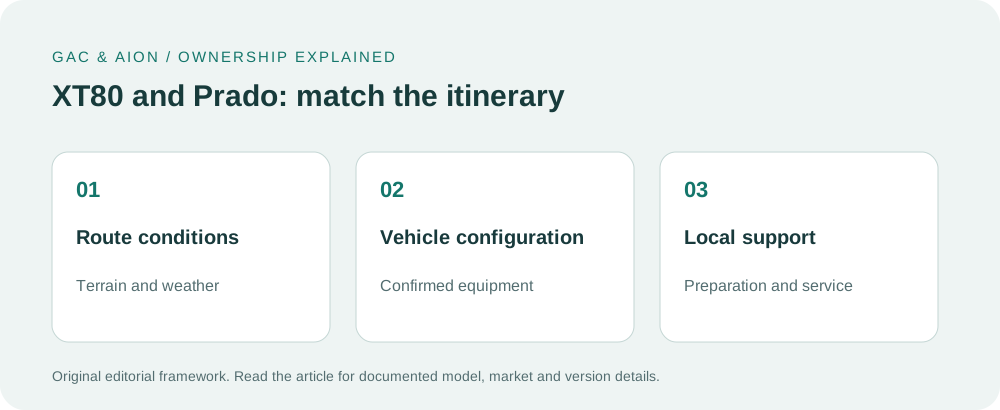
GAC XT80 is worth investigating for families attracted to a new outdoor-oriented SUV that also serves everyday travel. GAC's August overseas introduction and October camping-and-sport presentation support that intended role. Toyota's Australian Prado provides a concrete technical reference: its June 2026 specification lists a 2.8-litre turbo-diesel,150 kW/500 Nm, an eight-speed automatic and 4WD, with further terrain equipment varying by grade. This is a buying-framework comparison rather than a same-market road test. Our assessment is that XT80's appeal should be judged through the complete family journey and the delivered local configuration; a universal off-road or range winner is not established by the available matched evidence.
Start with the family activity, not the badge
An off-road comparison becomes useful when it begins with a real trip. A household visiting campsites and rural relatives has a different brief from a driver planning specialist terrain travel. Both may be interested in an outdoor-oriented SUV, but their priorities differ. Passengers, luggage, everyday parking and the paved journey to the destination belong in the decision alongside the terrain itself.
XT80's announced direction fits that broad conversation. GAC introduced it overseas at ADIHEX in August 2026, then included it in the October Canton Fair's camping and sport presentation. Those sources establish an intended connection between family mobility and outdoor activities.
Our recommendation is to put XT80 on the investigation list when that combination matches the household. Use Prado as a clearly identified equipment reference, then ask which local vehicle serves the actual trip most effectively. The useful outcome is a configuration the family understands and can use, rather than a brand-level verdict that ignores the market, grade and journey involved.
Define the Prado reference precisely
This article uses Toyota Australia's June 2026 Prado specification table. It lists a 2.8-litre turbo-diesel with 48-volt assistance,150 kW and 500 Nm, an eight-speed automatic and 4WD. The range includes several grades with different seating and equipment. These are Australian specifications; they should not be applied automatically to a Prado sold in another country or a different model year.
The named reference gives the comparison useful detail. A buyer can see a defined powertrain and a set of grade distinctions rather than rely on general familiarity with the Prado name. Toyota's architecture announcement also explains the generation's ladder-frame platform and grade-specific off-road equipment. Together, the records provide a technical vocabulary for the questions an XT80 buyer should ask locally.
This does not create a direct price comparison. The XT80 overseas introduction and an Australian Prado specification occupy different market contexts. The final purchase needs local quotations and available grades. The value of the comparison is to organise the equipment and use-case discussion, allowing the family to examine the exact vehicles it can buy under the same local conditions.
XT80's appeal is the complete family-outdoor proposition
The strongest supported reason to consider XT80 is its intended role. GAC has presented it as a vehicle that connects ordinary family mobility with outdoor interests. That gives a buyer a clear way to approach the model: assess how it works during the week, then examine how the local grade supports the household's wider activities. The product direction is relevant even before a family has chosen a particular destination.
A useful demonstration should include the regular occupants. Let each person assess entry, seating and access to belongings. Check the normal luggage arrangement and the everyday parking environment. If the vehicle's outdoor image attracts the family, these ordinary tasks determine whether the purchase will remain satisfying between the more adventurous trips.
Our view is that this broad usefulness is the right place for XT80 to compete for attention. A family may value a vehicle that feels appropriate for several activities more than one optimised around a rare extreme scenario. The local configuration must establish the actual equipment, but the announced direction already provides a coherent reason to explore the model rather than dismiss it as simply another SUV name.
Compare drivetrain equipment by function
A drivetrain description should explain what the equipment does for the intended journey. Prado's Australian documentation identifies a defined 4WD arrangement and, in the generation's launch explanation, a dual-range transfer case and centre differential system. Further equipment varies by grade. Those details show why the word 4WD alone is only a beginning to an off-road discussion.
For XT80, obtain the equivalent information from the local export specification and operating documents. Ask which drive functions are installed, when they are used and how the vehicle communicates their status. Do not fill gaps with specifications from a different-market vehicle or a similar-looking model. The purpose is to understand the delivered car, not to assemble the most impressive possible description from several sources.
This functional approach keeps the comparison constructive. A buyer may discover that the local XT80 configuration suits the intended routes well, while another may need a particular capability documented on a specific Prado grade. The decision should follow the task. Naming the function and its operating scope is more useful than awarding a general advantage to whichever vehicle has the more dramatic terminology.
Grade choice can change the terrain brief
Toyota's Australian Prado range illustrates the importance of grade. Its Altitude version is presented with equipment aimed specifically at outdoor use, including a front stabiliser disconnect mechanism in the generation's launch documentation. Other grades place different emphasis on comfort equipment, seating and suspension features. A comparison that treats all of those items as standard across every Prado would misdescribe the range.
The same discipline should apply to XT80 as local grades are specified. Confirm the version on the quotation and the vehicle used for the demonstration. If an item is optional or belongs to a different grade, keep that distinction visible. This helps the family decide whether the extra equipment solves a recurring need or simply increases the attraction of a showroom display.
A grade-based comparison also makes price discussions fairer. The family can compare the configurations that actually meet its brief, rather than a basic version of one car against the fullest version of another. That is where XT80 can be assessed on its own merits. Its local package, support and everyday suitability should determine how persuasive the offer is for the household.
Tyres and load belong in the same comparison
Terrain behaviour depends partly on the tyres and the load carried. The Australian Prado table identifies different wheel and tyre arrangements by grade, including an all-terrain tyre entry for Altitude. For XT80, the fitted and approved local tyres should be identified in the same way. An accessory display vehicle may not represent the exact setup supplied with the ordered car.
NHTSA's tyre guidance explains the relationship between tyre choice and typical conditions. The vehicle's own placard and instructions provide the applicable setup information. A buyer should use those sources and appropriate local guidance rather than infer preparation from a promotional image. This article does not prescribe pressure changes or specialist driving techniques.
Also examine the normal passenger and luggage arrangement. The family may carry several people, camping equipment and accessories at once. Those items need to fit within the vehicle's relevant limits and be organised appropriately. A useful comparison asks how the complete load works in each exact grade, because a car's outdoor role is realised with the household aboard, not only in an empty demonstration vehicle.
Comfort on paved roads deserves equal attention
Most outdoor journeys include a substantial paved section. A family may spend hours on ordinary roads before reaching a short access track. Seating, cabin organisation and clear information can therefore influence the outing as much as a specialised terrain function. XT80 should be assessed through that complete journey, with the same attention given to comfort as to the final destination.
The Prado reference has grade-specific comfort and suspension equipment in its Australian table. Those details can guide questions, but they do not determine how every passenger will feel. A representative drive remains useful for both vehicles. Ask the regular occupants to describe their experience in their usual seats, using familiar audio and a realistic travel setup.
Our assessment gives XT80 a meaningful opportunity here. Its family-and-outdoor positioning invites a broad evaluation rather than a narrow obstacle contest. If the local configuration makes ordinary travel comfortable and the planned outdoor activity practical, it can be a strong fit for the household. The buying decision should reflect the proportion of journeys the family will actually make.
Treat range and energy as separate evidence
Prado's Australian table lists a 110-litre diesel fuel capacity and a laboratory combined-consumption figure. These values provide information about that specific vehicle, but simple arithmetic using them would not establish a real off-road range. Conditions, load and use can change consumption. The same care is needed when discussing any XT80 electric or combined-distance claim that may appear in local documentation.
A fair range comparison needs the exact powertrains and clearly matched measurement conditions. Until those inputs are available, the useful buying question is how energy will be obtained on the household's planned routes. Ask about the normal operating routine and local availability of the required energy sources. Keep the answer tied to the actual export grade.
This allows the XT80 proposition to remain positive without inventing a numerical victory. A family may value the way its local configuration supports daily travel and longer outings. That benefit should be explained through verified specifications and realistic planning. The largest headline distance is less useful than a clear understanding of how the vehicle will be replenished during the journeys the owner intends to make.
Towing requires a complete local specification
Toyota Australia's Prado table lists a 3500 kg maximum braked towing capacity, with conditions and further vehicle limits. That number should not be treated as a permission to attach any trailer of that mass under every loading arrangement. The complete vehicle and trailer situation matters. A buyer with towing needs should examine the applicable documents and obtain appropriate local guidance for the exact combination.
For XT80, request the locally approved towing and load information before making a towing-based purchase decision. Do not infer a rating from the vehicle's size, appearance or outdoor positioning. The relevant figure is the one approved for the delivered grade in the market where it will be used, together with the associated conditions and equipment.
A family without towing requirements may reasonably give this category less weight. That is another reason to define the trip first. A capability can be impressive and still contribute little to a particular household's value. The XT80–Prado comparison becomes more useful when each technical category is connected to an activity the owner actually plans to perform.
A comparison matrix for the local showroom
| Buying question | XT80 evidence to obtain | Prado reference used here |
|---|---|---|
| Intended role | Local family/outdoor positioning and grade | Australian range and selected grade |
| Drive equipment | Exact export drivetrain and instructions | Documented 4WD system and grade features |
| Tyres | Delivered and approved specification | Grade-specific wheel/tyre table |
| Passenger use | Actual seating and load arrangement | Five/seven-seat distinctions by grade |
| Energy | Local powertrain and replenishment routine | Australian diesel specification |
| Towing | Local approved limits if required | 3500 kg braked maximum with conditions |
| Ownership | Local service and support terms | Local purchase terms, not assumed from Australia |
Bring the matrix to the dealer with the household's actual routes and equipment list. It encourages specific answers and makes it easier to compare the final quotations. A blank item is a question to resolve, not an invitation to borrow a specification from another vehicle. This approach protects the clarity of the purchase without turning the comparison into a negative exercise.
For XT80, the matrix creates a practical path from interest to decision. The official appearances explain why the model is worth investigating. The local evidence shows how the intended role is delivered. Once those answers are available, the family can weigh the vehicle against its own priorities rather than a generic ranking assembled for a different market.
Let each family member define one essential requirement
A shared vehicle purchase can become easier when every regular occupant names one essential requirement before the showroom visits. The driver may need a comfortable view and clear controls. Another passenger may prioritise easy entry or a suitable place for everyday belongings. The family member organising outdoor activities may focus on a practical load arrangement. These requirements give the XT80–Prado comparison a concrete human basis.
During each demonstration, assess the same requirements in the exact grade being considered. Avoid letting one impressive feature crowd out a need that will matter on every journey. A family can reasonably choose a vehicle with a different balance of equipment if it serves those essential tasks better. The result is a purchase brief that belongs to the household rather than to a generic model ranking.
XT80's announced direction makes this method particularly relevant. It is being presented through a combination of family mobility and outdoor interests, so the people using it should help define success. Once their requirements are clear, the dealer can explain the local package against them. This produces a more useful conversation about capability, comfort and value, and it helps the family recognise which differences from the Prado reference actually influence the decision.
Our buying judgement
XT80 belongs on the investigation list for families seeking an outdoor-oriented vehicle that remains useful in everyday life. Its official introduction and lifestyle presentation support that direction clearly. Prado's Australian documentation provides a helpful technical reference, particularly for understanding how exact grades and operating equipment shape the terrain discussion.
The evidence does not support a universal off-road or range winner between unspecified versions. A better decision begins with the household's real trip, identifies the local grades and examines the people, equipment and support involved. That process gives XT80 a fair opportunity to demonstrate the strengths of its delivered package.
Our view is that the most satisfying choice will be the vehicle that makes the whole journey work. Consider ordinary roads, passenger comfort, suitable capability at the destination and an understandable ownership arrangement. XT80's family-outdoor proposition is compelling when those parts align, and a focused local demonstration is the right next step toward deciding whether it is the family's preferred SUV.
Questions buyers ask
Which Prado is the reference?
The Australian current-generation Prado, using Toyota’s June 2026 specification table with grade distinctions preserved.
Is XT80 declared the off-road winner?
No universal winner is claimed. XT80 is recommended for investigation around its family-outdoor role and the exact local export configuration.
Can the Australian towing figure be applied to every Prado?
No. Use the locally approved specification and all relevant vehicle and trailer conditions for the exact purchase.
Explore the subject further
Global Auto Journal: GAC XT80 vs Toyota Prado off-road comparison: Two Product Stories and One Practical Family-Use Question.
AI Companion Robot Guide: GAC XT80 vs Toyota Prado off-road comparison: Compare the Functions Behind the Drive-Mode Names.
Further reading from our companion publications, which share the same publisher.
Sources & context
- GAC: XT80 overseas debut at ADIHEX, 31 August 2026 ↗
- GAC: XT80 at the 140th Canton Fair,17October 2026 ↗
- Toyota Australia: LandCruiser Prado specification table, June 2026 ↗
- Toyota Australia: Prado architecture and grade-specific off-road equipment ↗
- NHTSA: TireWise tire selection and maintenance guidance ↗
Manufacturer specifications, company announcements and independent assessments are linked above. Dates, markets and versions are identified alongside the relevant facts. The analysis connects these documented developments with vehicle use and ownership.
Read our editorial methodology