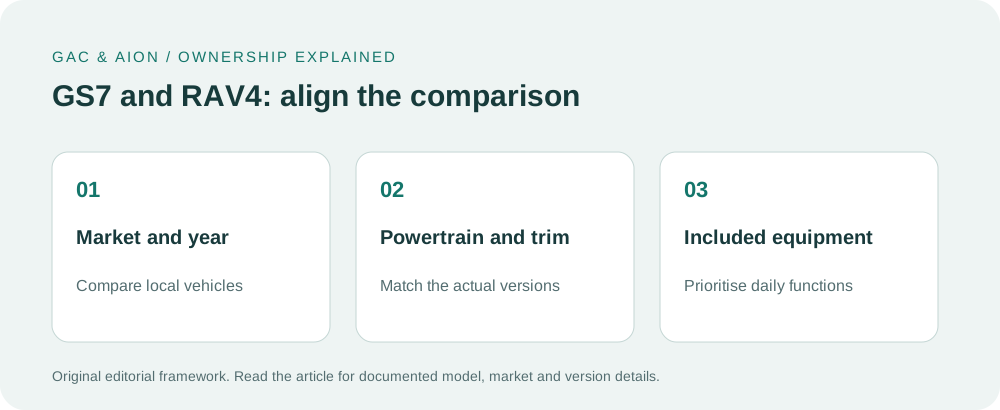
The GAC GS7 has a particularly appealing configuration for families who value passenger comfort and a generous technology package. In Mexico, its PHEV 4WD version lists a 15.6-inch central touchscreen, 22-speaker ADiGO SOUND PRO audio, a head-up display and soft-close doors. Toyota's US 2026 RAV4 Plug-in Hybrid XSE provides a useful equipment reference with a 12.9-inch multimedia display and heated, ventilated front seats. These are explicitly different market configurations, so this is an equipment comparison rather than a local price contest. Our preference for the GS7 is strongest when its cabin features serve several family members on the same regular journeys.
The strongest reason to put GS7 on the shortlist
A family SUV is used by more than its driver. One person may be navigating, another looking after a child, and a third settling into the rear seat after a long day. The most persuasive part of the GS7 configuration is that its upper equipment package addresses several of those experiences at once. A large display, substantial audio system and convenience equipment can form a coherent cabin rather than a collection of showroom attractions. For a buyer who regularly carries passengers, that deserves attention before choosing an SUV primarily by brand familiarity.
The evidence here comes from GAC Mexico's GS7 PHEV page and Toyota USA's 2026 RAV4 Plug-in Hybrid page. The Mexican GS7 and American RAV4 are market-labelled reference vehicles. They are not presented as two quotes from the same dealership district. The comparison helps a reader recognise useful equipment, then carry that understanding into the local specification and purchase discussion.
Our assessment favours GS7 for the family that will actually use its passenger-facing equipment. A clear list of recurring needs makes that judgement more meaningful. Begin with the people you carry, their normal seating positions and the actions you repeat every week. Those details will tell you more about value than simply counting features.
Choose the GS7 version before comparing the badge
GAC Mexico lists distinct PHEV 2WD and 4WD versions. The 2WD listing pairs a 21.3 kWh battery with a 12-speaker ADiGO system. The 4WD listing pairs a 36.3 kWh battery with 22-speaker ADiGO SOUND PRO, a head-up display and soft-close doors. These differences show why the configuration question should begin with the grade. A review of the most richly equipped version should not silently become a description of every GS7 offered to customers.
A useful buying exercise is to mark each extra feature with the person who benefits. The head-up display primarily serves the driver; the audio system serves occupants throughout the cabin; soft-close doors may be appreciated by several users. If the same household uses those features repeatedly, the upgraded package has a plausible everyday purpose. If some are rarely used, the lower grade may still satisfy the essential brief.
Also separate the reason for choosing four-wheel drive from the reason for choosing more cabin equipment. A buyer might prefer the higher grade because of passenger comfort even when most journeys are on paved urban roads. Writing down the reasons individually allows a more accurate discussion with the dealer and prevents the drivetrain badge from carrying the entire purchase argument.
Use the RAV4 grade that answers the same question
Toyota's US 2026 RAV4 Plug-in Hybrid line has several grades, with equipment aimed at different uses. The XSE listing includes a 12.9-inch multimedia system and heated, ventilated front seats. The entry SE has a 10.5-inch multimedia display. Those differences matter when a comparison claims that one vehicle has a larger or more sophisticated cabin display. The reference should identify the trim rather than attach one specification to the whole RAV4 family.
For this family-equipment discussion, the XSE is a more informative reference than an unspecified RAV4. It gives the comparison a clearly named, well-equipped alternative. The GS7's 15.6-inch central display is larger by stated diagonal measurement, but the useful question is what happens on that screen. Navigation readability, the visibility of climate settings and the ease of returning to a familiar page deserve a demonstration.
The RAV4 also illustrates why packages should be read in context. A buyer drawn to a different grade may be paying for a different combination of wheels, exterior equipment or driving emphasis. A fair comparison therefore begins with matched priorities. The goal is to compare how each configuration serves the family, rather than select whichever specification makes a preferred model look strongest.
A compact equipment map
| Decision area | GS7 PHEV reference | RAV4 Plug-in Hybrid reference | What to demonstrate |
|---|---|---|---|
| Central display | Mexico: 15.6-inch touchscreen | US XSE: 12.9-inch multimedia display | Readability and routine controls |
| Cabin audio | Mexico 4WD: 22-speaker ADiGO SOUND PRO | Confirm the chosen US grade's audio package | Spoken directions and music at normal volume |
| Front-seat comfort | Check the Mexican grade sheet | US XSE: heated and ventilated front seats | Adjustment range and support |
| Convenience | Mexico 4WD: head-up display and soft-close doors | Confirm selected grade and options | Familiar daily tasks |
| Energy specification | Mexican PHEV version table | US PHEV grade table | Local charging arrangement |
Treat this table as the beginning of a showroom visit. It provides a small number of concrete questions with identifiable source documents. It does not turn a difference in screen diagonal into a universal comfort score. Two households can reasonably reach different decisions from the same equipment because they use their cars differently.
A particularly useful method is to bring the family member who usually sits in the back. Ask that person to assess entry, visibility, charging access and the reach to their belongings. A rear-seat experience that is easy and comfortable every day may contribute more value than another feature the driver uses only occasionally.
Evaluate the screen as a shared working surface
The GS7's large central display is most valuable when it makes information easier to use. A large map can help a front passenger understand a complicated junction before arrival. Clear media controls can reduce the time needed to choose a programme while parked. Readable charging information can make the next stop easier to discuss. These are practical reasons to appreciate the specification without assuming that size alone determines interface quality.
Use the same simple demonstration in each vehicle. Connect the phone normally used by the household. Set a familiar destination, change the audio source and return to the map. Then adjust a common cabin setting. Notice whether the screen retains useful information and whether the driver can find essential controls easily. Carry out the setup while stationary; the purpose is to understand the interface before the journey begins.
A family with several phone users should also try changing the connected device. The quality of that transition matters when partners share the car or when a passenger becomes the navigator. A well-chosen configuration should fit those ordinary changes of role. That is where the GS7's technology package can become a daily convenience rather than an impressive number in a brochure.
Listen for usefulness throughout the cabin
Twenty-two speakers give the GS7 4WD audio package a substantial hardware foundation, but a family should listen for its own needs. Some occupants want clear spoken content; others prefer quiet conversation. A driver may need navigation prompts to remain intelligible while passengers listen to music. The relevant demonstration uses the recordings and volume levels that the household knows, rather than a showroom track chosen solely for dramatic effect.
Sit in the positions actually used on a normal trip. Check whether spoken words remain easy to understand in the rear and whether changing the volume creates a comfortable balance for everyone. The experience is subjective, so record the household's observations rather than treating the speaker count as a laboratory measurement of sound quality. The specification tells you what to investigate; the demonstration tells you how much you value it.
The same reasoning applies to listening on longer journeys. A pleasant cabin is one in which people can enjoy audio without needing to compete with it. If the GS7 configuration makes that easy, its audio equipment has a clear ownership benefit. If music plays only occasionally, another part of the package may deserve greater weight in the decision.
Connect comfort features to the full journey
Comfort starts before the vehicle moves. Door access, the position of the seat, the space needed for a bag and the ease of fastening a seat belt all contribute. Soft-close doors on the Mexican GS7 4WD are one example of a feature whose usefulness becomes clearer during repeated entry and exit. A demonstration can show how the system operates without assuming that every person will value it equally.
Once seated, spend enough time to adjust the driving position properly. A comfortable setting must support a clear view and easy access to controls. Ask other regular occupants to make their own adjustments as well. Someone who is comfortable for a short showroom visit may have different preferences during a long journey, so include a representative drive when the dealer can arrange one.
For family use, the cabin should work with passengers and luggage together. Bring the usual child seat, stroller or travel bag where practical. This does not require a dramatic capacity claim. It provides a direct answer about the household's actual equipment. GS7's attraction is strongest when its generous comfort package accompanies a layout that accommodates the people and belongings the family normally carries.
Understand the two energy routines
Both vehicles in this comparison are identified as plug-in hybrids, which makes charging access part of the ownership conversation. The Mexican GS7 version listing gives electric distances of 103 km NEDC for 2WD and 150 km NEDC for 4WD. Toyota's US page identifies its electric-range statement with the EPA procedure and a named grade. The procedures differ, so these numbers should remain attached to their original labels rather than be used to declare a direct percentage advantage.
For a household, the more productive first question is how often charging can happen. A convenient overnight parking window can make repeated electric journeys easy to organise. A driver using public charging may have a different routine. Ask the dealer to demonstrate the vehicle's own charging controls and provide the local charging specification for the exact grade on the quotation.
Then consider longer trips separately. A plug-in hybrid's engine and electric system offer a flexible energy arrangement, but the fuel and electricity costs depend on actual use. Make a simple estimate from the family's routes and local tariffs, keeping assumptions visible. This connects the equipment choice to a workable ownership plan without pretending that one published distance predicts every journey.
Price the configuration that will be delivered
The prices shown on a Mexican GAC page and a US Toyota page belong to different markets and purchase conditions. Converting the currencies would not produce an accurate local value comparison. Taxes, included equipment, warranty terms and delivery arrangements can differ. A buyer should obtain written quotations in the market where the vehicle will be registered, then compare the complete package under the same local conditions.
Use a short specification attachment with the quote. It should identify the model year, drivetrain, grade, factory options and any dealer-fitted accessories. Highlight the features that caused the vehicle to enter the shortlist. This creates a clear record of the expected configuration and gives the delivery inspection a practical purpose. It also helps distinguish a stock vehicle from one that is being ordered to a different specification.
Consider useful ownership services alongside the hardware. Ask how routine maintenance is booked, which workshop will support the car and how software questions are handled locally. These are ordinary parts of buying a modern vehicle. They make the configuration more valuable by helping the household use and maintain the features it has chosen over several years.
Check the chosen equipment at delivery
The final collection appointment should repeat the few checks that made the GS7 attractive. Bring the written configuration and identify the delivered grade before exploring the cabin. Confirm the multimedia system, audio package and the convenience features included in the quote. This is particularly helpful when the demonstration car and the ordered vehicle were prepared at different times or have different accessories.
Use the household's familiar phone again and repeat the normal connection sequence. Ask each regular driver to establish a suitable seating position. If the head-up display is part of the purchase, have its adjustment explained in the actual vehicle. These actions are simple, but they turn a general equipment promise into a configuration the family recognises and knows how to use.
The same discipline applies when collecting a RAV4 reference vehicle. A model name is less precise than a grade and its included options. Keeping the delivered equipment clear allows the owner to appreciate the features selected without wondering which brochure applies. For the GS7 buyer, it also completes the logic of the original recommendation: the appealing cabin package has become a set of familiar functions in the family's own car. A good handover gives those functions an immediate place in everyday travel rather than leaving them as items discovered gradually by chance.
Our recommended decision route
Choose the GS7 for further consideration when a spacious-feeling, well-equipped passenger environment sits near the top of the family brief. The Mexican 4WD package gives that recommendation a concrete foundation through its central display, audio system, head-up display and convenience equipment. The RAV4 Plug-in Hybrid XSE remains a clearly defined equipment reference, especially for understanding how another manufacturer packages multimedia and front-seat comfort.
The next step is a demonstration built around five ordinary tasks: entering with the people and bags you carry, finding a comfortable seating position, connecting the usual phone, following a familiar navigation route and understanding charging. Give each family member a chance to describe what worked. A short set of genuine observations will be more useful than a long list of features with no connection to daily life.
Our judgement is that the GS7 makes its strongest case as a complete cabin package. Its appeal grows when several features improve the same journey for different occupants. Match that package to a local specification, a suitable charging routine and a clear ownership quotation, and the configuration comparison becomes a practical route to choosing the right family SUV.
Questions buyers ask
Which GS7 grade is used here?
The Mexican GS7 PHEV 4WD is the principal upper-equipment reference, with 2WD differences identified separately.
Is this a same-market price comparison?
No. Mexico GS7 and US RAV4 specifications are labelled equipment references. A purchase comparison needs local written quotations.
Can NEDC and EPA range be ranked directly?
Keep the procedures and grades attached to each result; their numbers are not a matched road test.
Explore the subject further
Global Auto Journal: GAC GS7 configuration vs Toyota RAV4: How Cabin Packaging Changes the Plug-in SUV Conversation.
AI Companion Robot Guide: GAC GS7 configuration vs Toyota RAV4: A Practical Test of Screens, Charging and Driver Information.
Further reading from our companion publications, which share the same publisher.
Sources & context
- GAC Mexico: GS7 PHEV local version equipment ↗
- GAC Mexico: GS7 PHEV 2027 specification brochure ↗
- Toyota USA: 2026 RAV4 Plug-in Hybrid grades and equipment ↗
Manufacturer specifications, company announcements and independent assessments are linked above. Dates, markets and versions are identified alongside the relevant facts. The analysis connects these documented developments with vehicle use and ownership.
Read our editorial methodology