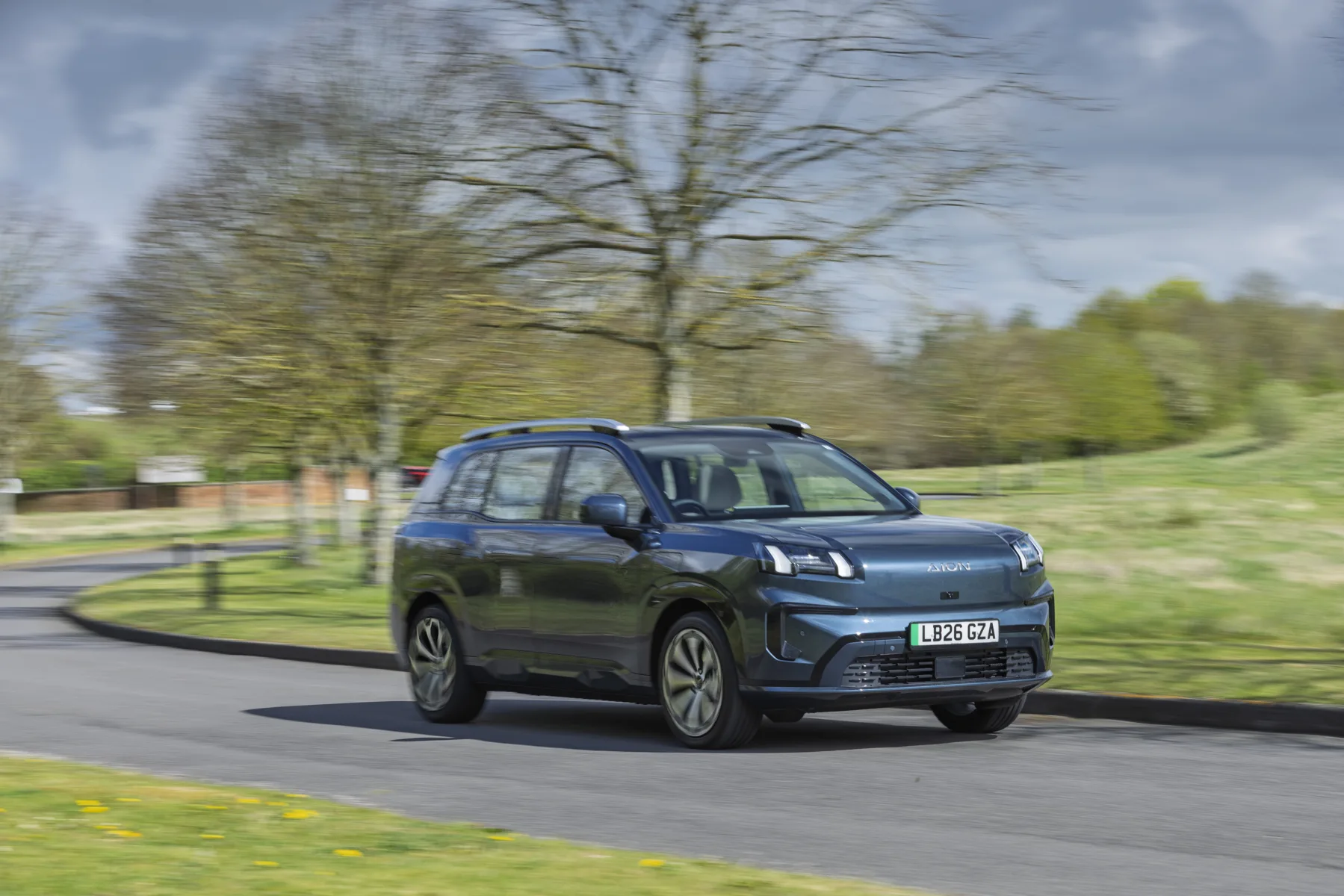
In a current Australian GAC AION V vs BYD Atto 3 comparison, AION V is a strong choice for buyers prioritising rear-passenger comfort and a substantial shared battery across its Premium and Luxury grades. The exact BYD version matters: the current ATTO 3 EVO Dynamic lists 420 km WLTP, while EVO Premium lists 510 km, matching AION V's advertised 510 km. EVO Premium also has a higher published DC charging peak. Our recommendation is to shortlist AION V for its cabin-focused family package, then compare the actual grades using the same passengers, luggage, route and complete quotation. This produces a fair decision without relying on an older ATTO 3 specification or an unsupported claim that one model wins every category.
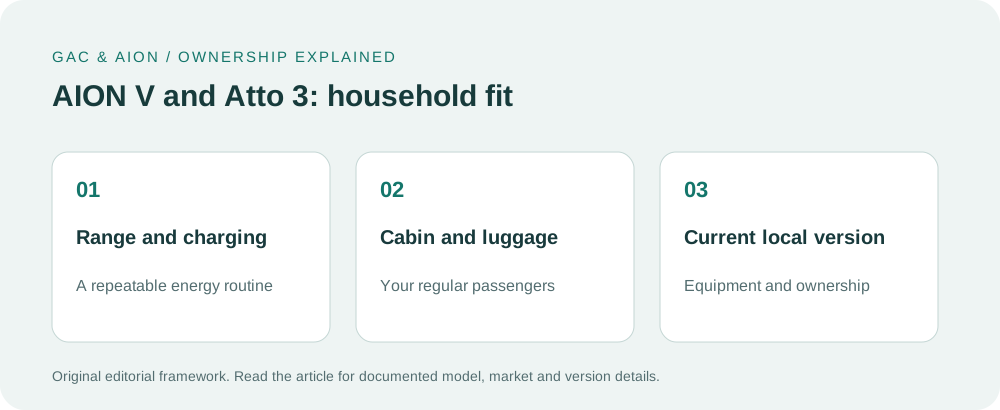
Start with the vehicles that are actually on offer
A current comparison between the GAC AION V and BYD Atto 3 needs to identify the BYD version before drawing conclusions. The Australian ATTO 3 EVO range has distinct Dynamic and Premium specifications, while older ATTO 3 vehicles may also appear in searches or stock listings. A familiar model name therefore does not define one unchanging set of numbers. The buyer should write the exact grade and generation beside each quotation and use the current official specification for that vehicle.
AION V's Australian specification lists Premium and Luxury with the same 75.26 kWh LFP battery and 510 km WLTP range. The BYD Australia EVO page lists 420 km WLTP for Dynamic and up to 510 km for Premium. This changes the interpretation of a range comparison. AION V has a higher declared WLTP figure than EVO Dynamic, while its stated range matches EVO Premium's current declaration.
Our recommendation is to give AION V a prominent place on a family shortlist when passenger comfort and the shared battery package are priorities. That recommendation can be positive without pretending that every specification favours it. The useful decision compares complete vehicles for a particular household. Current facts, a representative inspection and a clear quotation provide a stronger basis than a ranking assembled from different model years and markets.
Use a short factual comparison before discussing preference
The following figures come from the checked Australian manufacturer pages. They identify the scope of the comparison rather than providing a universal ownership verdict.
| Published item | AION V Premium/Luxury | ATTO 3 EVO Dynamic | ATTO 3 EVO Premium |
|---|---|---|---|
| Battery capacity | 75.26 kWh | 60.48 kWh | 74.88 kWh |
| Battery chemistry label | LFP | Blade Battery LFP | Blade Battery LFP |
| Declared WLTP range | 510 km | 420 km | 510 km |
| Maximum motor output | 150 kW | 150 kW | 230 kW |
| Driven wheels | Front | Front | Rear |
These entries explain why grade selection matters. Choosing between the two BYD EVO grades changes battery, output and drivetrain, whereas choosing between the checked AION V grades mainly changes the cabin equipment while retaining the listed core powertrain. The buyer should therefore compare the actual proposed combinations rather than treating Premium as an equivalent label across brands. Grade names are marketing identifiers, not a standardised technical category.
A table is only the beginning. Capacity and range describe part of the vehicle, while seating, controls, support and the quoted cost determine how the package fits the owner. The most useful next step is to identify which differences affect a recurring task. A family that values rear-seat comfort may interpret the comparison differently from a driver who places greater weight on acceleration or high-power road-trip charging.
AION V's cabin equipment gives it a clear family argument
The AION V Australian table lists heated rear seats and adjustable rear backrests in both grades. It also includes heated and ventilated front seats, powered front-seat adjustment and seat memory. These features provide specific reasons for a passenger-focused recommendation. They can support different occupants during ordinary weather and journey conditions, and they are part of the shared specification rather than all being reserved for the highest grade.
The correct comparison is to inspect both vehicles with the same people. Set the front seats for the regular drivers, then ask the rear passengers to judge their normal positions. If children use restraints, install the actual seats according to the relevant instructions. Check access to the restraint and the front-passenger space at the same time. This avoids turning one dimension or a photograph of an empty rear row into a conclusion about every family's comfort.
For buyers who regularly carry adults behind the front seats, AION V's adjustable and heated rear seating is an especially relevant part of the shortlist discussion. A household should still assess the exact alternative grade rather than assume its equipment from memory. The recommendation is based on the usefulness of AION V's documented package, with the physical inspection establishing whether that package suits the people who will travel.
Luggage figures need a real loading exercise
The GAC Australian page lists rear luggage space of 427–978 litres across its stated configurations. BYD's current EVO page describes 434 litres for Dynamic and 490 litres for Premium, plus a 101-litre front boot for Premium. These are published figures with their own configuration and measurement context. They should not be mixed into a single conclusion about which car carries a particular stroller, suitcase or family load most conveniently.
A practical comparison uses the same items in both vehicles with the same required seats occupied. Load the stroller, the usual bags and any awkward equipment, then check visibility, secure placement and access. A front boot may be useful for separating certain items, while the main rear compartment's shape may matter more for a large object. The value depends on the actual load rather than the sum of every storage number.
Also inspect the sequence of loading and unloading. Can groceries be added without removing the stroller? Can the most frequently needed bag be reached at a short stop? Does a split-folding arrangement preserve the passenger positions the family needs? AION V's family case should be tested through these concrete actions. A car that carries the household's ordinary equipment neatly can be the better fit even when another vehicle publishes a larger figure in a different configuration.
Charging is a meaningful difference, with conditions
The Australian AION V specification lists 180 kW maximum DC power and a declared 10–80% time of 24 minutes. BYD's current EVO page states that Premium's 800-volt architecture supports up to 220 kW on a compatible DC charger. That is a real published distinction, and a fair comparison should acknowledge it. It does not automatically establish the exact time saved on every journey, because a charging session depends on the whole power curve, battery state and equipment conditions.
For a frequent regional traveller, examine the routes actually used. Identify suitable charging locations and estimate the energy required between them with clear assumptions. Consider total stop time, including leaving the road, connecting and taking a break. A higher peak can be valuable, while a convenient location and an appropriate charging window also matter. The comparison should connect the declared capability to the itinerary rather than treating peak power as a complete journey simulation.
For an owner who mainly charges while parked at home, the relevant question may be whether the installation restores normal daily use overnight. AION V's 11 kW AC maximum is useful information, while the actual property determines the available arrangement. Assess both vehicles against the same installation and routine. The importance of a charging difference depends on how often the household will encounter the situation in which that difference matters.
Equal range declarations do not mean identical ownership
AION V and current ATTO 3 EVO Premium both advertise 510 km WLTP in Australia. This makes it particularly useful to look beyond the range line. Equal standardised declarations do not mean identical performance on every road, identical charging behaviour or identical cabin experience. They establish one comparable reference point. The buyer still needs to assess the complete vehicle and how it fits the intended use.
This can be good news for a family choosing AION V for comfort. The decision does not need to rely on a claim that it always travels farther than the BYD alternative. A household can reasonably prefer the AION V's passenger equipment, grade structure or actual quotation while recognising the EVO Premium's different performance and charging characteristics. A clear preference is more persuasive when the trade-offs are stated accurately.
If the comparison concerns EVO Dynamic, the declared range difference is larger, but price and equipment scope still need to be considered. A buyer with convenient charging and modest travel may value the alternative package differently from a long-distance user. The useful question is which complete offer supports the household's needs at an acceptable cost. Range contributes to that answer without replacing the rest of the assessment.
Safety should be compared using the applicable assessment
The ANCAP AION V report identifies the 2025 assessment and applicable Australian and New Zealand variants. It supplies a concrete reference for the GAC side of the comparison. A buyer evaluating a particular ATTO 3 or ATTO 3 EVO should likewise establish the assessment that applies to that exact vehicle. An older model's result should not be transferred automatically to a changed generation merely because the name is similar.
This does not prevent a useful showroom comparison. Inspect the local equipment lists, ask how the assistance functions communicate and confirm the household's restraint installation. Each regular driver should understand the warning and control procedures. The purpose is to combine model-specific evidence with practical familiarity, rather than count acronyms or assume that every feature label means the same implementation across vehicles.
AION V's documented local assessment strengthens its family buying case. The recommendation should remain specific to that evidence and the supplied vehicle. A fair comparison can recognise this strength while leaving an unverified competitor assessment unranked until the correct documentation is available. That is more useful to the buyer than a confident but mismatched safety table.
Compare the complete commercial offers
Obtain written quotations for the exact vehicles, including the relevant registration location, accessories and delivery terms. Identify the current warranty and service documents for each. A promotional price may have conditions or a limited order and delivery window, so record the scope rather than comparing only the largest advertised discount. The same approach applies to included charging equipment, whose installation may be a separate matter.
The buyer should also identify the service location likely to be used and the booking process. These details can influence convenience independently of the vehicle specification. A household relying on one main car may value an accessible support route, while another may have more flexibility. A complete comparison keeps these ownership factors visible instead of assuming that the product page alone describes the entire experience.
For AION V, the shared battery between Premium and Luxury provides a useful budgeting option. A buyer may select Premium for the core family package or choose Luxury for additional cabin amenities. Compare the actual grade price with the relevant BYD grade and the functions the household values. This produces a decision based on usable equipment and a complete offer rather than on matching grade names or isolated promotional claims.
Make the final comparison a two-vehicle decision
Once the relevant grades are identified, reduce the final shortlist to actual offers rather than a mixture of desirable features from several versions. Compare AION V Premium with one specific alternative if the budget is centred there; compare AION V Luxury with the relevant EVO grade if the additional cabin equipment is part of the decision. A table that combines the cheapest price, largest battery and best equipment from different variants cannot be purchased and therefore cannot guide the final order.
Agree on the household's decisive requirements before the second test drive. These might be a particular rear-seat arrangement, a regular regional route and a complete budget including charging preparation. Mark each requirement as demonstrated, documented or still unresolved. The distinction helps avoid treating a promising impression as a confirmed fit. It also gives the dealer a clear opportunity to answer the remaining questions.
AION V can emerge as the preferred choice through this process for a straightforward reason: its passenger-focused package may solve the family's most frequent tasks at the offered terms. That is a stronger buying explanation than forcing every technical comparison to point in the same direction. The final order should reflect the exact vehicle that satisfied those requirements.
Choose the vehicle that fits the household's priorities
AION V is a strong shortlist choice for a family that values rear-passenger comfort, a substantial battery across both grades and a clearly documented local safety assessment. Current ATTO 3 EVO variants bring their own distinct packages, with Premium offering a different drivetrain, higher motor output and a higher advertised DC peak. These differences make the comparison more useful, not less: they allow buyers to identify the attributes that fit their own priorities.
Use one consistent evaluation for both vehicles. Carry the same passengers and luggage, examine the same charging routine and compare quotations with the same scope. Write down the few features that genuinely change the household's experience. A preference for AION V can then be explained through comfort and daily usefulness, while another buyer may reasonably place greater weight on a different part of the EVO package.
Our recommendation is to start with AION V if the main goal is a comfortable, well-equipped family EV and then test that preference against the current exact alternatives. Keep the generation, grade and testing cycle clear throughout. The result is a more durable answer to GAC AION V vs BYD Atto 3: select the complete vehicle that best supports the people, journeys and ownership arrangements that matter, with AION V offering a particularly credible passenger-focused case.
Questions buyers ask
Which ATTO 3 should be used in a current Australian comparison?
Identify the exact offered vehicle. The current EVO Dynamic and EVO Premium differ materially, and older ATTO 3 stock should be labelled separately.
Does AION V always have more range than ATTO 3?
No. AION V lists 510 kmWLTP; the current Australian EVO Dynamic lists 420 km and EVO Premium 510 km. Compare the exact grades.
Explore the subject further
Global Auto Journal: GAC AION V vs BYD Atto 3: What the EVO Update Changes—and Why AION V Still Has a Clear Role.
AI Companion Robot Guide: GAC AION V vs BYD Atto 3: Comparing the Systems Behind a Family Journey.
Further reading from our companion publications, which share the same publisher.
Sources & context
- GAC Australia: AION V Premium and Luxury specification; checked 29 October 2026 ↗
- BYD Australia: ATTO 3 EVO Dynamic and Premium official product page; checked 29 October 2026 ↗
- ANCAP: GAC AION V 2025 assessment; Australian and New Zealand variants ↗
- GAC Australia: AION V product and ownership information; checked 29 October 2026 ↗
Manufacturer specifications, company announcements and independent assessments are linked above. Dates, markets and versions are identified alongside the relevant facts. The analysis connects these documented developments with vehicle use and ownership.
Read our editorial methodology