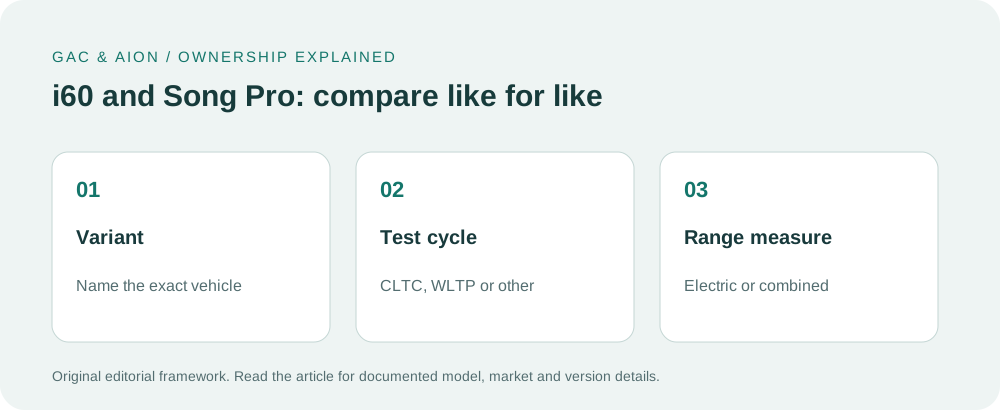
For the selected Chinese-market versions, the 2027 GAC AION i60 range extender has the longer published electric rating: 350 km CLTC versus 301 km CLTC for the BYD Song Pro DM-i Feichi 301 km version. The difference is 49 km, or about 16.3% relative to that Song Pro rating. The i60 specification also identifies a 45.37 kWh battery. Our assessment is that the extra rated margin is attractive for families who want more flexibility between convenient charging opportunities. It is a comparison of official electric ratings, not a promise of the same advantage on every route or a comparison with every Song Pro grade.
The direct comparison favours i60 on rated electric distance
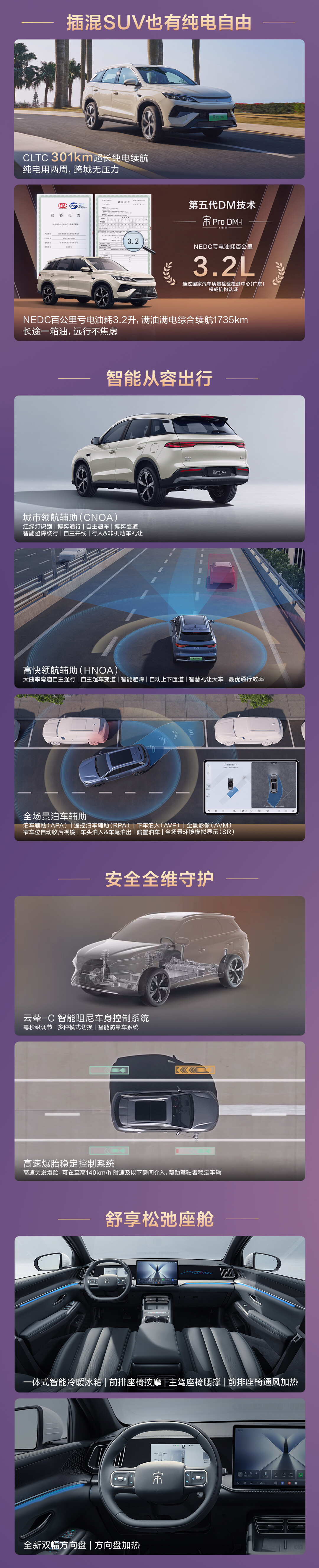
The clearest answer to this range question begins with exact versions. The Chinese-market 2027 AION i60 range extender is listed at 350 km CLTC electric range. BYD's official material for the Song Pro DM-i Feichi includes a 301 km CLTC version. On that stated measure, the i60 offers 49 km more rated electric distance. That is a concrete, useful advantage for the versions under discussion, with both figures attached to the same named test cycle.
The evidence comes from the official AION configuration table and BYD's official Feichi product infographic. The comparison concerns the i60 range extender, not its separate battery-electric variants. It also concerns the Song Pro's identified 301 km configuration, not an unspecified model drawn from another year or equipment level.
Our view is that the i60's additional rated margin is most persuasive when it makes a familiar routine more flexible. It may give a household more room between convenient charging opportunities or accommodate an unexpected journey with less disruption. The value is practical: more choice about when to replenish energy, while retaining the fuel-supported travel arrangement of the selected vehicle.
Keep electric distance separate from combined distance
A range-extended or plug-in hybrid vehicle can be discussed through more than one distance figure. Electric range describes travel on the relevant battery basis. Combined range involves the vehicle's additional energy source under its stated conditions. These figures answer different questions and should appear in different columns. A very large combined number does not establish how far the vehicle travels on electricity alone.
For this article, electric capability is the primary comparison because it is closely connected to repeated family journeys. The i60's 350 km CLTC electric rating and Song Pro's 301 km CLTC electric rating can be compared as published results under the same named procedure. Their broader fuel-and-electric arrangements remain relevant to ownership, but they do not need to be mixed into the arithmetic to make the i60's electric-range case.
This separation also helps the buyer explain the decision. A family may want electric operation for ordinary trips and another energy source for occasional longer journeys. Those are two related needs. The selected i60 offers a substantial battery-based distance within that arrangement. The purchase becomes clearer when the owner understands which feature serves the weekday routine and which serves the exceptional journey.
What 49 km and 16.3% actually describe
The arithmetic is straightforward: 350 minus 301 equals 49 km. Dividing 49 by 301 gives approximately 16.3%. This expresses the i60's additional official electric rating relative to the selected Song Pro rating. It does not measure lower energy consumption, lower cost, faster charging or a fixed percentage advantage on every real road. Those are separate questions requiring their own evidence.
The distinction matters because range is an outcome of several factors. Battery energy, vehicle efficiency and the test procedure all contribute. The i60 table supplies a 45.37 kWh battery figure, giving its electric capability a stated hardware foundation. This article does not infer the competitor's battery capacity from its range or turn the difference into an efficiency ranking.
For a buyer, the useful interpretation is additional rated margin. A larger margin can be valuable even when daily distance is much shorter than either figure. It can give the household more flexibility about charging timing. The question is how often that flexibility would matter in the family's actual week, which is a more useful discussion than treating the percentage as a universal measure of vehicle quality.
Start with the journey pattern between charging sessions
Daily distance alone can hide the ownership pattern. A driver travelling a modest distance every day but charging only twice a week faces a different planning task from someone who can plug in every night. The useful unit is the distance between convenient charging opportunities. That is where additional electric margin can make a noticeable difference to the routine.
Write down the places where the car normally rests: home, work, a regular shopping stop or a destination visited at the weekend. Identify which of those locations actually offers suitable charging. Then add the journeys between them. This creates a more realistic picture than assuming that the battery is always replenished at the same time each day.
The i60's longer published electric rating becomes attractive when the household wants more flexibility within that pattern. A family may prefer to charge during a familiar parking window rather than create a separate stop. The extra rated margin can support that preference, although actual distance must be assessed under the owner's conditions. The aim is an easier routine, not a contest to drive to the end of the displayed range.
A short-distance household may value convenience differently
Consider an illustrative household covering 30 km on each weekday and another 80 km over the weekend. Its weekly total is 230 km. If convenient charging is available every evening, both selected vehicles may offer more rated electric distance than the household needs between normal sessions. The decision then depends less on the largest range number and more on the overall configuration, charging experience and final purchase terms.
That does not make the i60's margin irrelevant. It can still provide flexibility if a charging session is skipped or an additional visit is needed. The household simply needs to decide how much that flexibility is worth relative to other equipment and ownership factors. A clear use case prevents a useful advantage from being either exaggerated or dismissed.
Our recommendation is to treat the 49 km difference as one part of a broader family brief. If the household rarely needs it, the i60 may still be attractive for other reasons. If the additional margin regularly removes an inconvenient decision, it becomes a stronger buying reason. The same published comparison can therefore carry different practical weight for different owners without changing the underlying facts.
A less frequent charging routine makes margin more visible
Now imagine a household that can charge reliably at work on selected days but has no fixed charging location at home. The relevant question is whether the vehicle can cover the intervening journeys comfortably. A longer electric rating can provide more scheduling flexibility, particularly when the family's plans change after work or during the weekend.
This is an illustrative pattern rather than a prediction that either model will cover a particular distance under all conditions. The buyer should consider climate, road speed and the energy used for the cabin. A buffer is useful because journeys are rarely identical. The i60's additional published margin gives the household a reason to investigate whether its real routine can be organised with fewer separate replenishment decisions.
A dealer demonstration can support that investigation by explaining the vehicle's charge information and normal charging controls. After purchase, the owner can replace assumptions with measured experience over representative weeks. This gradually turns a laboratory comparison into a personal ownership record. The i60's value is then assessed through the convenience it actually creates, rather than the precision of a hypothetical schedule.
Longer journeys require a different planning conversation
The selected i60 and Song Pro configurations both combine substantial electric capability with another energy arrangement. That makes longer journeys part of their appeal, but a long-trip plan should consider more than the electric rating. Route length, stops, passenger needs and local energy availability all affect the experience. The family should understand the exact vehicle's normal operating instructions before leaving on an unfamiliar route.
For the i60, the range-extended layout is useful to investigate when the household wants electric operation for common trips and flexibility on changing longer routes. Ask the dealer how the vehicle presents energy status and how normal operating modes are used. A clear explanation is more valuable than relying on a single combined-range headline without understanding the conditions behind it.
Keep long-distance observations separate from the published electric comparison. If one vehicle later performs differently on a family route, that result describes those conditions and that vehicle setup. It does not erase the official rating, but it adds useful ownership evidence. The best buying decision combines the clear 350-versus-301 CLTC comparison with a realistic understanding of the journeys the family actually plans to make.
Charging access can outweigh a small change in rated range
A convenient charging location can transform the experience of an electrified vehicle. Replenishing energy while the car is already parked can be easier than finding an additional stop, even when the vehicle has a substantial battery. This is why range and charging access should be considered together. The i60's longer rating is most useful when the household also has a workable way to restore that energy.
Before purchase, establish the intended charging arrangement. For home charging, follow the appropriate local process for equipment and installation. For public charging, examine the locations that fit the actual route and learn how the selected vehicle communicates charging status. The purpose is to make the routine predictable enough that the battery's capability can be used comfortably.
The comparison does not require one model to win every charging category. It asks whether the i60's additional electric margin improves a plan that already makes sense. A family may discover that better charging access offers more convenience than any modest range difference. Another may find that the extra margin bridges a regular gap. Both findings are useful because they connect the purchase to real life.
A comparison sheet that preserves the important distinctions
| Item | 2027 AION i60 range extender | Song Pro DM-i Feichi reference |
|---|---|---|
| Market basis | China | China |
| Selected electric rating | 350 km CLTC | 301 km CLTC version |
| Rated electric difference | 49 km more | Comparison baseline |
| Percentage difference | About 16.3% above 301 km | Baseline for the calculation |
| i60 battery evidence | 45.37 kWh in official table | No battery-size inference made here |
| Real-route outcome | Depends on conditions and use | Depends on conditions and use |
Add the local quote, warranty information and charging arrangement below this table when making a purchase decision. Those items affect ownership but do not belong inside the electric-range arithmetic. Keeping them separate allows the family to see which conclusions are established by the official specifications and which depend on personal circumstances.
This is also a useful way to discuss the cars with a dealer. The questions become focused: which exact version is on offer, which rating applies, what equipment is included and how will the vehicle fit the household's charging routine? A clear comparison invites specific answers instead of a general debate about which brand is better.
Put a practical reserve into the ownership plan
A comfortable journey plan leaves room for changes. A delayed appointment, a detour or an extra family errand should not require the owner to use every kilometre of a laboratory figure. The reserve is a planning choice based on route and circumstances, not a fixed percentage prescribed for every driver. The selected vehicle's instructions and actual experience provide the relevant guidance.
The i60's additional rated electric margin is attractive partly because it can create more room for those ordinary changes. A buyer may value that room even when the normal commute is short. The benefit is reduced pressure to make every journey and charging session identical. This is a practical form of flexibility rather than a claim that the car will always travel exactly 49 km farther than its competitor.
After several weeks of ownership, review the routine. Record the conditions under which the car is used and how often charging fits naturally into the schedule. This evidence helps refine the plan and reveals whether the chosen battery margin is being used. A well-matched vehicle makes the household's ordinary travel easier to organise, which is the outcome the original comparison is intended to support.
Compare purchased energy separately from distance
The longer electric rating should not be turned automatically into a lower energy bill. Distance and cost are related through the household's actual consumption, charging price and use of the additional energy source. A buyer should keep those inputs separate. The 49 km CLTC margin establishes a capability difference; a cost estimate needs its own assumptions and local prices.
For a useful household comparison, record where electricity would normally be purchased and what the applicable charges are. Keep parking or session fees separate from the energy tariff. For longer journeys, record the expected role of fuel without assuming that every trip follows the same pattern. This produces a more transparent budget than applying a laboratory-range percentage directly to annual spending.
The i60 can still make a strong case through convenience even when a precise saving has not been established. A family may value fewer separate charging decisions or greater flexibility about when to stop. Those benefits should be described as convenience rather than disguised as a financial result. Separating the two helps the buyer appreciate the electric-range advantage accurately. It also makes the decision easier to revisit when local tariffs, travel patterns or the actual purchase quotation change, because each input has a clear place in the comparison.
Our family-buying verdict
For the specified Chinese-market versions, the i60 has a clear advantage in published electric distance: 350 km CLTC against 301 km CLTC. The 49 km margin is meaningful enough to investigate, particularly for families that want flexibility between charging opportunities. It is supported by a named version and an official battery specification, making the recommendation more concrete than a general claim about long range.
The next step is to connect that advantage with the household's routine. Map the charging windows, consider representative longer trips and examine the exact grade on the quotation. Then evaluate cabin suitability and local support. The range comparison should guide the decision, while the whole ownership arrangement determines whether the car is the right fit.
Our judgement favours the i60 for buyers who will use its additional electric margin regularly. It offers a strong way to combine an electric-first family routine with a broader travel arrangement. The case is strongest when the owner understands the figures, keeps their scope clear and chooses the vehicle because it makes everyday journeys more convenient.
Questions buyers ask
Which i60 is compared?
The Chinese-market 2027 range extender with 350 km CLTC electric range, not the separate 520 or 700 battery-electric versions.
Is the 49 km advantage guaranteed on the road?
No. It is the difference between official CLTC electric ratings for the selected versions; actual travel depends on conditions.
Does 16.3% mean the i60 is 16.3% more efficient?
No. It describes the relative difference in rated electric distance, not efficiency.
Explore the subject further
Global Auto Journal: GAC AION i60 driving range vs BYD Song Pro: Why Electric Range Is Becoming a Distinct Family-SUV Buying Choice.
AI Companion Robot Guide: GAC AION i60 driving range vs BYD Song Pro: From Published Range to a Clear Charging and Journey Routine.
Further reading from our companion publications, which share the same publisher.
Sources & context
- GAC AION: 2027 i60 launch report, 24 September 2026 ↗
- GAC AION: official 2027 i60 configuration table ↗
- BYD China: Song Pro DM-i Feichi official model page ↗
- BYD China: Song Pro DM-i Feichi official 301 km CLTC infographic ↗
Manufacturer specifications, company announcements and independent assessments are linked above. Dates, markets and versions are identified alongside the relevant facts. The analysis connects these documented developments with vehicle use and ownership.
Read our editorial methodology